


Media personality Clara Chou (周玉蔻) yesterday said that she cross-checked with different sources before going public with allegations that President Ma Ying-jeou (馬英九) received an off-the-books political donation, amid counteraccusations that she based her claim on unconfirmed, skewed information.
Chou also rejected the Presidential Office’s demand that she apologize to Ma and the public for “spreading false rumors” that Ma received NT$200 million (US$6.2 million) from Ting Hsin International Group (頂新集團) during his 2012 presidential campaign.
Presidential Office spokesperson Ma Wei-kuo (馬瑋國) yesterday demanded that Chou apologize after former National Security Council deputy secretary-general Chang Jung-feng (張榮豐) on Sunday said he was Chou’s “confidential source” and dismissed her allegations.
Chang wrote on Facebook that the allegation is based on a private conversation she had with Chang and then distorted.
The Special Investigation Division of the Supreme Prosecutors’ Office began to look into the case on Thursday after Chou repeatedly said that she has evidence to back up her claims, but the Presidential Office said Chang’s Facebook post called the “evidence” into question.
Chang said he never told Chou that the Chinese Nationalist Party (KMT) received a political donation from Ting Hsin, which Ma Wei-kuo said showed that Chou used false rumors to slander the president and “cause trouble.”
In his post, Chang said that although Chou had asked him to reveal what he knew about the alleged donation to the Special Investigation Division in their Dec. 3 conversation, the discussion had not been about whether the KMT had received donations from Ting Hsin.
“My point was that if Ting Hsin did make a political donation, it would likely offer NT$200 million at the most,” Chang wrote.
In response to the post, Chou said she cross-checked all her information before making the allegation, adding that Chang was not the only person she hoped would give testimony regarding the truth of the matter.
Chou said that when she talked to Chang on Dec. 3, he asked her about the source of a previous allegation made by Wu Tsu-chia (吳子嘉), who runs the my-formosa.com news site, that Ma’s campaign team in 2012 received NT$1 billion from Ting Hsin. Chou said she told Chang that Wu received his information from “authoritative sources.”
“Chang then told me: ‘What I learned in business circles was NT$200 million. This was the amount Ting Hsin offers as a political donation,’” Chou said.
Separately yesterday, Chou made more allegations about what she said is the inappropriate relationship between Ma and Ting Hsin.
Last week, she described Ma as being the guardian angel, or men shen (門神), of the conglomerate owned by the Wei (魏) family when it became embroiled in a series of food safety scandals this year.
When Wei Ying-chun (魏應充), a former executive of Taipei 101 operator Taipei Financial Center Corp (台北金融大樓公司) — in which Ting Hsin then owned a 37.1 percent stake — was seeking to control ownership of the skyscraper, he enlisted the help of the Presidential Office’s then-deputy secretary-general, Lo Chih-chiang (羅智強), Chou said.
She said that Wei reached out to Lo with the help of then-Central News Agency chairman Chen Shen-ching (陳申青), who was a good friend and college classmate of National Security Council Secretary-General King Pu-tsung (金溥聰).
Reporters asked Lo to comment earlier yesterday after he was summoned by the Special Investigation Division for questioning over the case.
He said that the allegation made by Chou against the president is a “farce,” adding that Chang had already debunked it in his Facebook post.
“Let’s see how Clara Chou continues to play this out,” Lo said.
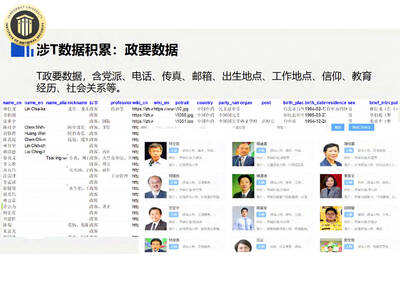
NETWORK-MAPPING PROJECT: The database contains 170 detailed files of Taiwanese politicians and about 23 million records of household registration data in Taiwan China has developed a network-mapping project targeting political figures and parties in Taiwan to monitor public opinion during elections and to craft tailored influence campaigns aimed at dividing Taiwanese society, according to documents leaked by Chinese technology firm GoLaxy (中科天璣). The documents, collected by Taipei-based Doublethink Lab, showed a database was specifically created to gather detailed information on Taiwanese political figures, including their political affiliations, job histories, birthplaces, residences, education, religion and a brief biography about them. Several notable Taiwanese politicians are in the database, including President William Lai (賴清德), former president Tsai Ing-wen (蔡英文), Minister of Foreign Affairs Lin Chia-lung (林佳龍),
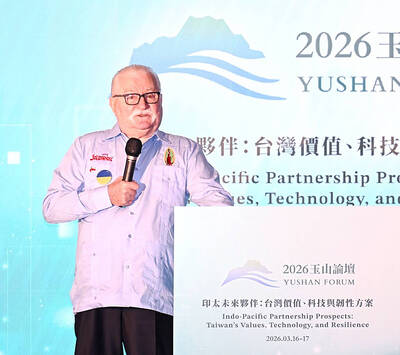
RECOGNITION: Former Fijian prime minister Mahendra Chaudhry said that Taiwan’s New Southbound Policy serves as a stabilizing force in the Indo-Pacific region Taiwan can lead the unification of the Chinese people, Nobel Peace Prize laureate and former Polish president Lech Walesa said in Taipei yesterday, adding that as the world order is changing, peaceful discussion would find good solutions, and that the use of force and coercion would always fail. Walesa made the remarks during his keynote address at a luncheon of the Yushan Forum in Taipei, titled “Indo-Pacific Partnership Prospects: Taiwan’s Values, Technology and Resilience,” organized by the Taiwan-Asia Exchange Foundation with the Ministry of Foreign Affairs. Walesa said that he had been at the forefront of a big peaceful revolution and “if
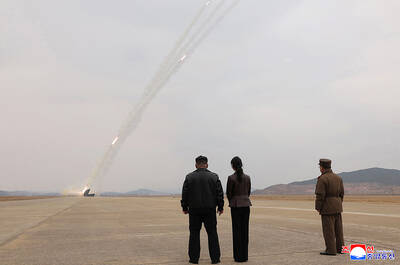
North Korea tested nuclear-capable rocket launchers, state media reported yesterday, a day after Seoul detected the launch of about 10 ballistic missiles. The test comes after South Korean and US forces launched their springtime military drills, due to run until Thursday. North Korean leader Kim Jong-un on Saturday oversaw the testing of the multiple rocket launcher system (MRLS), the Korean Central News Agency (KCNA) said. The test involved 12 600mm-caliber ultra-precision multiple rocket launchers and two artillery companies, it said. Kim said the drill gave Pyongyang’s enemies, within the 420km striking range, a sense of “uneasiness” and “a deep understanding
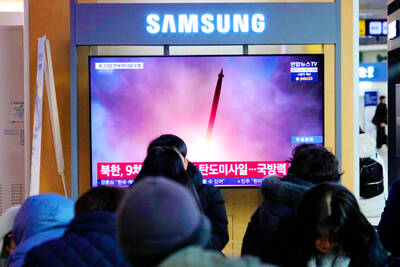
North Korea yesterday fired about 10 ballistic missiles to the sea toward Japan, the South Korean Joint Chiefs of Staff (JCS) said, days after Pyongyang warned of “terrible consequences” over ongoing South Korea-US military drills. Pyongyang recently dashed hopes of a diplomatic thaw with Seoul, Washington’s security ally, describing its latest peace efforts as a “clumsy, deceptive farce.” Seoul’s military detected “around 10 ballistic missiles launched from the Sunan area in North Korea toward the East Sea [Sea of Japan] at around 1:20pm,” JCS said in a statement, referring to South Korea’s name for the body of water. The missiles


 RSS
RSS