


Chinese President Xi Jinping (習近平) yesterday warned Hong Kong and Macau to remember that they are part of “one China,” as pro-democracy campaigners in both semiautonomous territories call for free leadership elections.
Dozens of protesters marched through Macau’s historic center yesterday afternoon as Xi wrapped up his two-day visit to mark the 15th anniversary of the territory’s handover from Portugal — just days after police cleared the last remaining protest sites in neighboring Hong Kong.
Residents of all ages walked in the middle of the road through the historic district shouting: “We want universal suffrage” through megaphones, some wrapped in banners and others with slogans painted across their faces.
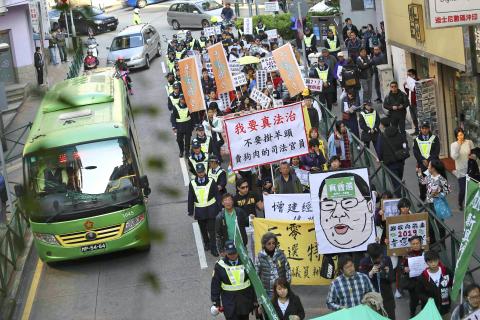
Photo: EPA
“I am uncertain about Macau’s future, so we have to come out to make noise for ourselves,” said Mark Pang, a 15-year-old high-school student who held up an open yellow umbrella — the symbol of the Hong Kong democracy movement.
The protest march culminated in a public square where about 100 demonstrators remained in the early evening, though some bystanders were confused by the scene.
“Are these people from Hong Kong?” one asked.
Xi warned both territories against a “misguided approach” in a speech.
“We must both adhere to the ‘one China’ principle and respect the difference of the two systems,” Xi said at the inauguration of Macau Chief Executive Fernando Chui (崔世安), who was selected for a second term by a pro-Beijing committee in August.
“At no time should we focus only on one side to the neglect of the other. This is the only way leading to sound and steady progress. Otherwise, a misguided approach from the beginning, just like putting one’s left foot into the right shoe, would lead us to nowhere,” Xi said.
He also warned against “external infiltration and interference” to safeguard the stability of Macau. Beijing has accused foreign forces of stirring up the Hong Kong protests.
There were also reports that some visitors and journalists from Hong Kong were denied entry after being told their names were on a blacklist.
Both Macau and Hong Kong enjoy freedoms unseen elsewhere in China — but their leaders are selected by a loyalist committee.
“In the light of Hong Kong’s Umbrella movement, I think Macau people should escalate our actions for democracy,” local protest leader Jason Chao (周庭希) told reporters.
“We need a democratic political system in which the citizens can hold the officials accountable,” Chao said, adding that despite a huge economic boom in the gambling enclave in the past decade, the quality of life for residents has been on the decline, with government officials seen as too close to big business.
Similar discontent over corruption and social inequality partly underpins the Hong Kong movement.
Although Macau’s democracy movement is not on the scale of Hong Kong’s, the territory saw its largest ever protest in May over proposed cash benefits for retired Macau officials, with 20,000 people.
Xi gave his backing to Hong Kong Chief ExecutiveLeung Chun-ying (梁振英), who he met in Macau on Friday, pledging “full trust” in him after the clearance of protest camps that blocked Hong Kong highways for more than two months.
Xi’s visit was also a chance to assert that the territory needs to diversify away from casinos, which have seen revenues dive owing to a national anti-corruption drive and a stuttering economy.
He called on Macau to “promote appropriately diversified and sustainable economic development” during his speech, before leaving the enclave in the late afternoon.
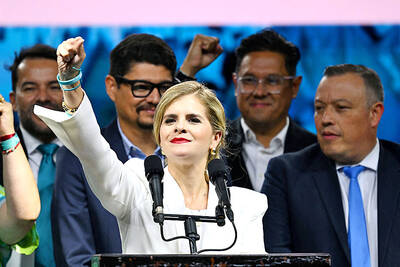
Right-wing political scientist Laura Fernandez on Sunday won Costa Rica’s presidential election by a landslide, after promising to crack down on rising violence linked to the cocaine trade. Fernandez’s nearest rival, economist Alvaro Ramos, conceded defeat as results showed the ruling party far exceeding the threshold of 40 percent needed to avoid a runoff. With 94 percent of polling stations counted, the political heir of outgoing Costa Rican President Rodrigo Chaves had captured 48.3 percent of the vote compared with Ramos’ 33.4 percent, the Supreme Electoral Tribunal said. As soon as the first results were announced, members of Fernandez’s Sovereign People’s Party
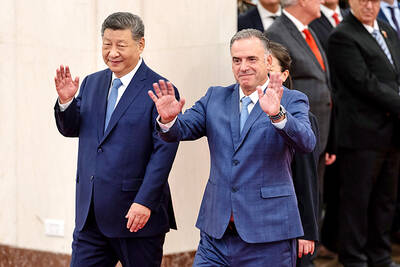
EMERGING FIELDS: The Chinese president said that the two countries would explore cooperation in green technology, the digital economy and artificial intelligence Chinese President Xi Jinping (習近平) yesterday called for an “equal and orderly multipolar world” in the face of “unilateral bullying,” in an apparent jab at the US. Xi was speaking during talks in Beijing with Uruguayan President Yamandu Orsi, the first South American leader to visit China since US special forces captured then-Venezuelan president Nicolas Maduro last month — an operation that Beijing condemned as a violation of sovereignty. Orsi follows a slew of leaders to have visited China seeking to boost ties with the world’s second-largest economy to hedge against US President Donald Trump’s increasingly unpredictable administration. “The international situation is fraught
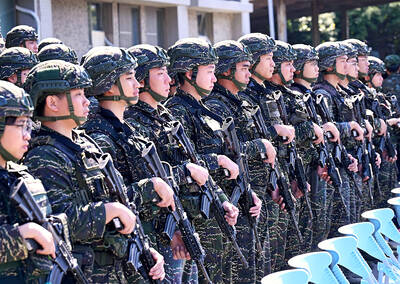
MORE RESPONSIBILITY: Draftees would be expected to fight alongside professional soldiers, likely requiring the transformation of some training brigades into combat units The armed forces are to start incorporating new conscripts into combined arms brigades this year to enhance combat readiness, the Executive Yuan’s latest policy report said. The new policy would affect Taiwanese men entering the military for their compulsory service, which was extended to one year under reforms by then-president Tsai Ing-wen (蔡英文) in 2022. The conscripts would be trained to operate machine guns, uncrewed aerial vehicles, anti-tank guided missile launchers and Stinger air defense systems, the report said, adding that the basic training would be lengthened to eight weeks. After basic training, conscripts would be sorted into infantry battalions that would take
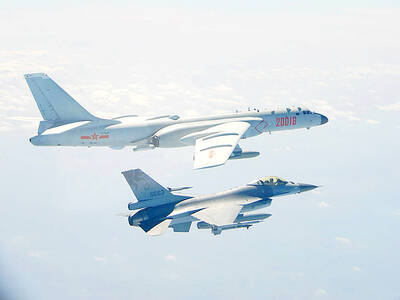
GROWING AMBITIONS: The scale and tempo of the operations show that the Strait has become the core theater for China to expand its security interests, the report said Chinese military aircraft incursions around Taiwan have surged nearly 15-fold over the past five years, according to a report released yesterday by the Democratic Progressive Party’s (DPP) Department of China Affairs. Sorties in the Taiwan Strait were previously irregular, totaling 380 in 2020, but have since evolved into routine operations, the report showed. “This demonstrates that the Taiwan Strait has become both the starting point and testing ground for Beijing’s expansionist ambitions,” it said. Driven by military expansionism, China is systematically pursuing actions aimed at altering the regional “status quo,” the department said, adding that Taiwan represents the most critical link in China’s


 RSS
RSS