


With no traditional political language and no criticism of his rival at a rally last night, independent Taipei mayoral candidate Ko Wen-je (柯文哲) vowed that, if elected, he would tear down the wall dividing residents with different backgrounds and build a city filled with love, hope and trust.
With music including opera, rock, jazz, pop, Aboriginal and Vietnamese styles playing, there was a party atmosphere upon arriving at Ko’s campaign headquarters for the rally.
Ko said that he intended to run a different campaign rally on election eve, as he believes that the objective of politics is to make people happy — not sorrowful or angry — and replace hatred with love through the campaign.
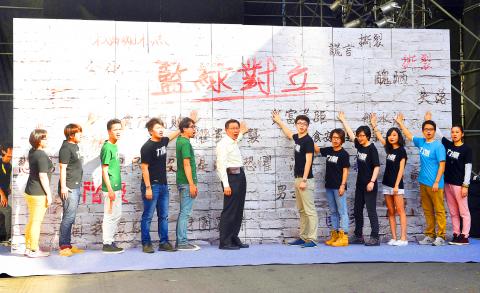
Photo: Chen Chih-chu, Taipei Times
“At 8am on Feb. 17, I finished my night shift. I took off my surgeon’s robe, hung it on a wall, walked out of National Taiwan University Hospital and bid farewell to my 30-year career as a doctor,” Ko told the crowd, with his wife, parents, sister and brother alongside him. “I knew there was a bigger mission awaiting me: to cure society and save the city.”
Ko said that at the time he was working solo and without money. The only thing supporting him was hope for a transparent government, that the wisdom of the public would surpass the wisdom of one, and that democracy is all about people having the final say on public issues, he said.
“It was these beliefs that have brought us all the way here,” he said.
“I would like to thank all of you here, because I am no longer just one person; I am a group of people, and we are a family with a shared objective,” Ko said. “If we believe, we can make the change come true, and change Taiwan’s history.”
He called on the public to help him tear down the walls that divide people into pan-blue and pan-green camps, pro-independence and pro-unification thinking, different ethnicities, rich and poor, nationalists and “Japanized,” and together achieve social justice and better city governance.
The crowd cheered, applauded and waved colorful flags that read: “One city, one family,” as Ko spoke.
Chen Si-teh (陳四德), a retired government employee who was a Chinese Nationalist Party (KMT) member for 45 years, said that he agreed with Ko’s ideas and would vote for a non-KMT candidate for the first time in his life.
“In the past, I’ve always believed that the KMT in power meant a good life, so I never hesitated to follow the party’s direction on who to vote for,” Chen told the crowd. “However, this time, I’m not a first-time voter, but I’m a first-time non-voter, because this will be the first time that I will not vote for a candidate the KMT nominates.”
“I was a hardcore pan-blue supporter, but I’ve awakened this time,” Chen said. “I invite everyone with the same background to awaken with me, to become aware of Taipei’s future and the future of our children.”
Several first-time voters also took the stage, saying they are tired of traditional election campaigns and division along party lines.
“I will vote for someone who is neither pan-blue nor pan-green for a change,” Chang Chih-chun (張智鈞), a 22-year-old first-time voter, told the crowd.
Ko’s campaign office said that more than 20,000 supporters attended the rally, while more than 8,500 people watched the rally live online.
Prior to the evening rally, Ko had parades at several locations in the city, including an open-air market event in Songshan District (松山), a rally in Dihua Street (迪化街) and another at the busy shopping district near the MRT Zhongshan Station, where he received a hero’s welcome from supporters, with long lines of people waiting to have their photograph taken with him.

The nation’s fastest supercomputer, Nano 4 (晶創26), is scheduled to be launched in the third quarter, and would be used to train large language models in finance and national defense sectors, the National Center for High-Performance Computing (NCHC) said. The supercomputer, which would operate at about 86.05 petaflops, is being tested at a new cloud computing center in the Southern Taiwan Science Park in Tainan. The exterior of the server cabinet features chip circuitry patterns overlaid with a map of Taiwan, highlighting the nation’s central position in the semiconductor industry. The center also houses Taiwania 2, Taiwania 3, Forerunner 1 and
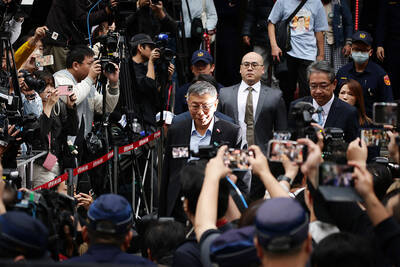
FIRST TRIAL: Ko’s lawyers sought reduced bail and other concessions, as did other defendants, but the bail judge denied their requests, citing the severity of the sentences Former Taipei mayor Ko Wen-je (柯文哲) was yesterday sentenced to 17 years in prison and had his civil rights suspended for six years over corruption, embezzlement and other charges. Taipei prosecutors in December last year asked the Taipei District Court for a combined 28-year, six-month sentence for the four cases against Ko, who founded the Taiwan People’s Party (TPP). The cases were linked to the Core Pacific City (京華城購物中心) redevelopment project and the mismanagement of political donations. Other defendants convicted on separate charges included Chinese Nationalist Party (KMT) Taipei City Councilor Angela Ying (應曉薇), who was handed a 15-year, six-month sentence; Core Pacific

J-6 REMODEL: The converted drones are part of Beijing’s expanding mix of airpower weapons, including bombers with stand-off missiles and UAV swarms, the report said China has stationed obsolete supersonic fighters converted to attack drones at six air bases close to the Taiwan Strait, a report published this month by the Arlington, Virginia-based Mitchell Institute for Aerospace Studies said. Satellite imagery of the airfields from the institute’s “China Airpower Tracker” shows what appear to be lines of stubby, swept-winged aircraft matching the shape of J-6 fighters that first flew with the Chinese People’s Liberation Army (PLA) Air Force in the 1960s. Since their conversion to drones, the aircraft have been identified at five bases in China’s Fujian Province and one in Guangdong Province, the report said. J.

China used fake LinkedIn profiles to harvest sensitive data from NATO and EU institutions by soliciting information from staff, a European security source said on Friday. The operation, allegedly orchestrated by the Chinese Ministry of State Security, targeted dozens of employees at the military alliance or EU organizations through fictitious accounts, the source said, confirming reports in French and Belgian media. Posing as recruiters on the online professional networking platform, Chinese spies would initially request paid reports before later soliciting non-public or even classified information. One particularly active fake profile used the name “Kevin Zhang,” claiming to be the head


 RSS
RSS