


Independent Taipei mayoral candidate Ko Wen-je’s (柯文哲) campaign office yesterday said it suspects that Chinese Nationalist Party (KMT) candidate Sean Lien’s (連勝文) campaign tapped the Ko camp’s phone lines, demanding to know how the pan-blue side had obtained private internal information about Ko’s campaign.
Ko’s office became suspicious of the rival camp after the executive director of Lien’s campaign, KMT Legislator Alex Tsai (蔡正元), publicized a list at about 10:40pm on Tuesday that had not yet been made public naming the advisers Ko would have if elected. Soon after the revelation, Ko’s campaign staff announced that they had discovered suspicious electronic devices in the campaign office’s policy department.
The office immediately contacted the police and Chunghwa Telecom Co (中華電信), which promptly sent staff to search the office at about midnight.
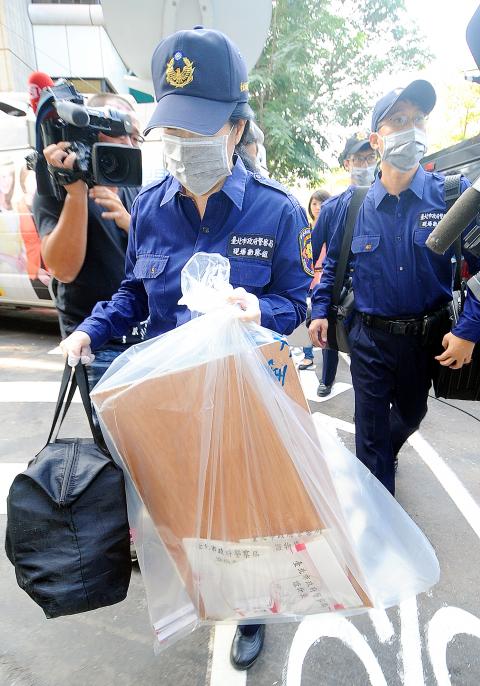
Photo: Liao Chen-huei, Taipei Times
“I only learned about what happened when my campaign staff called me a little past 11pm last [Tuesday] night, saying that there may be some problems at our policy department office,” Ko told reporters yesterday morning at a campaign event. “We had already felt that something was wrong last week when Tsai posted a list of my campaign event schedule on Facebook.”
Ko said that the post was suspicious because campaign events are usually scheduled simultaneously by different campaign departments, but these event were tentative, and are only confirmed by a meeting of the top campaign managers.
“I felt it was odd that many of the events included in Tsai’s post had not been approved by the managers,” Ko said. “So when the advisers’ list was exposed, we felt certain that there must be some privacy issues at the policy department office.”
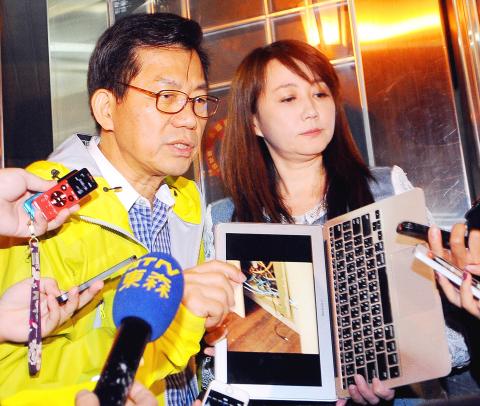
Photo: Fan Pin-chao, Taipei Times
While the main campaign office is on Songjiang Road (松江路), the policy department office is located on Jianguo S Road (建國南路) to avoid the leaking of details of policy meetings.
Ko declined to speak further about the incident, saying that he would leave it to the police and technicians from Chunghwa Telecom to investigate. However, he added that his office would launch its own probe into the incident.
In a separate press conference at Ko’s campaign headquarters, Democratic Progressive Party Legislator Lee Ying-yuan (李應元) and Taipei City Councilor Chien Yu-yen (簡余晏), who serves as Ko’s campaign spokesperson, made public pictures they said showed suspicious wires in the telephone switchboard room on the third floor of the policy department’s building.
They then played reporters a video clip of Chunghwa Telecom technicians saying that the wires found could be used for tapping phone lines, urging Tsai to explain how he obtained so much classified information from Ko’s campaign.
Lee and Chien said the wires were used to tap two numbers — (02)2706-7637 and (02)2706-7655 — used by Ko’s office on the ninth floor of the same building.
Commenting on the issue outside a legislative meeting, National Police Agency Director-General Wang Cho-chiun (王卓鈞) confirmed that the police did discover two wires that could possible be part of phone tapping devices.
However, when asked if he would call the incident a case of illegal telephone tapping, Wang declined to comment, saying that further investigation is required to answer the question.
Nevertheless, some technology companies and private investigators did point to a real possibility that Ko’s office was wiretapped.
Tech company manager Lin Pao-lin (林寶琳) said in an interview that from the photographs shown to him purportedly showing the suspicious wires, the “black wire” on the branching switchboard connected the switchboard to a telecommunications company, so tapping into it would allow the person to listen in on all phone conversations going through the switchboard.
Incoming and outgoing phone calls would automatically be recorded as long as the suspect tapped into the right line, Lin said.
Based on the T-shaped connector between the telephone lines in Ko’s office on the ninth floor and the wires found on the third floor, Lin said it was highly possible that Ko’s office was being wiretapped.
Responding to the allegations, Tsai said he would quit politics if he “is personally found to be involved in wiretapping,” but also accused Ko’s campaign team of making its inconsistent statements about the incident, citing a discrepancy between Yao’s initial claim that two wiretapping devices were found in the building and Chien’s later revision saying that only wires suspected of being used for stealthy recording had been found.
Tsai added that Lien had no idea that he had got hold of the advisers list, which he said had been leaked by Ko’s office because some of the members of his team were “blabbermouths” who were careless enough to reveal the names to him.
“If Ko’s office cannot present to the public the two wiretapping devices that it claims to have found, but still called the police asserting that their office was bugged, it shows that [the whole story was fake] and Ko’s camp was accusing others of wiretapping them so they could avoid the embarrassment of having their classified information leaked due to their own blunder,” Tsai said.
The KMT lawmaker later wrote on Facebook that Ko’s team had first tried smear tactics — referring to an online rumor that Lien allegedly bought a yam from a peddler and then threw it away without finishing it — and failed, so they are again attempting to hang Lien with an ordinary cable wire.
Lien called on Ko to withdraw from the election if it is found that the insinuations about wiretapping were made to direct attention away from allegations made in a book by a US author against the physician that he bought organs for his patients in China.
Responding to Tsai’s accusation that Ko’s policy director Chang Ching-sen (張景森) may have not kept the classified information as confidential as Ko would have liked, the independent candidate said that Chang could not have leaked the list.
Lien then sought to draw a parallel between Ko and former president Chen Shui-bian (陳水扁), saying that Ko is “like the Chen he supported” as he uses “bizarre and dirty tactics” during electoral campaigns.
Lien then cited a case in which Chen accused the KMT of poisoning him during a councilor election campaign in Tainan County in 1985, an allegation “which was later proved to be unfounded, but did not stop Chen from getting elected.”
Local media then pointed out some errors in Lien’s example, saying that the election in Tainan involving Chen in 1985 was for county commissioner, not for city councilor, and that the former president had in reality lost the race.
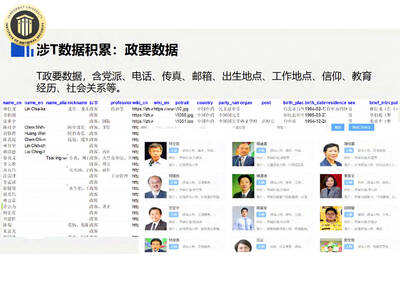
NETWORK-MAPPING PROJECT: The database contains 170 detailed files of Taiwanese politicians and about 23 million records of household registration data in Taiwan China has developed a network-mapping project targeting political figures and parties in Taiwan to monitor public opinion during elections and to craft tailored influence campaigns aimed at dividing Taiwanese society, according to documents leaked by Chinese technology firm GoLaxy (中科天璣). The documents, collected by Taipei-based Doublethink Lab, showed a database was specifically created to gather detailed information on Taiwanese political figures, including their political affiliations, job histories, birthplaces, residences, education, religion and a brief biography about them. Several notable Taiwanese politicians are in the database, including President William Lai (賴清德), former president Tsai Ing-wen (蔡英文), Minister of Foreign Affairs Lin Chia-lung (林佳龍),
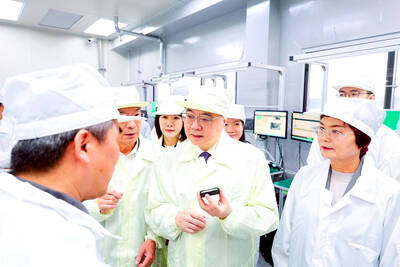
KEY INDUSTRY: The vice premier discussed a plan to create a non-red drone supply chain by next year, which has been allocated a budget of more than NT$7.2 billion The government has budgeted NT$44.2 billion (US$1.38 billion) to cultivate Taiwan’s uncrewed aerial vehicle (UAV) industry over the next five years, which would make the nation a major player in the industry’s democratic supply chain in the Asia-Pacific region, Premier Cho Jung-tai (卓榮泰) said yesterday. Cho made the remarks during a visit to the facilities of Cub Elecparts Inc (為升電裝). Democratic Progressive Party (DPP) Legislator Chen Su-yueh (陳素月) and Chinese Nationalist Party (KMT) Legislator Hsieh Yi-fong (謝依鳳) also participated in the trip. Cub Elecparts has transitioned from the automotive industry to the defense industry, which is the top priority among the nation’s
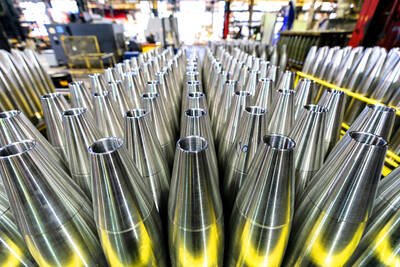
UPGRADED MISSILE: The Chungshan Institute of Science and Technology is reportedly to conduct a live-fire test of the Hsiung Feng III anti-ship missile on Thursday next week The US Army is planning to build new facilities to boost explosives production and strengthen its supply chain, a move aimed at addressing munitions shortages and supporting obligations to partners including Taiwan, Ukraine and Israel, Defense News reported. The army has issued a sources sought notice for a proposed Center of Excellence at the Blue Grass Army Depot in Kentucky, the report said. The facility would serve as a hub within the US industrial base for the production of key military explosives, including research department explosives (RDX) and high melting explosives (HMX), while also supporting research and development of next-generation materials. The proposed
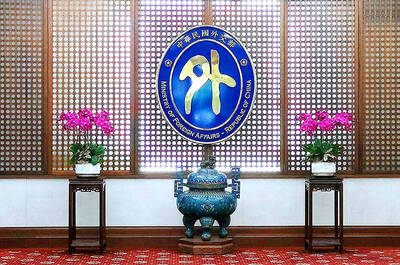
SOUTH KOREA DISPUTE: If Seoul continues to ignore its request, Taiwan would change South Korea’s designation on its arrival cards, the foreign ministry said If South Korea does not reply appropriately to a request to correct Taiwan’s name on its e-Arrival card system before March 31, the government would take corresponding measures to change how South Korea is labeled on the online Taiwan Arrival Card system, the Ministry of Foreign Affairs said yesterday. South Korea’s e-Arrival card system lists Taiwan as “China (Taiwan)” in the “point of departure” and “next destination” fields. Taipei has asked Seoul to change the wording. Since March 1, South Koreans who hold government-issued Alien Resident Certificates (ARC) have been identified as from “South Korea” rather than the “Republic of Korea,” the


 RSS
RSS