


Chinese Nationalist Party (KMT) Taipei mayoral candidate Sean Lien’s (連勝文) failure to pay his respects to victims of the 228 Massacre while visiting the 228 Memorial Park yesterday has sparked fierce controversy.
Lien visited the park to pay his respects to historical figures that he said are considered to have made great contributions to the nation.
During his visit, he laid flowers at the bronze busts of Cheng Chen-kung (鄭成功), a Ming Dynasty loyalist also known as Koxinga; Liu Ming-chuan (劉銘傳), the governor of Taiwan during the Qing Dynasy; Chiu Feng-jia (丘逢甲), a patriotic poet who has been honored for his resistance against the Japanese military after the signing of the Treaty of Shimonoseki; and Lien Heng (連橫), a historian, author of A General History of Taiwan and Sean Lien’s great-grandfather.
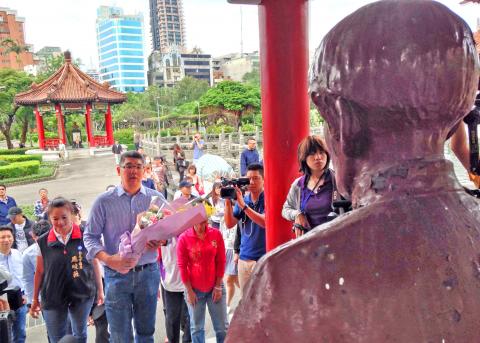
Photo: CNA
Sean Lien said his visit was prompted by his meeting earlier this week with former Democratic Progressive Party (DPP) chairman Shih Ming-te (施明德) — who later quit the party and led the “red shirt” protests against then-president Chen Shui-bian (陳水扁) in 2008 — who raised the idea of building a shrine for those who had contributed significantly to the nation.
“We are supportive of Shih’s idea of having a place to honor and remember the contributions and deeds of people of diverse backgrounds, ethnic groups and places of origin, who have, at different times, done great things for Taiwan. I think Taipei could work in this direction so that Taiwanese know what their predecessors achieved,” Sean Lien said.
Yet his failure to visit the 228 Memorial Monument in the park, which commemorates the victims of a brutal crackdown launched by the then-KMT regime on Feb. 27, 1947, was interpreted by the local media as intentional.
Yesterday was the eve of Retrocession Day, declared by the previous KMT government to observe the end of Japanese colonial rule of Taiwan and its “return” to the Republic of China in 1945.
Sean Lien’s spokesperson, Chien Chen-yu (錢震宇), confirmed that the visit was purposely made on the eve of Retrocession Day “to pay respect to the four historical figures in the 228 Memorial Park and to thank them for their devotion to the land.”
“As for the 228 Memorial Monument, we will pay our respects another day,” he added.
Sean Lien told reporters that paying tribute to the 228 Memorial Monument was not on his campaign itinerary yesterday.
“[I] followed the planned itinerary. There was no arrangement made [for me to pay my respects to the 228 Memorial Monument today],” Sean Lien said.
Asked about the particularly long prayer he made at the bust of his great-grandfather Lien Heng, Sean Lien said he regretted that — while his camp has refrained from attacking their opponents’ families and ancestors — “the opposition camp has continued the tactic long practiced by the DPP, which is to harshly criticize my ancestors by distorting the facts, taking things out of context and using insulting words [against them].”
The reputation of Lien Heng, well known for his work on Taiwanese history, has been criticized over an opinion piece he wrote for Taiwan Nichinichi Shinpo (台灣日日新報), a daily newspaper published during the Japanese colonial era in 1930.
In the opinion piece, Lien Heng, who was said to have been paid by the Japanese colonial government to write the essay, encouraged the use of opium and called the practice “beneficial.”
Taiwanese literati were infuriated by the essay, resulting in Lien Heng’s ostracism and his relocation to China.
His son, Lien Chen-tung (連震東), returned to Taiwan in 1945 with the KMT regime and became one of the KMT officials responsible for the takeover of the government.

‘NO SECURITY RISK’: The Railway Bureau reassured the public that the technicians’ activities were limited to technical guidance and did not involve sensitive systems The Railway Bureau yesterday said it had invited eight Chinese technicians to assist with an airport MRT construction project. The bureau issued the confirmation after an Internet user said Chinese nationals had entered the construction zone of Taiwan Taoyuan International Airport’s Terminal 3 project. They asked why “individuals from an enemy state” were allowed access to such a major national infrastructure project, which raised serious concerns over Taiwan’s industrial safety, sensitive systems and information security. The bureau’s Northern Region Engineering Branch Office said subcontractor Taiwan Handle Industrial Co (台灣手把工業) of the Taoyuan airport MRT’s “Contract No. CU05 Project A14 Station Civil, MEP &

A US uncrewed surface vessel (USV) encountered multiple Chinese warships during an autonomous transit of the Taiwan Strait, US defense company Seasats said in a statement on Wednesday. Seasats announced that a Lightfish USV had completed the first autonomous transit of the Taiwan Strait. Over five days, the USV traversed the entire length of the Strait while constantly monitoring surface vessel traffic, the company said. The Lightfish encountered multiple Chinese warships, one of which was a Chinese People’s Liberation Army Navy (PLAN) Type 056 corvette, it said. The Chinese vessels were operating “well within Taiwan’s exclusive economic zone without transmitting their identity via the

Taiwan is still in the process of assessing the possibility of recruiting workers from Eswatini, the Ministry of Foreign Affairs said yesterday, adding that its goal is to help Eswatini upgrade its vocational training centers. If there are plans to recruit workers from Eswatini, safeguarding national security, protecting public health and ensuring the employment rights of Taiwanese would be prerequisites, Department of West Asian and African Affairs Director-General Yen Chia-liang (顏嘉良) told a news conference. Key considerations would also include filling labor shortages in specific industries, and fostering bilateral professional and technical exchanges, he said. Yen was asked about the progress of labor
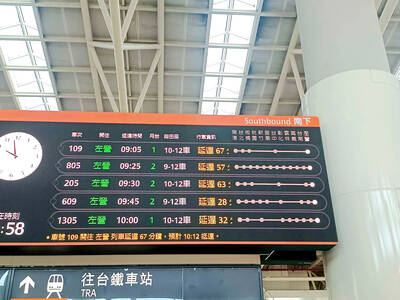
The nation’s usually punctual high-speed rail system yesterday was hit by major disruptions after all scheduled services were canceled and replaced with three hourly trains offering only non-reserved seating, affecting more than 200,000 passengers. Preliminary findings indicate the disruption was caused by a faulty power module in a track switch control cabinet, Taiwan High-Speed Rail Corp (THSRC) said, adding that as a full system inspection could only be conducted after operations end for the day, a decision on whether normal service would resume today would be announced before the first train departs. During a routine inspection early yesterday, a switch signal abnormality


 RSS
RSS