


Qatar yesterday promised US$1 billion in reconstruction aid for Gaza at a donor conference in Cairo, topping US and European pledges for the devastated Palestinian enclave.
“Qatar announces its participation with US$1 billion for the reconstruction of Gaza,” Qatari Minister of Foreign Affairs Khalid bin Mohammed al-Attiyah said.
Washington earlier called for renewed peace talks between Israel and the Palestinians as a donor conference pledged millions for rebuilding the ruin left by this summer’s conflict in Gaza.
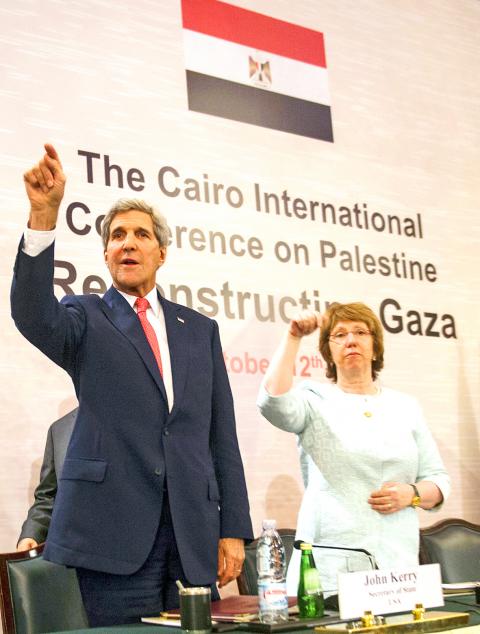
Photo: AFP
The US and EU member states made substantial pledges of new aid at the conference in Cairo, but expressed wariness of financing the reconstruction of Gaza without a peace deal in sight.
The crowded coastal enclave, ruled by the Islamist militant Hamas movement since 2007, remained a “tinderbox,” UN Secretary-General Ban Ki-moon said at the conference.
The US pledged US$212 million in new aid, to meet what US Secretary of State John Kerry described as an “enormous” challenge in Gaza.
Kerry, who failed to broker a peace deal earlier this year, urged renewed talks and said that the Palestinians and Israelis needed to make “tough choices”.
The call was echoed by Arab and European envoys.
“The people of Gaza do need our help, desperately, not tomorrow, not next week. They need it now,” Kerry told the gathering of some 30 global envoys.
The Palestinians asked for up to US$4 billion in international aid after Gaza was devastated in its 50-day conflict with Israel in July and August.
EU member states are to contribute a total of 450 million euros (US$568 million) to Gaza, EU High Representative for Foreign Affairs and Security Policy Catherine Ashton said.
There is widespread concern that — after three destructive conflicts in the past six years — any help to Gaza will eventually be lost to more violence.
Ban expressed the fears of many when he told the conference the situation in Gaza remained potentially explosive.
“Gaza remains a tinderbox; the people desperately need to see results in their daily lives,” the secretary-general said.
Jordanian Foreign Minister Nasser Judeh said donor nations were “suffering fatigue” in the absence of a peace deal.
“Many countries who have been generous in their support for the Palestinians are indeed suffering from donors’ fatigue, and they are right,” he said, referring to repeated conflicts in Gaza.
The Palestinian government unveiled a 76-page reconstruction plan ahead of the conference, with the lion’s share of assistance to build housing.
“Gaza has suffered three wars in six years. Entire neighborhoods have been destroyed,” Palestinian President Mahmoud Abbas told the conference.
Kerry said the new aid brought Washington’s contribution to helping Gaza to more than US$400 million over the past year alone.
Kerry was due later to meet Abbas to press for further peace efforts.
“Make no mistake. What was compelling about a two-state solution a year ago is even more compelling today,” Kerry said.
This summer’s conflict killed nearly 2,200 Palestinians, mostly civilians, while attacks by Gaza militants killed 73 on the Israeli side, mostly soldiers.
One crucial question will be how the aid is delivered, especially given Israel’s strict blockade of the territory since 2006.
Israel was not invited to the conference, but Israeli Foreign Minister Avigdor Lieberman said any effort would need his government’s consent.
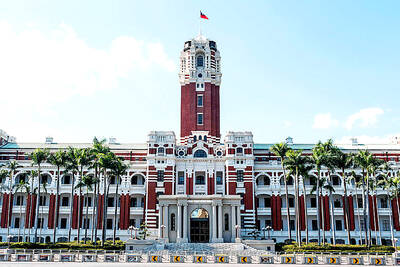
SECURITY: Taipei presses the US for arms supplies, saying the arms sales are not only a reflection of the US security commitment to Taiwan but also serve as a mutual deterrent against regional threats Taiwan is committed to preserving the cross-strait “status quo” and contributing to regional peace and stability, the Presidential Office said yesterday. “It is an undeniable fact that the Republic of China is a sovereign and independent democratic nation,” Presidential Office spokeswoman Karen Kuo (郭雅慧) reiterated, adding that Beijing has no right to claim sovereignty over Taiwan. The statements came after US President Donald Trump warned against Taiwanese independence. Trump wrapped up a state visit to Beijing on Friday, during which Chinese President Xi Jinping (習近平) had pressed him not to support Taiwan. Taiwan depends heavily on US security backing to deter China from carrying
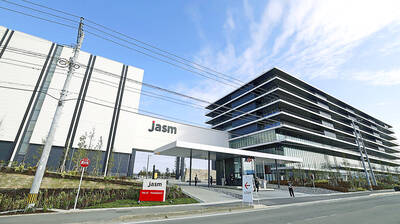
The subsidiary of Taiwan Semiconductor Manufacturing Co (TSMC, 台積電) in Kumamoto, Japan, turned a profit in the first quarter of this year, marking the first time the first fab of the unit has become profitable since mass production started at the end of 2024. According to the contract chipmaker’s financial statement released on Friday, Japan Advanced Semiconductor Manufacturing Inc (JASM), a joint venture running the fab in Kumamoto, posted NT$951 million (US$30.19 million) in profit in the January-to-March period, compared with a loss of NT$1.39 billion in the previous quarter, and a loss of NT$3.25 billion in the first quarter of
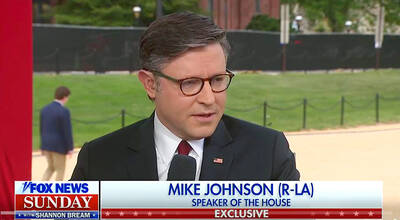
RESOLUTE BACKING: Two Republican senators are planning to introduce legislation that would impose immediate sanctions on China if it attempts to invade Taiwan US House of Representatives Speaker Mike Johnson on Sunday reaffirmed US congressional support for Taiwan, saying the US and “all freedom-loving people” have a stake in preventing China from seizing Taiwan by force. Johnson made the remarks in an interview with Fox News Sunday on US President Donald Trump’s summit with Chinese President Xi Jinping (習近平) last week. In an interview that aired on Friday on Fox News, just as Trump wrapped up a high-stakes visit to China, he said he has yet to green-light a new US$14 billion arms package to Taiwan and that it “depends on China.” “It’s a very good
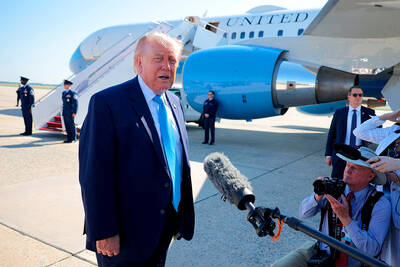
US President Donald Trump yesterday said he would speak to President William Lai (賴清德) as his administration considers whether to move ahead with a US$14 billion weapons sale to Taiwan — a potential arms deal that has drawn criticism from China. “Well, I’ll speak to him. I speak to everybody,” Trump told reporters yesterday when asked if he had any plans to call his counterpart, although he did not offer a time frame for when such a conversation could take place. Trump previously said he would speak to the person “that’s running Taiwan,” without specifying who he meant. “We have that situation very


 RSS
RSS