


The Democratic Progressive Party (DPP) yesterday accused the government of giving preferential treatment to former
Ting Hsin Oil and Fat Industrial Co (頂新製油實業) and Cheng I Food Co (正義股份) chairman Wei Ying-chun (魏應充) in several food scandals involving his firms, since Wei has been a “faithful supporter” of President Ma Ying-jeou (馬英九).
Amid the latest tainted oil crisis involving Cheng I, a subsidiary of the Ting Hsin International Group (頂新集團), many of the businesses involved have been searched, while managers of several companies, including Ting Hsin, have been detained. Yet, so far, Wei has been left out of investigations.
“When investigating tainted cooking oil cases in the past, the prosecutor in charge was quick to apply for detention of Chang Chi Foodstuff Factory Co (大統長基食品公司) chairman Kao Cheng-li (高振利) and Chang Guann Co (長冠企業) chairman Yeh Wen-hsiang (葉文祥) to prevent them from colluding on testimony and destroying evidence,” DPP spokesperson Huang Di-ying (黃帝穎) said yesterday. “However, the prosecutor has yet to call for Wei’s detention.”
“We therefore question if it is because Wei has served as the vice chairman of a business leaders’ support group for Ma during his presidential campaign and has good connections to the government,” Huang said.
Huang said that during the 2012 presidential election, Wei attended meetings by business leaders to voice their support for Ma and was handed an official certificate by Ma appointing him to serve as vice chairman of the National Business and Industrial Leaders’ Support Group for Ma Ying-jeou.
“This shows that Wei may have a better relationship with Ma than Kao and Yeh,” Huang said. “However in a democracy with rule of law, prosecutors should treat all cases the same way, they should not investigate cases selectively or detain people selectively.”
In related news, Huang rejected a message circulating online that accused the DPP of blocking revisions to the Act Governing Food Safety and Sanitation (食品衛生安全管理法) with a legislative vote on Nov. 22 last year.
“The voting was actually on the meeting agenda, not on amendments to the law,” Huang said.
“In fact, at the time, the DPP was voting ‘no’ to a Chinese Nationalist Party (KMT) proposal to list amendments to the Act Governing Food Safety and Sanitation the last of all 80 proposals to be discussed,” Huang said. “The KMT’s proposal would not have left the legislature enough time to discuss amendments to the law.”
He said that just before the vote, the KMT rejected a DPP proposal to create a compensation fund for victims of food scandals using penalties from food manufacturers involved.
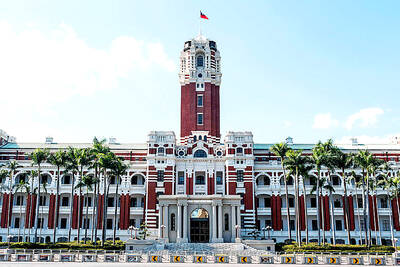
SECURITY: Taipei presses the US for arms supplies, saying the arms sales are not only a reflection of the US security commitment to Taiwan but also serve as a mutual deterrent against regional threats Taiwan is committed to preserving the cross-strait “status quo” and contributing to regional peace and stability, the Presidential Office said yesterday. “It is an undeniable fact that the Republic of China is a sovereign and independent democratic nation,” Presidential Office spokeswoman Karen Kuo (郭雅慧) reiterated, adding that Beijing has no right to claim sovereignty over Taiwan. The statements came after US President Donald Trump warned against Taiwanese independence. Trump wrapped up a state visit to Beijing on Friday, during which Chinese President Xi Jinping (習近平) had pressed him not to support Taiwan. Taiwan depends heavily on US security backing to deter China from carrying
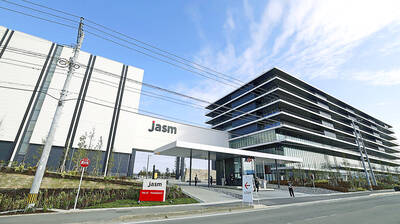
The subsidiary of Taiwan Semiconductor Manufacturing Co (TSMC, 台積電) in Kumamoto, Japan, turned a profit in the first quarter of this year, marking the first time the first fab of the unit has become profitable since mass production started at the end of 2024. According to the contract chipmaker’s financial statement released on Friday, Japan Advanced Semiconductor Manufacturing Inc (JASM), a joint venture running the fab in Kumamoto, posted NT$951 million (US$30.19 million) in profit in the January-to-March period, compared with a loss of NT$1.39 billion in the previous quarter, and a loss of NT$3.25 billion in the first quarter of
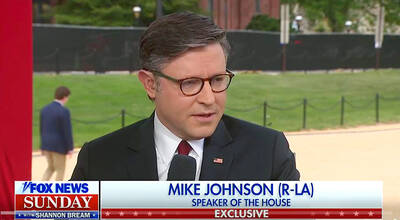
RESOLUTE BACKING: Two Republican senators are planning to introduce legislation that would impose immediate sanctions on China if it attempts to invade Taiwan US House of Representatives Speaker Mike Johnson on Sunday reaffirmed US congressional support for Taiwan, saying the US and “all freedom-loving people” have a stake in preventing China from seizing Taiwan by force. Johnson made the remarks in an interview with Fox News Sunday on US President Donald Trump’s summit with Chinese President Xi Jinping (習近平) last week. In an interview that aired on Friday on Fox News, just as Trump wrapped up a high-stakes visit to China, he said he has yet to green-light a new US$14 billion arms package to Taiwan and that it “depends on China.” “It’s a very good
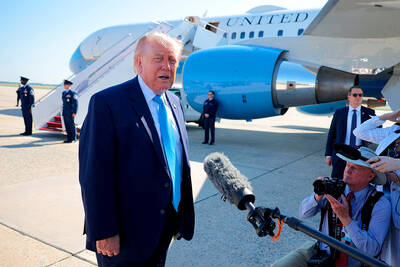
US President Donald Trump yesterday said he would speak to President William Lai (賴清德) as his administration considers whether to move ahead with a US$14 billion weapons sale to Taiwan — a potential arms deal that has drawn criticism from China. “Well, I’ll speak to him. I speak to everybody,” Trump told reporters yesterday when asked if he had any plans to call his counterpart, although he did not offer a time frame for when such a conversation could take place. Trump previously said he would speak to the person “that’s running Taiwan,” without specifying who he meant. “We have that situation very


 RSS
RSS