


Thousands of students braved sweltering heat in Hong Kong yesterday to demand greater democracy as they launched a week-long boycott of classes, underscoring a restive younger generation’s determination to challenge the Chinese Communist Party (CCP).
Dressed in white and wearing yellow ribbons, students from more than 20 universities and colleges packed into the grounds of picturesque, bay-side Chinese University where they were greeted by banners that said: “The boycott must happen. Disobey and grasp your destiny.”
Managing the former British colony is proving a challenge for Beijing, which is worried that calls for democracy in Hong Kong and Macau could spread to cities on the mainland, threatening the CCP’s grip on power.
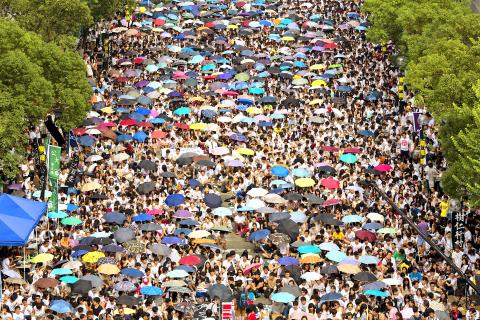
Photo: EPA
Hong Kong returned to Chinese rule in 1997 with a high degree of autonomy and freedoms not enjoyed on the mainland under a formula known as “one country, two systems.”
However, Beijing last month rejected demands for people to freely choose the territory’s next leader, prompting threats from pro-democracy activists to shut down the Central financial district.
The protests were peaceful, but the mood at the university was defiant as demonstrators demanded nominations for Hong Kong’s next leader in 2017 to be open to everyone. China’s leaders want to ensure only pro-Beijing candidates are on the ballot.
“We demand the government responds to our call to endorse civil nominations,” said Alex Chow Yongkang (周永康), leader of the Hong Kong Federation of Students, one of the organizers of the boycott, who also called on Hong Kongers to “reject fake elections.”
Chow, 24, who wore a black T-shirt with the words “freedom now,” has said he was inspired by a high-school teacher who began crying as he played a clip of China’s bloody crackdown on pro-democracy student demonstrators in and around Beijing’s Tiananmen Square on June 4, 1989.
His federation put the number of students attending the rally at about 13,000, describing the turn-out as “inspirational.”
There was no independent or police estimate.
The Occupy Central movement, which has threatened to shut down the business district, will likely be encouraged by the turnout. The students’ ability to mobilize such a large crowd makes their support an increasingly important driver of Hong Kong’s burgeoning civil disobedience movement.
Students converged on a long boulevard at the university, with some carrying umbrellas to protect them from the baking sun, and many chanting “united we stand” and “democracy now.”
The Federation of Students said its application to hold a rally in Hong Kong’s Central district had been approved for today to Thursday.
It had written a letter to Hong Kong Chief Executive Leung Chun-ying (梁振英) and planned to gather outside his office today if it had not received a reply by then.
The Hong Kong government said in a statement it respected the students’ “ambition and persistence.”
“The issue of political system development has been complicated and controversial, so it’s understandable that different groups in the society hold different opinions and arguments, which is also a normal phenomenon in Hong Kong’s diversified society,” it said.
The student boycott coincided with a trip by some of Hong Kong’s most powerful tycoons to Beijing, where they discussed Hong Kong with Chinese President Xi Jinping (習近平).
“We will continue to carry out ‘one country, two systems’ and the Basic Law in Hong Kong, which serve the interests of the nation, the interests of Hong Kong people, and the interests of foreign investors,” said Xi, who was flanked by former Hong Kong chief executive Tung Chee-hwa (董建華). “The central government will firmly support and push for the democratic development in Hong Kong and will maintain the prosperous development in Hong Kong.”
The Basic Law refers to the mini-constitution for post-1997 Hong Kong, which enshrines the “one country, two systems” formula.
Leading academics in Hong Kong have voiced support for the student boycott, with some offering to record lectures and post them online for students who miss school to watch later.
“As long as the spirit of democracy stays alive, we cannot and will not be defeated,” Occupy Central cofounder Chan Kin-man (陳健民) said.
Student group Scholarism is planning to lead a boycott of secondary-school classes on Friday to rally further support for the democracy movement, while Occupy is expected to lock down the financial district on about Wednesday next week.
“I believe on Aug. 31, when the National People’s Congress made their decision, it crushed the dreams of some Hong Kong people who have been fighting hard for democracy for the past 30 years,” third-year student Hong Yuen said, referring to Beijing’s decision to rule out full democracy.
Hong Kong has been dogged by a series of rallies this summer over the issue of electoral reform. A survey by the Chinese University showed more than one-fifth of Hong Kong residents are considering leaving the territory, spurred by concerns over its political future.
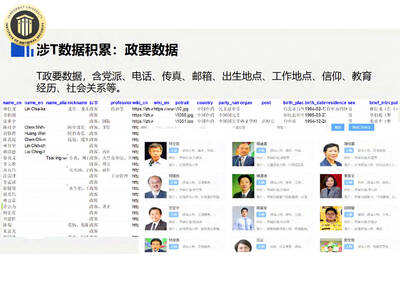
NETWORK-MAPPING PROJECT: The database contains 170 detailed files of Taiwanese politicians and about 23 million records of household registration data in Taiwan China has developed a network-mapping project targeting political figures and parties in Taiwan to monitor public opinion during elections and to craft tailored influence campaigns aimed at dividing Taiwanese society, according to documents leaked by Chinese technology firm GoLaxy (中科天璣). The documents, collected by Taipei-based Doublethink Lab, showed a database was specifically created to gather detailed information on Taiwanese political figures, including their political affiliations, job histories, birthplaces, residences, education, religion and a brief biography about them. Several notable Taiwanese politicians are in the database, including President William Lai (賴清德), former president Tsai Ing-wen (蔡英文), Minister of Foreign Affairs Lin Chia-lung (林佳龍),
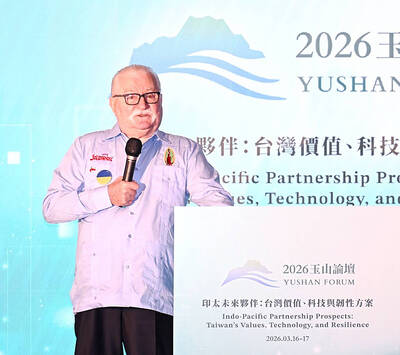
RECOGNITION: Former Fijian prime minister Mahendra Chaudhry said that Taiwan’s New Southbound Policy serves as a stabilizing force in the Indo-Pacific region Taiwan can lead the unification of the Chinese people, Nobel Peace Prize laureate and former Polish president Lech Walesa said in Taipei yesterday, adding that as the world order is changing, peaceful discussion would find good solutions, and that the use of force and coercion would always fail. Walesa made the remarks during his keynote address at a luncheon of the Yushan Forum in Taipei, titled “Indo-Pacific Partnership Prospects: Taiwan’s Values, Technology and Resilience,” organized by the Taiwan-Asia Exchange Foundation with the Ministry of Foreign Affairs. Walesa said that he had been at the forefront of a big peaceful revolution and “if
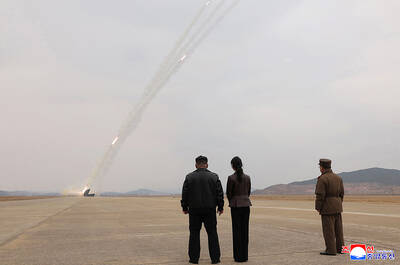
North Korea tested nuclear-capable rocket launchers, state media reported yesterday, a day after Seoul detected the launch of about 10 ballistic missiles. The test comes after South Korean and US forces launched their springtime military drills, due to run until Thursday. North Korean leader Kim Jong-un on Saturday oversaw the testing of the multiple rocket launcher system (MRLS), the Korean Central News Agency (KCNA) said. The test involved 12 600mm-caliber ultra-precision multiple rocket launchers and two artillery companies, it said. Kim said the drill gave Pyongyang’s enemies, within the 420km striking range, a sense of “uneasiness” and “a deep understanding
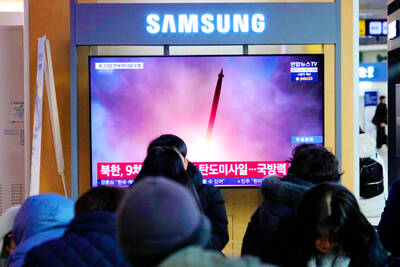
North Korea yesterday fired about 10 ballistic missiles to the sea toward Japan, the South Korean Joint Chiefs of Staff (JCS) said, days after Pyongyang warned of “terrible consequences” over ongoing South Korea-US military drills. Pyongyang recently dashed hopes of a diplomatic thaw with Seoul, Washington’s security ally, describing its latest peace efforts as a “clumsy, deceptive farce.” Seoul’s military detected “around 10 ballistic missiles launched from the Sunan area in North Korea toward the East Sea [Sea of Japan] at around 1:20pm,” JCS said in a statement, referring to South Korea’s name for the body of water. The missiles


 RSS
RSS