


Ukrainian forces and pro-Russian militias were due yesterday to pull back their troops from a demilitarized zone created under a new peace plan agreed in marathon overnight talks.
A nine-point agreement thrashed out in the early hours yesterday in the Belarussian capital, Minsk, also requires the withdrawal of all “mercenaries” from the conflict zone and an immediate end to hostilities.
However, Russia appeared ready to keep up the pressure on its Westward-leaning neighbor by sending in a new 30-truck convoy it said was carrying aid for the rebel-held city of Donetsk, but that Ukraine never approved.
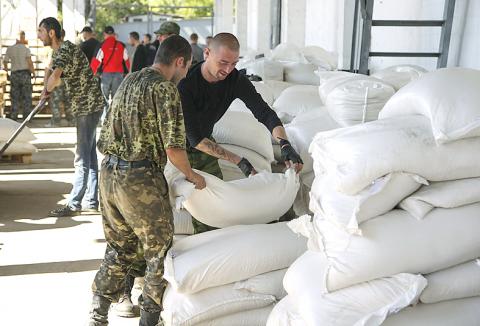
Photo: EPA
Former Ukrainian president Leonid Kuchma — who is representing Kiev in the stuttering efforts to resolve the five-month conflict — said the agreement rested on the creation of a 30km buffer zone.
Forces from both sides are required to retreat 15km from current frontlines within 24 hours of the signing of the accord and allow monitors from the Organization for Security and Co-operation in Europe into the area to make sure the truce holds.
The areas under rebel control would be left open to their administration under a temporary self-rule plan adopted by lawmakers in Kiev on Tuesday.
The Minsk pact — also signed by Moscow’s ambassador to Kiev and the self-proclaimed “prime ministers” of the rebel-run regions of Donetsk and Lugansk — aims to shore up a ceasefire deal agreed two weeks ago.
The agreement crucially requires both sides to immediately withdraw “foreign mercenaries” from the conflict zone in industrial eastern Ukraine.
Kiev and Western allies accuse Russia of clandestinely slipping at least 1,000 paratroopers into eastern Ukraine to help the guerrillas mount a surprise counteroffensive late last month.
The Kremlin denies ordering soldiers into Ukraine. However, Moscow’s Kiev envoy Mikhail Zurabov told Russian media after the signing of the Minsk deal that both sides appeared to have hired foreign mercenaries.
The sides agreed to leave the most divisive political issues for future negotiation in order to get the terms of the truce worked out first.
Donetsk separatist leader Alexander Zakharchenko said that the explosive question of the status of rebel-held Donetsk and Lugansk was not discussed in Minsk by mutual consent.
“We each have our own understanding of [Kiev’s] law on special status,” Russian media quoted Zakharchenko as saying.
“These are issues for future negotiations that will last another year,” he added.
The elusive ultimate goal is to find a lasting solution to a conflict that has claimed nearly 3,000 lives and stoked Western alarm about Russia’s territorial ambitions.
The talks came in the wake of a peace overture by Ukrainian President Petro Poroshenko that included a limited self-rule offer for separatist-controled areas in the east and an amnesty for all fighters.
The ceasefire has helped calm the worst fighting, but continues to be regularly broken around Donetsk — the scene of almost daily shelling on the city’s outskirts — and other disputed parts of the Russian-speaking industrial heartland.
Rebel representatives in the city of nearly 1 million — now with neighborhoods abandoned by families devastated by constant shelling and food shortages — said they had received a Russian humanitarian convoy overnight.
The press service of the self-proclaimed Donetsk People’s Republic said the volume of aid “was very large,” but provided few other details.
Ukraine was still set to receive an important boost from the 28-member NATO military alliance when its defense chiefs gathered yesterday in the Lithuanian capital Vilnius for a three-day meeting.
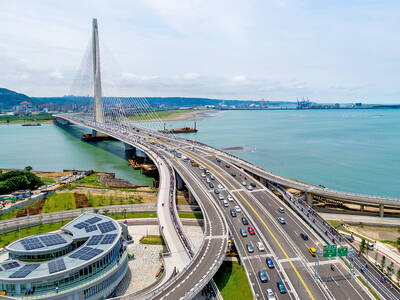
The Ministry of Transportation and Communications yesterday inaugurated the Danjiang Bridge across the Tamsui River in New Taipei City, saying that the structure would be an architectural icon and traffic artery for Taiwan. Feted as a major engineering achievement, the Danjiang Bridge is 920m long, 211m tall at the top of its pylon, and is the longest single-pylon asymmetric cable-stayed bridge in the world, the government’s Web site for the structure said. It was designed by late Iraqi-British architect Zaha Hadid. The structure, with a maximum deck of 70m, accommodates road and light rail traffic, and affords a 200m navigation channel for boats,
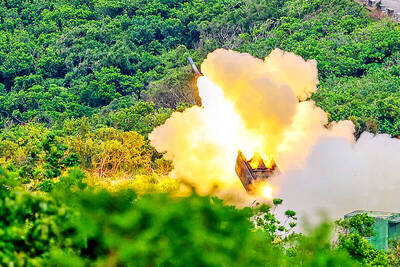
PRECISION STRIKES: The most significant reason to deploy HIMARS to outlying islands is to establish a ‘dead zone’ that the PLA would not dare enter, a source said A High Mobility Artillery Rocket System (HIMARS) would be deployed to Penghu County and Dongyin Island (東引) in Lienchiang County (Matsu) to force the Chinese military to retreat at least 100km from the coastline, a military source said yesterday. Taiwan has been procuring HIMARS and Army Tactical Missile Systems (ATACMS) from the US in batches. Once all batches have been delivered, Taiwan would possess 111 HIMARS units and 504 ATACMS, which have a range of 300km. Considering that “offense is the best defense,” the military plans to forward-deploy the systems to outlying islands such as Penghu and Dongyin so that

Taiwan Semiconductor Manufacturing Co (TSMC, 台積電), the world’s largest foundry service provider, yesterday said that global semiconductor revenue is projected to hit US$1.5 trillion in 2030, after the figure exceeds US$1 trillion this year, as artificial intelligence (AI) demand boosts consumption of token and compute power. “We are still at the beginning of the AI revolution, but we already see a significant impact across the whole semiconductor ecosystem,” TSMC deputy cochief operating officer Kevin Zhang (張曉強) said at the company’s annual technology symposium in Hsinchu City. “It is fair to say that in the past decade, smartphones and other mobile devices were

‘CLEAR MESSAGE’: The bill would set up an interagency ‘tiger team’ to review sanctions tools and other economic options to help deter any Chinese aggression toward Taiwan US Representative Young Kim has introduced a bill to deter Chinese aggression against Taiwan, calling for an interagency “tiger team” to preplan coordinated sanctions and economic measures in response to possible Chinese military or political action against Taiwan. “[Chinese President] Xi Jinping [習近平] has directed the People’s Liberation Army to be ready to invade Taiwan by 2027. China has a plan. America should have one too,” Kim said in a news release on Thursday last week. She introduced the “Deter PRC [People’s Republic of China] aggression against Taiwan act” to “ensure the US has a coordinated sanctions strategy ready should


 RSS
RSS