


The Democratic Progressive Party (DPP) yesterday lauded the Scottish independence referendum as a triumph of democratic values, while the Taiwan Solidarity Union (TSU) said that Taiwan may lose its independence if it relies too much on China economically.
“The DPP admires the Scottish people for expressing their desire for independence through voting, as well as the British government for the tolerance and respect that it demonstrated to the right to self-determination of the Scots along the way,” DPP spokesperson Hsu Chia-ching (徐佳青) said.
“The entire referendum process is a victory for the Scottish people and for all nations and peoples in the Commonwealth; more importantly, it is a triumph of democratic values,” she added.
She said that by trying to persuade voters through rational debates, both supporters and opponents to the independence proposals have set an example for all people, including Taiwanese.
“The DPP has always insisted that the future of Taiwan should be decided by its 23 million people,” she said. “What Scotland demonstrates could serve as an inspiration for deepening Taiwan’s democracy.”
On the other hand, TSU Policy Committee chairman Hsu Chung-hsin (許忠信), who once lived in the UK, cited the result as an example and warned Taiwanese against the risk of economic over-dependence.
“More people voted against independence because Scotland depends deeply on the UK in banking, insurance, sea transportation and trade, making most Scots afraid of seceding from the UK,” Hsu Chung-hsin said. “Taiwan might face the same dilemma if it continues to deepen its economic dependence on China.”
He said that Scotland has been economically marginalized, since most of the UK’s industrial developments are concentrated in cities in England, such as Liverpool, Newcastle, Birmingham and Manchester.
“The British government grants pensions totaling up to £1,400 [US$2,200] per year to each Scot,” he said. “The pensions would be canceled if Scotland becomes independent.”
“At the moment, 40 percent of exports from Taiwan go to China, while 80 percent of Taiwan’s overseas investments are in China. If we continue to push cross-strait economic integration, we will be further economically locked into China,” Hsu Chung-hsin said. “That would certainly have an impact on Taiwan’s political future and independence.”
Separately yesterday, when commenting on the referendum in Scotland, officials from the Chinese Nationalist Party (KMT) said they respected the outcome of the independence vote, while again making a distinction between the vote there and the situation across the Taiwan Strait.
“The Republic of China on Taiwan is a sovereign, independent nation and the future of Taiwan can only be decided by its 23 million residents, rather than all Chinese, including those who live in mainland China,” Premier Jiang Yi-huah (江宜樺) said.
The significance of the referendum in Scotland is completely different from the case of a possible referendum on Taiwan’s independence, he told legislators.
The vote was held to decide whether Scotland, which has been a part of the UK, should become a separate country, Jiang said.
“This is not the same as the case we have here,” he said.
That about 55 percent of Scottish voters rejected independence means that the outcome would have a much smaller impact on Taiwan’s relationship with the UK and the EU than if the result had gone the other way, he added.
Minister of Foreign Affairs David Lin (林永樂) said he respected the decision of the Scottish voters and said that Taiwan is prepared to continue to develop cooperative relations with both the UK and Scotland.
Additional reporting by CNA
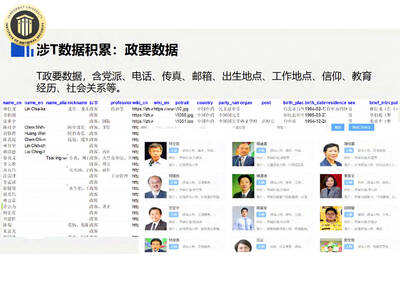
NETWORK-MAPPING PROJECT: The database contains 170 detailed files of Taiwanese politicians and about 23 million records of household registration data in Taiwan China has developed a network-mapping project targeting political figures and parties in Taiwan to monitor public opinion during elections and to craft tailored influence campaigns aimed at dividing Taiwanese society, according to documents leaked by Chinese technology firm GoLaxy (中科天璣). The documents, collected by Taipei-based Doublethink Lab, showed a database was specifically created to gather detailed information on Taiwanese political figures, including their political affiliations, job histories, birthplaces, residences, education, religion and a brief biography about them. Several notable Taiwanese politicians are in the database, including President William Lai (賴清德), former president Tsai Ing-wen (蔡英文), Minister of Foreign Affairs Lin Chia-lung (林佳龍),
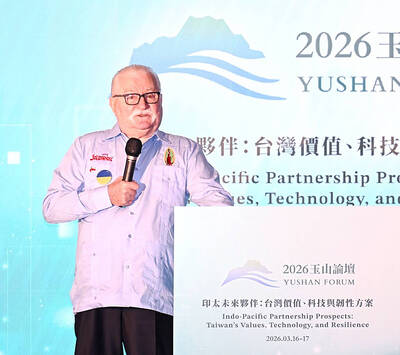
RECOGNITION: Former Fijian prime minister Mahendra Chaudhry said that Taiwan’s New Southbound Policy serves as a stabilizing force in the Indo-Pacific region Taiwan can lead the unification of the Chinese people, Nobel Peace Prize laureate and former Polish president Lech Walesa said in Taipei yesterday, adding that as the world order is changing, peaceful discussion would find good solutions, and that the use of force and coercion would always fail. Walesa made the remarks during his keynote address at a luncheon of the Yushan Forum in Taipei, titled “Indo-Pacific Partnership Prospects: Taiwan’s Values, Technology and Resilience,” organized by the Taiwan-Asia Exchange Foundation with the Ministry of Foreign Affairs. Walesa said that he had been at the forefront of a big peaceful revolution and “if
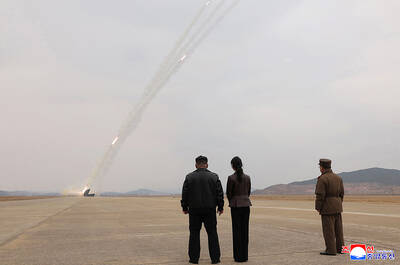
North Korea tested nuclear-capable rocket launchers, state media reported yesterday, a day after Seoul detected the launch of about 10 ballistic missiles. The test comes after South Korean and US forces launched their springtime military drills, due to run until Thursday. North Korean leader Kim Jong-un on Saturday oversaw the testing of the multiple rocket launcher system (MRLS), the Korean Central News Agency (KCNA) said. The test involved 12 600mm-caliber ultra-precision multiple rocket launchers and two artillery companies, it said. Kim said the drill gave Pyongyang’s enemies, within the 420km striking range, a sense of “uneasiness” and “a deep understanding

North Korea yesterday fired about 10 ballistic missiles to the sea toward Japan, the South Korean Joint Chiefs of Staff (JCS) said, days after Pyongyang warned of “terrible consequences” over ongoing South Korea-US military drills. Pyongyang recently dashed hopes of a diplomatic thaw with Seoul, Washington’s security ally, describing its latest peace efforts as a “clumsy, deceptive farce.” Seoul’s military detected “around 10 ballistic missiles launched from the Sunan area in North Korea toward the East Sea [Sea of Japan] at around 1:20pm,” JCS said in a statement, referring to South Korea’s name for the body of water. The missiles


 RSS
RSS