


Independent Taipei mayoral candidate Ko Wen-je (柯文哲) yesterday went on the attack against repeated accusations of corruption and money laundering by making public the details of three bank accounts — two for the National Taiwan University Hospital and one of his own — as well as his tax filings from 1995 to last year. He challenged Chinese Nationalist Party (KMT) rival Sean Lien (連勝文) to do the same.
“Lien should stop hiding behind the negative campaign strategy of [KMT Legislator and Lien campaign director] Alex Tsai (蔡正元) and [KMT Legislator] Lo Shu-lei (羅淑蕾), and get out from under the protection of his family and his political party,” the physician-turned-novice politician told a news conference at his campaign headquarters. “I hereby declare war on you, do not dodge it.”
Both Tsai and Lo have made accusations against Ko, allowing Lien to distance himself from negative campaigning.
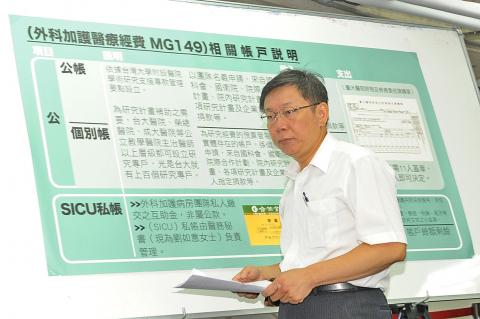
Photo: Chen Chih-chu, Taipei Times
Lo on Wednesday last week accused Ko of corruption, tax evasion and money laundering while serving as head of the hospital’s surgical intensive care unit (SICU).
Ko denied that he had used the MG149 account, a bank account used by the hospital, and a private account for the surgical unit as Lo has claimed.
He said he knew first-hand the difficulties a lack of funding can cause many young doctors and medical students, which is why the MG149 account was established to provide funding for medical research for them.
“The objective of the account is to help medical personnel grow, so that they may be empowered to help more people,” Ko said. “I think we have succeeded, because National Taiwan University Hospital’s SICU has the best quality medical service. And that is why Lien was able to recover so quickly after being shot [in 2010].”
The hospital has strict regulations on the use of funds, so “to use money from the hospital’s public account would require permission from 11 people, including myself and nine other supervisors,” he said.
“Accusing me of corruption and misconduct is no different from accusing everyone who handled the fund, from the hospital’s president to the clerk, of being involved in corruption and misconduct,” Ko said.
The SICU’s shared account is not his own “little private vault” as Lo has said, since it is a private account funded by SICU team members, and the money is used for research expenses or gatherings for the entire SICU team, he said.
In providing his bank and tax records, Ko said he was making public all his tax receipts from 1995 to 2013, except for one year’s, which was lost.
“I am making public all my bank accounts, because I want to tell you, Sean Lien, that my wife and I have worked hard to accumulate what we have, just like most people in Taipei,” Ko said. “I would like to ask you — since you drive a Porsche, but do not have a car registered under your own name, and live in a luxury apartment complex, but have no house registered in your name — do you dare to make public all your account information?”
“The election is a competition between you and I. Do not harm National Taiwan University Hospital, and do not insult SICU team members, because they were the ones who saved your life,” Ko said.
Ko’s campaign director, Yao Li-ming (姚立明), said that all account documents will be on public view at the campaign office for three days.
“Anyone who would like to check them, including people from Lien’s campaign, may contact us,” he said.
Lien did not say yesterday if he would make public his bank and tax records, but he said Ko was trying to blur the focus of the election.
“The point is who is most capable to govern the city. It is not about bank accounts,” he said.
However, the Control Yuan checked his bank accounts several times when he served as the head of the Taipei EasyCard Corp (悠遊卡), Lien said.
Meanwhile, Lo said she would contact Ko’s campaign to arrange a time to inspect all his account information.
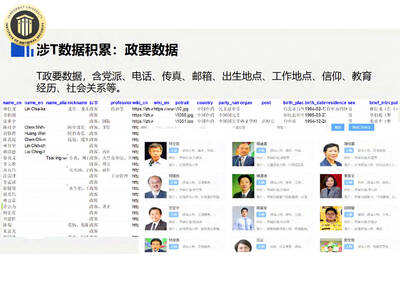
NETWORK-MAPPING PROJECT: The database contains 170 detailed files of Taiwanese politicians and about 23 million records of household registration data in Taiwan China has developed a network-mapping project targeting political figures and parties in Taiwan to monitor public opinion during elections and to craft tailored influence campaigns aimed at dividing Taiwanese society, according to documents leaked by Chinese technology firm GoLaxy (中科天璣). The documents, collected by Taipei-based Doublethink Lab, showed a database was specifically created to gather detailed information on Taiwanese political figures, including their political affiliations, job histories, birthplaces, residences, education, religion and a brief biography about them. Several notable Taiwanese politicians are in the database, including President William Lai (賴清德), former president Tsai Ing-wen (蔡英文), Minister of Foreign Affairs Lin Chia-lung (林佳龍),
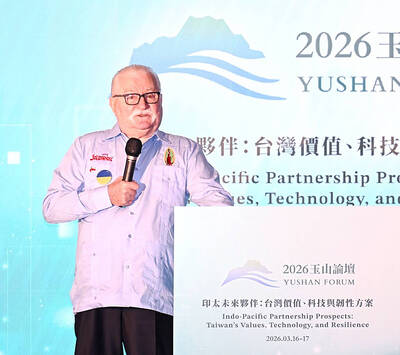
RECOGNITION: Former Fijian prime minister Mahendra Chaudhry said that Taiwan’s New Southbound Policy serves as a stabilizing force in the Indo-Pacific region Taiwan can lead the unification of the Chinese people, Nobel Peace Prize laureate and former Polish president Lech Walesa said in Taipei yesterday, adding that as the world order is changing, peaceful discussion would find good solutions, and that the use of force and coercion would always fail. Walesa made the remarks during his keynote address at a luncheon of the Yushan Forum in Taipei, titled “Indo-Pacific Partnership Prospects: Taiwan’s Values, Technology and Resilience,” organized by the Taiwan-Asia Exchange Foundation with the Ministry of Foreign Affairs. Walesa said that he had been at the forefront of a big peaceful revolution and “if
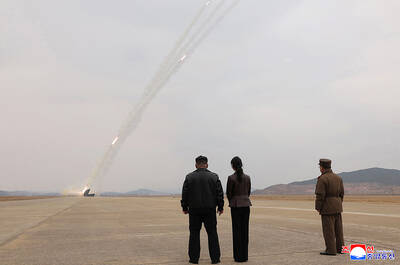
North Korea tested nuclear-capable rocket launchers, state media reported yesterday, a day after Seoul detected the launch of about 10 ballistic missiles. The test comes after South Korean and US forces launched their springtime military drills, due to run until Thursday. North Korean leader Kim Jong-un on Saturday oversaw the testing of the multiple rocket launcher system (MRLS), the Korean Central News Agency (KCNA) said. The test involved 12 600mm-caliber ultra-precision multiple rocket launchers and two artillery companies, it said. Kim said the drill gave Pyongyang’s enemies, within the 420km striking range, a sense of “uneasiness” and “a deep understanding
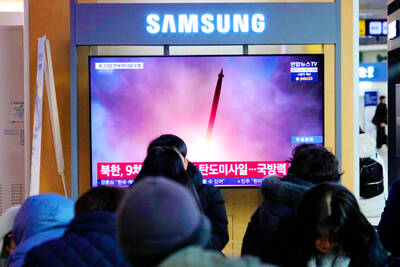
North Korea yesterday fired about 10 ballistic missiles to the sea toward Japan, the South Korean Joint Chiefs of Staff (JCS) said, days after Pyongyang warned of “terrible consequences” over ongoing South Korea-US military drills. Pyongyang recently dashed hopes of a diplomatic thaw with Seoul, Washington’s security ally, describing its latest peace efforts as a “clumsy, deceptive farce.” Seoul’s military detected “around 10 ballistic missiles launched from the Sunan area in North Korea toward the East Sea [Sea of Japan] at around 1:20pm,” JCS said in a statement, referring to South Korea’s name for the body of water. The missiles


 RSS
RSS