


Dozens of civic groups yesterday took to the streets of Taipei to vent their frustration over what they said was the government not taking responsibility for its handling of the tainted lard oil scandal, calling on Premier Jiang Yi-huah (江宜樺) to step down.
Chanting slogans such as “Waste oil hits, food safety ruined,” representatives of the Homemakers United Foundation, the Homemakers Union Consumers Coop, the National Alliance of Parents Organizations, the Taiwan Yucheng Victims’ Support Organization and other groups staged a protest in front of the Executive Yuan yesterday morning.
“Although the Executive Yuan has held several emergency meetings to seek ways to handle the snowballing tainted lard oil scare, it has yet to disclose the issues discussed or any consensus reached during the meetings, nor has it given a time line for when the scandal will be brought under control or what emergency measures it will implement to tackle a food scare that has had a widespread impact,” Homemakers United Foundation chairman Chiang Miao-ying (江妙瑩) said.
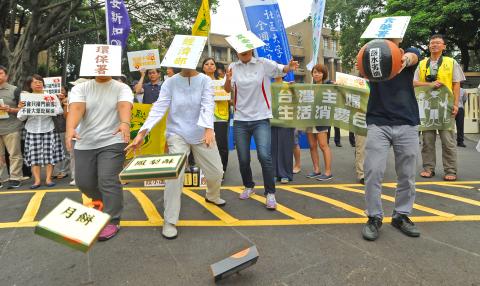
Photo: Liu Hsin-de, Taipei Times
Chiang also accused government agencies of shirking their responsibility during the scandal and failing to join forces to work out ways to improve the nation’s regulations on the sources of ingredients used in food, especially the Food and Drug Administration, the Council of Agriculture, the Ministry of Economic Affairs and the Environmental Protection Administration.
“The seemingly endless string of food scares in recent years has completely exposed the ineffectiveness of the government’s efforts to safeguard food safety,” Chiang said.
Chiang also criticized Jiang.
“If you cannot do your job, please step down. We will find someone else who can,” Chiang said.
Homemakers Union Consumers Coop chairman Hsu Hsiu-chiao (許秀嬌) said the group has spent years of effort trying to educate consumers to monitor what they eat by reading the ingredient labels, but its endeavors have repeatedly been nullified by food scares.
“Usually, government agencies do nothing to regulate food manufacturers and rely solely on ‘self-monitoring.’ When problems surface, they evade responsibility and have no desire to address them,” Hsu said.
Taiwan Yucheng Victims’ Support Organization standing director Lo Shih-hsiang (羅士翔) said the government’s indifference toward food safety is evidenced by its apparent attempts to downplay the potential health impacts of consuming recycled waste oil.
“The victims of PCB [polychlorinated biphenyl] poisoning have for years been forced to live with the painful trauma left by a food scare [in 1979], yet their suffering and predicament seem insufficient to awaken the government to the importance of food safety,” Lo said.
The 1979 scandal involved rice bran oil laced with PCB — a group of industrial chemicals that can cause long-term skin problems if consumed in large amounts — that affected more than 2,000 people across the nation.
National Alliance of Parents Organizations supervisor Huang Tsung-chih (黃聰智) said the tainted lard oil scandal has unnerved many parents nationwide, who fret that the government’s inability to monitor the quality of raw materials could leave their children vulnerable to more contaminated food.
Tsai Meng-lun (蔡孟倫), an adviser at the Executive Yuan’s Department of the Interior, Health, Welfare and Labor, received the petition from the groups.
The groups also issued three demands: that the Executive Yuan immediately hold inter-ministerial food safety conferences to seek ways to make the control of food materials at the source more stringent; that the government establish a mechanism to allow the public to help monitor food safety risks; and that a law on dietary education be implemented as soon as possible.
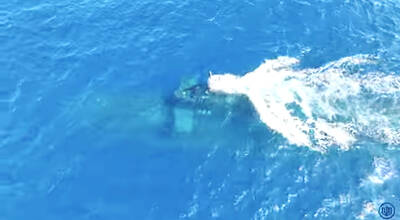
CSBC Corp, Taiwan (台灣國際造船) yesterday released the first video documenting the submerged sea trials of Taiwan’s indigenous defense submarine prototype, the Hai Kun (海鯤), or Narwhal, showing underwater navigation and the launch of countermeasures. The footage shows the vessel’s first dive, steering and control system tests, and the raising and lowering of the periscope and antenna masts. It offered a rare look at the progress in the submarine’s sea acceptance tests. The Hai Kun carried out its first shallow-water diving trial late last month and has since completed four submerged tests, CSBC said. The newly released video compiles images recorded from Jan. 29 to
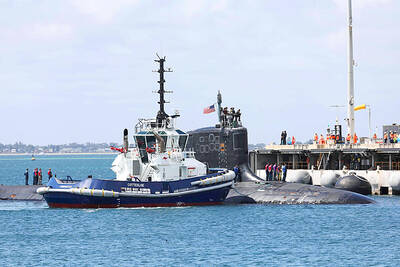
DETERRENCE EFFORTS: Washington and partners hope demonstrations of force would convince Beijing that military action against Taiwan would carry high costs The US is considering using HMAS Stirling in Western Australia as a forward base to strengthen its naval posture in a potential conflict with China, particularly over Taiwan, the Wall Street Journal reported on Saturday. As part of its Indo-Pacific strategy, Washington plans to deploy up to four nuclear-powered submarines at Stirling starting in 2027, providing a base near potential hot spots such as Taiwan and the South China Sea. The move also aims to enhance military integration with Pacific allies under the Australia-UK-US trilateral security partnership, the report said. Currently, US submarines operate from Guam, but the island could
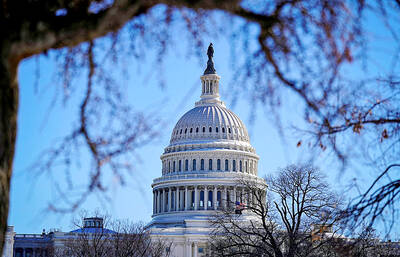
RESTRAINTS: Should China’s actions pose any threat to Taiwan’s security, economic or social systems, China would be excluded from major financial institutions, the bill says The US House of Representatives on Monday passed the PROTECT Taiwan Act, which states that Washington would exclude China from participating in major global financial organizations if its actions directly threaten Taiwan’s security. The bill, proposed by Republican Representative Frank Lucas, passed with 395 votes in favor and two against. It stipulates that if China’s actions pose any threat to Taiwan’s security, economic or social systems, the US would, “to the maximum extent practicable,” exclude Beijing from international financial institutions, including the G20, the Bank for International Settlements and the Financial Stability Board. The bill makes it clear that China must be prepared

Taiwanese trade negotiators told Washington that Taipei would not relocate 40 percent of its semiconductor production to the US, and that its most advanced technologies would remain in the nation, Vice Premier Cheng Li-chiun (鄭麗君) said on Sunday. “I told the US side very clearly — that’s impossible,” Cheng, who led the negotiation team, said in an interview that aired on Sunday night on Chinese Television System. Cheng was referring to remarks last month by US Secretary of Commerce Howard Lutnick, in which he said his goal was to bring 40 percent of Taiwan’s chip supply chain to the US Taiwan’s almost


 RSS
RSS