


China warned against foreign meddling in Hong Kong’s politics yesterday, ahead of an expected announcement to recommend highly contentious restrictions on the first direct elections for the leader of the Chinese-controlled financial hub.
An article in the People’s Daily, the Chinese Communist Party’s (CCP) flagship newspaper, said that some people in the former British colony were colluding with outside forces to interfere in Hong Kong’s governance.
“Not only are they undermining Hong Kong’s stability and development, but they’re also attempting to turn Hong Kong into a bridgehead for subverting and infiltrating the Chinese mainland... This can absolutely not be permitted,” the article said, citing an unidentified official in the Chinese Ministry of Foreign Affairs’ department for Hong Kong, Macau and Taiwan.
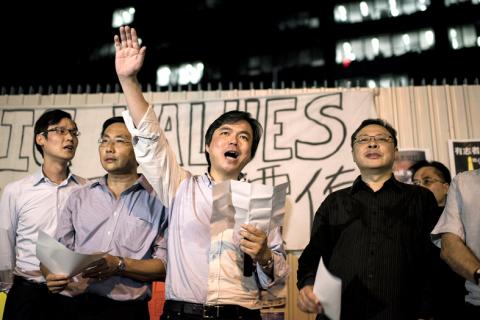
Photo: AFP
The article said that as a special administrative region of China, Hong Kong’s affairs are entirely a Chinese internal matter.
China would refute and make “solemn representations” in response to statements and actions by foreign forces and demand that they “cease meddling in Hong Kong’s affairs and Chinese internal political matters by any means,” the article said.
The article did not identify any individuals or groups, although the UK and the US have both been vocal about their hopes for genuine democratic reform in Hong Kong.
The warning appeared as China’s legislature was expected to announce today that an elite pro-Beijing body must vet candidates for the territory’s leader starting from 2017 — setting up a showdown with pro-democracy groups who want Hong Kongers to be able to freely nominate candidates.
Hong Kong newspapers have reported that the Chinese Standing Committee of the National People’s Congress is to recommend that voters choose from up to three candidates named by a nominating body, while the public gets no say.
That would resemble the current system under which a 1,200-member panel stacked with mostly pro-Beijing elites gets to pick the leader.
Democracy activists are threatening to respond with a mass sit-in which would paralyze the financial district that is the symbolic heart of the city. Student leaders are also considering a walkout of university classes next month.
Since being handed back from the UK in 1997, Hong Kong has retained a high degree of legal, economic and political autonomy.
However, there are growing concerns among many of the territory’s 7 million people that Beijing wishes to insert itself more strongly into Hong Kong’s affairs, particularly in ensuring that its leadership remains beholden to the CCP.
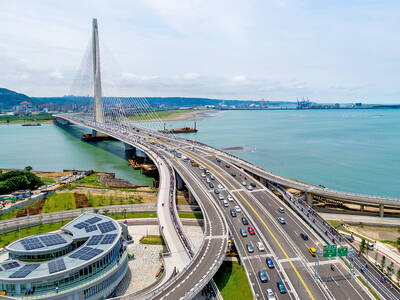
The Ministry of Transportation and Communications yesterday inaugurated the Danjiang Bridge across the Tamsui River in New Taipei City, saying that the structure would be an architectural icon and traffic artery for Taiwan. Feted as a major engineering achievement, the Danjiang Bridge is 920m long, 211m tall at the top of its pylon, and is the longest single-pylon asymmetric cable-stayed bridge in the world, the government’s Web site for the structure said. It was designed by late Iraqi-British architect Zaha Hadid. The structure, with a maximum deck of 70m, accommodates road and light rail traffic, and affords a 200m navigation channel for boats,
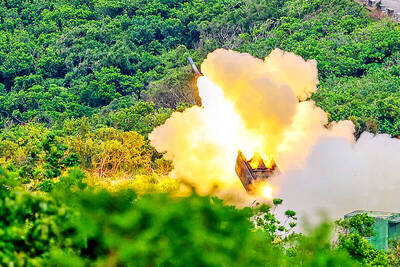
PRECISION STRIKES: The most significant reason to deploy HIMARS to outlying islands is to establish a ‘dead zone’ that the PLA would not dare enter, a source said A High Mobility Artillery Rocket System (HIMARS) would be deployed to Penghu County and Dongyin Island (東引) in Lienchiang County (Matsu) to force the Chinese military to retreat at least 100km from the coastline, a military source said yesterday. Taiwan has been procuring HIMARS and Army Tactical Missile Systems (ATACMS) from the US in batches. Once all batches have been delivered, Taiwan would possess 111 HIMARS units and 504 ATACMS, which have a range of 300km. Considering that “offense is the best defense,” the military plans to forward-deploy the systems to outlying islands such as Penghu and Dongyin so that
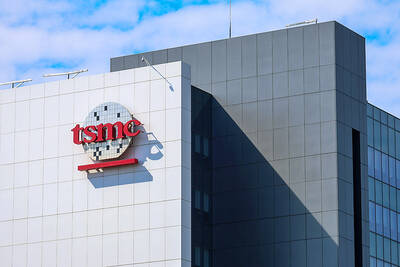
Taiwan Semiconductor Manufacturing Co (TSMC, 台積電), the world’s largest foundry service provider, yesterday said that global semiconductor revenue is projected to hit US$1.5 trillion in 2030, after the figure exceeds US$1 trillion this year, as artificial intelligence (AI) demand boosts consumption of token and compute power. “We are still at the beginning of the AI revolution, but we already see a significant impact across the whole semiconductor ecosystem,” TSMC deputy cochief operating officer Kevin Zhang (張曉強) said at the company’s annual technology symposium in Hsinchu City. “It is fair to say that in the past decade, smartphones and other mobile devices were
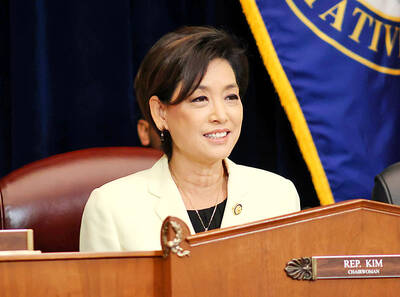
‘CLEAR MESSAGE’: The bill would set up an interagency ‘tiger team’ to review sanctions tools and other economic options to help deter any Chinese aggression toward Taiwan US Representative Young Kim has introduced a bill to deter Chinese aggression against Taiwan, calling for an interagency “tiger team” to preplan coordinated sanctions and economic measures in response to possible Chinese military or political action against Taiwan. “[Chinese President] Xi Jinping [習近平] has directed the People’s Liberation Army to be ready to invade Taiwan by 2027. China has a plan. America should have one too,” Kim said in a news release on Thursday last week. She introduced the “Deter PRC [People’s Republic of China] aggression against Taiwan act” to “ensure the US has a coordinated sanctions strategy ready should


 RSS
RSS