


The Taiwan Solidarity Union’s (TSU) legislative caucus yesterday said that the cross-strait service trade agreement should not be reviewed until the case in which former Mainland Affairs Council (MAC) deputy minister Chang Hsien-yao (張顯耀) is accused of leaking state secrets is closed.
Chang is accused of having spied for China during his time at the council and as vice chairman and secretary-general of the Straits Exchange Foundation, Taiwan’s semi-official negotiating body with China.
The Cabinet on Aug. 16 announced Chang’s resignation and initially said he left for “family reasons,” but later cited national security concerns.
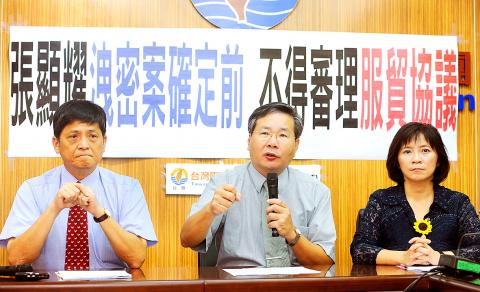
Photo: Liao Chen-huei, Taipei Times
The Mainland Affairs Council later referred the matter to the Investigation Bureau, which is investigating the allegations against Chang, which it said could constitute treason.
Chang has maintained his innocence and has accused some in the government of fabricating accusations against him.
TSU caucus whip Lai Chen-chang (賴振昌) told a press conference yesterday that the council has so far failed to clarify the matter involving Chang and the accusations being traded by multiple “anonymous sources,” but has instead turned it into “a national security crisis” that started with the council’s “sneaky attempt to cover up [Chang’s ouster] by fabricating the excuse of him leaving for ‘family reasons.’”
“The Mainland Affairs Council, at this point, should not shun its responsibility to spell out all the cross-strait negotiations in which Chang has participated,” Lai said.
TSU Policy Committee Chairman Hsu Chung-hsin (許忠信) listed three major allegations that have been laid against Chang: “Influence peddling for Taiwanese businesspeople, divulging negotiation bottom lines and exercising power beyond the domain in which he had been authorized to act.”
“The latter two are extremely serious stuff,” he said, adding that Chang in his two-and-half-year stint as Mainland Affairs Council deputy minister had handled the signing of the Cross-Strait Bilateral Investment Protection and Promotion Agreement and the cross-strait service trade agreement.
“However, the MAC has been downplaying the possible repercussions, with MAC Minister Wang Yu-chi (王郁琦) claiming lightly that cross-strait negotiations would not be affected and Minister of Economic Affairs Woody Duh (杜紫軍) calling bottom lines ‘layered’ and asserting that Chang therefore might not have leaked the most confidential parts,” Hsu said.
Hsu said that what the nation’s representatives do during negotiations with foreign countries all involve national interests, “and once the bottom lines are disclosed, the agreement thereafter struck would not be in line with national interests.”
“If Chang did overreach his authority during the negotiations, the result of those negotiations, including the service trade pact, should be considered ineffective based on the legal notion of ultra vires,” Hsu added.
“Not only should the agreements not be handed over to the Executive Yuan for review, the Executive Yuan should not have referred them to the Legislative Yuan for deliberation either,” he said.
The TSU therefore “strongly demands” that all the reviews concerning the service trade pact, including the draft of cross-strait agreement oversight mechanism, be mothballed, at least until there has been a judgement made on Chang’s case, TSU Legislator Chou Ni-an (周倪安) said, calling on the government to also suspend all ongoing negotiations until the negotiation team has been reorganized.
Additional reporting by CNA

South Korea has adjusted its electronic arrival card system to no longer list Taiwan as a part of China, a move that the Ministry of Foreign Affairs said would help facilitate exchanges between the two sides. South Korea previously listed “Taiwan” as “Taiwan (China)” in the drop-down menus of its online arrival card system, where people had to fill out where they came from and their next destination. The ministry had requested South Korea make a revision and said it would change South Korea’s name on Taiwan’s online immigration system from “Republic of Korea” to “Korea (South),” should the issue not be

Tainan, Taipei and New Taipei City recorded the highest fines nationwide for illegal accommodations in the first quarter of this year, with fines issued in the three cities each exceeding NT$7 million (US$220,639), Tourism Administration data showed. Among them, Taipei had the highest number of illegal short-term rental units, with 410. There were 3,280 legally registered hotels nationwide in the first quarter, down by 14 properties, or 0.43 percent, from a year earlier, likely indicating operators exiting the market, the agency said. However, the number of unregistered properties rose to 1,174, including 314 illegal hotels and 860 illegal short-term rental
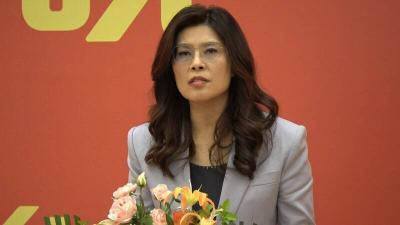
Both sides of the Taiwan Strait share a political foundation based on the “1992 consensus” and opposition to Taiwanese independence, Chinese Nationalist Party (KMT) Chairwoman Cheng Li-wun (鄭麗文) today said during her meeting with Chinese President Xi Jinping (習近平). Both sides of the Strait should plan and build institutionalized and sustainable mechanisms for dialogue and cooperation based on that foundation to make peaceful development across the Strait irreversible, she said. Peace is a shared moral value across the Strait, and both sides should move beyond political confrontation to seek institutionalized solutions to prevent war, she said. Mutually beneficial cross-strait relations are what the
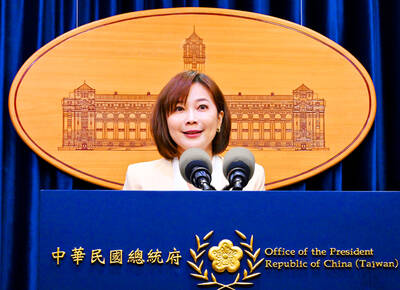
ECONOMIC COERCION: Such actions are often inconsistently applied, sometimes resumed, and sometimes just halted, the Presidential Office spokeswoman said The government backs healthy and orderly cross-strait exchanges, but such arrangements should not be made with political conditions attached and never be used as leverage for political maneuvering or partisan agendas, Presidential Office spokeswoman Karen Kuo (郭雅慧) said yesterday. Kuo made the remarks after China earlier in the day announced 10 new “incentive measures” for Taiwan, following a landmark meeting between Chinese President Xi Jinping (習近平) and Chinese Nationalist Party (KMT) Chairwoman Cheng Li-wun (鄭麗文) in Beijing on Friday. The measures, unveiled by China’s Xinhua news agency, include plans to resume individual travel by residents of Shanghai and China’s Fujian


 RSS
RSS