


Israeli and Palestinian negotiators in Egypt-mediated Gaza truce talks hardened their positions yesterday ahead of the expiration of a five-day ceasefire, though both sides appeared reluctant to return to the deadly all-out fighting that has destroyed large parts of the densely populated coastal strip.
The month-long Israel-Hamas war has killed more than 1,900 Palestinians, the majority of them civilians, according to Palestinian and UN officials. The Palestinian Health Ministry put the Gaza death toll at 2,016. Israel has lost 67 people, all but three of them soldiers.
Since last week, indirect talks have been taking place in Cairo through Egyptian mediators in an effort to broker a substantive end to the war.
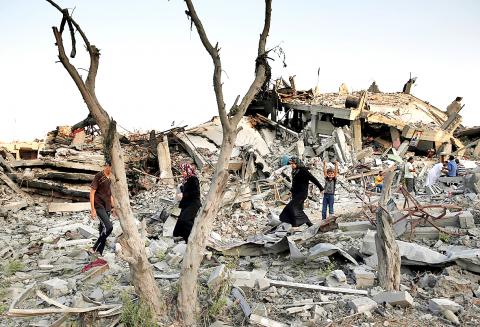
Photo: AFP
On Sunday, Palestinian and Israeli delegations resumed the talks following weekend consultations across the Middle East, but gaps between the two sides remain wide, with each staking out maximalist positions.
The Gaza blockade, imposed by Israel and Egypt since Hamas took control of the strip in 2007, remains the main stumbling block. It has greatly limited the movement of Palestinians in and out of the territory of 1.8 million people, restricted the flow of goods into Gaza and blocked virtually all exports.
A Palestinian negotiator, Qais Abdul Karim, said that on Sunday, Israel pressed for guarantees that Hamas and other militant factions in Gaza would be disarmed, while the Palestinians demanded an end to the blockade without preconditions.
The current ceasefire was set to end at midnight yesterday, but Ziad Nakhleh, head of the Islamic Jihad faction within the Palestinian delegation in Cairo, said he expected it to be extended if a deal was not reached by then.
“The war is behind us now,” he said. “We are not returning to war.”
Hamas has repeatedly said it will not give up its weapons, while Israel says it needs to maintain some degree of control over Gaza crossings to prevent the smuggling of weapons and weapons production materials into the coastal strip.
Karim said Egyptian mediators have pressed the Palestinians to present compromise proposals on the border-crossing issue.
The Palestinian delegation was in a meeting in the early hours yesterday over it, but the outcome was not immediately known.
In a possible move to pressure Hamas to soften its positions on the blockade and related issues, Norwegian Minister of Foreign Affairs Boerge Brende yesterday said that his country and Egypt are planning to cohost a donor conference in Cairo for the reconstruction of Gaza.
Brende said invitations will be sent out once there is an agreement in the Egypt-mediated truce talks.
Israeli Minister of Justice Tzipi Livni addressed the prospect of renewed hostilities, while signaling that Israel would continue to hold its fire as long as Palestinians did the same.
“If they shoot at us, we will respond,” Livni told Israel Radio.
Additional reporting by Reuters
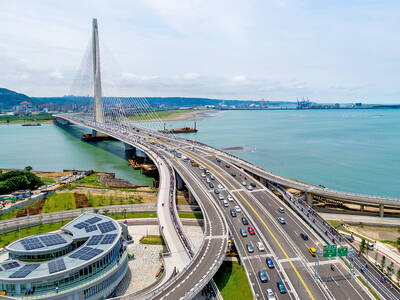
The Ministry of Transportation and Communications yesterday inaugurated the Danjiang Bridge across the Tamsui River in New Taipei City, saying that the structure would be an architectural icon and traffic artery for Taiwan. Feted as a major engineering achievement, the Danjiang Bridge is 920m long, 211m tall at the top of its pylon, and is the longest single-pylon asymmetric cable-stayed bridge in the world, the government’s Web site for the structure said. It was designed by late Iraqi-British architect Zaha Hadid. The structure, with a maximum deck of 70m, accommodates road and light rail traffic, and affords a 200m navigation channel for boats,
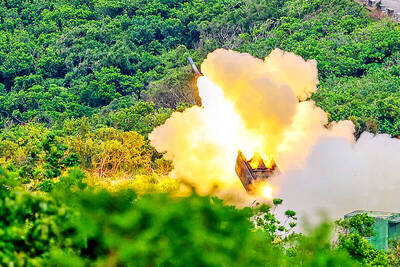
PRECISION STRIKES: The most significant reason to deploy HIMARS to outlying islands is to establish a ‘dead zone’ that the PLA would not dare enter, a source said A High Mobility Artillery Rocket System (HIMARS) would be deployed to Penghu County and Dongyin Island (東引) in Lienchiang County (Matsu) to force the Chinese military to retreat at least 100km from the coastline, a military source said yesterday. Taiwan has been procuring HIMARS and Army Tactical Missile Systems (ATACMS) from the US in batches. Once all batches have been delivered, Taiwan would possess 111 HIMARS units and 504 ATACMS, which have a range of 300km. Considering that “offense is the best defense,” the military plans to forward-deploy the systems to outlying islands such as Penghu and Dongyin so that

Taiwan Semiconductor Manufacturing Co (TSMC, 台積電), the world’s largest foundry service provider, yesterday said that global semiconductor revenue is projected to hit US$1.5 trillion in 2030, after the figure exceeds US$1 trillion this year, as artificial intelligence (AI) demand boosts consumption of token and compute power. “We are still at the beginning of the AI revolution, but we already see a significant impact across the whole semiconductor ecosystem,” TSMC deputy cochief operating officer Kevin Zhang (張曉強) said at the company’s annual technology symposium in Hsinchu City. “It is fair to say that in the past decade, smartphones and other mobile devices were

‘CLEAR MESSAGE’: The bill would set up an interagency ‘tiger team’ to review sanctions tools and other economic options to help deter any Chinese aggression toward Taiwan US Representative Young Kim has introduced a bill to deter Chinese aggression against Taiwan, calling for an interagency “tiger team” to preplan coordinated sanctions and economic measures in response to possible Chinese military or political action against Taiwan. “[Chinese President] Xi Jinping [習近平] has directed the People’s Liberation Army to be ready to invade Taiwan by 2027. China has a plan. America should have one too,” Kim said in a news release on Thursday last week. She introduced the “Deter PRC [People’s Republic of China] aggression against Taiwan act” to “ensure the US has a coordinated sanctions strategy ready should


 RSS
RSS