


President Ma Ying-jeou (馬英九) yesterday called for end to “vicious political infighting” among the nation’s politicians, while repeatedly praising the views expressed in a Wall Street Journal editorial last week titled: “Taiwan Leaves Itself Behind” and urging legislators to speedily ratify the cross-strait service trade agreement.
“Once again I appeal to the minority opposition parties to stop using violent means like occupying the legislative floor to bully the majority and paralyze legislative proceedings. [If their boycott continues,] what alternatives are there to deal with issues vital to the nation’s economic development?” Ma said.
No one will emerge victorious from vicious political infighting at the expense of the nation’s interests, Ma said, adding: “We have to unite under the accord to keep our nation moving forward because Taiwan is the only homeland we have and moving forward is our only choice. There is no turning back — we must march on bravely.”
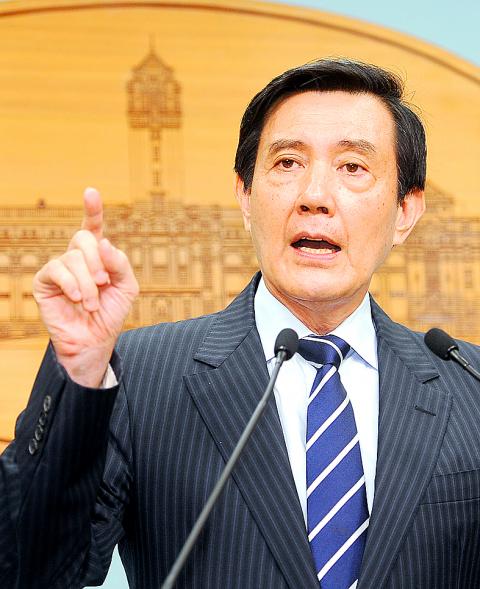
Photo: Fang Pin-chao, Taipei Times
Ma made the remarks at a press conference that the Presidential Office said had been called so the president could deliver an “important speech” on the gas pipeline explosions that devastated Greater Kaohsiung on July 31 and Aug. 1.
However, after dedicating the first three minutes of a nine-minute speech to detailing what the central government has done to assist the Greater Kaohsiung Government in rescue and relief operations, Ma quickly moved from the blasts that killed 30 people and injured 310 to “the future of Taiwan’s economy.”
“After the rescue operations come to an end, there are three things we need to do in the future: rebuild our homeland, determine what the causes of the explosion were and prevent the recurrence of such incidents,” Ma said, pledging that the central government would continue providing assistance to the city government.
He then turned to the subject of the nation’s economy, starting with the Journal editorial from Aug. 4.
“The editorial’s critique of the aura of isolation Taiwan has imposed on itself has resonated with many people,” he said, adding that the article delivered three home truths.
The first is that Taiwan will “only hurt itself” if it preserves national barriers to cross-strait trade. Second, as South Korea and China step up negotiations aimed at signing a free-trade agreement by the end of the year, the success of those talks could “be a serious problem for Taiwan,” whose exports to China overlap significantly with those of South Korea, Ma said.
The third point is that the legislature should ratify the service trade agreement stymied by the student-led Sunflower movement as soon as possible, while also passing the trade in goods agreement being negotiated with Beijing once those talks have concluded, Ma said, warning that if lawmakers do not do this, “Taiwan will be further isolated.”
The editorial echoed many of the views that the government has espoused over the past year, and which have seen it criticized by “some people who are of the opinion that the government is just exaggerating things to scare people,” the president said.
“Now, the international media is expressing the same views as us [the government],” Ma said. “We must continue to push for trade liberalization to avoid being marginalized... To that end, further cross-strait cooperation in trade and economics is inevitable.”
The president said he drew on the Journal editorial to strengthen his arguments not because he is obsequious to whatever foreigners say, but with the purpose of letting “everyone know that the international community is looking at Taiwan and, in their eyes, it is very regrettable that Taiwan is falling behind other countries in opening up its economy and that vicious political infighting has dragged down its major economic policy agenda.”
In response to media inquires on what steps can be taken to end the political squabbling, Ma said he does not — and has never — rule out sitting down with Democratic Progressive Party chairperson Tsai Ing-wen (蔡英文), but that ideally, he would start the reconciliation process by building a consensus within the Chinese Nationalist Party (KMT) that he chairs before reaching out to the opposition.

NATIONAL SECURITY THREAT: An official said that Guan Guan’s comments had gone beyond the threshold of free speech, as she advocated for the destruction of the ROC China-born media influencer Guan Guan’s (關關) residency permit has been revoked for repeatedly posting pro-China content that threatens national security, the National Immigration Agency said yesterday. Guan Guan has said many controversial things in her videos posted to Douyin (抖音), including “the red flag will soon be painted all over Taiwan” and “Taiwan is an inseparable part of China,” while expressing hope for expedited “reunification.” The agency received multiple reports alleging that Guan Guan had advocated for armed reunification last year. After investigating, the agency last month issued a notice requiring her to appear and account for her actions. Guan Guan appeared as required,
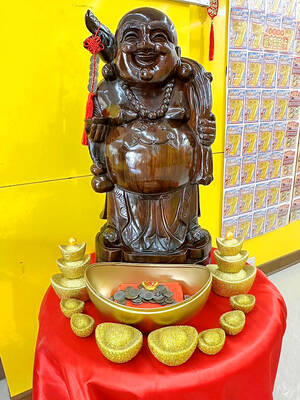
A Vietnamese migrant worker yesterday won NT$12 million (US$379,627) on a Lunar New Year scratch card in Kaohsiung as part of Taiwan Lottery Co’s (台灣彩券) “NT$12 Million Grand Fortune” (1200萬大吉利) game. The man was the first top-prize winner of the new game launched on Jan. 6 to mark the Lunar New Year. Three Vietnamese migrant workers visited a Taiwan Lottery shop on Xinyue Street in Kaohsiung’s Gangshan District (崗山), a store representative said. The player bought multiple tickets and, after winning nothing, held the final lottery ticket in one hand and rubbed the store’s statue of the Maitreya Buddha’s belly with the other,
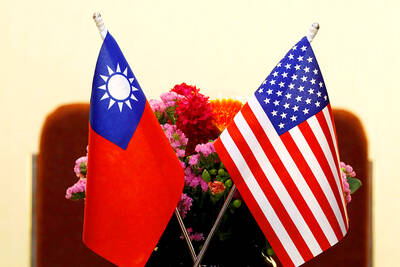
‘NATO-PLUS’: ‘Our strategic partners in the Indo-Pacific are facing increasing aggression by the Chinese Communist Party,’ US Representative Rob Wittman said The US House of Representatives on Monday released its version of the Consolidated Appropriations Act, which includes US$1.15 billion to support security cooperation with Taiwan. The omnibus act, covering US$1.2 trillion of spending, allocates US$1 billion for the Taiwan Security Cooperation Initiative, as well as US$150 million for the replacement of defense articles and reimbursement of defense services provided to Taiwan. The fund allocations were based on the US National Defense Authorization Act for fiscal 2026 that was passed by the US Congress last month and authorized up to US$1 billion to the US Defense Security Cooperation Agency in support of the
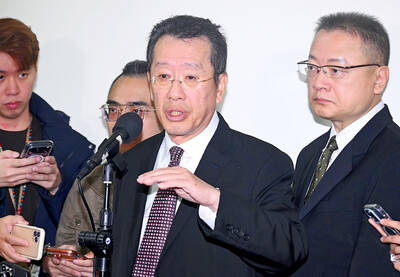
CLASSIFIED BRIEFING: The ministry said the special budget focuses on building a comprehensive defense system and strengthening the domestic defense industry The Ministry of National Defense yesterday released information on seven categories of weapons systems to be procured under a stalled NT$1.25 trillion (US$39.57 billion) special defense budget, including precision artillery, long-range missiles, air defense anti-tank missiles and more than 200,000 uncrewed aerial vehicles (UAVs). The Executive Yuan approved a draft version of the budget on Nov. 27 last year and submitted it to the legislature for review. The legislature’s Foreign Affairs and National Defense Committee yesterday invited Minister of National Defense Wellington Koo (顧立雄) to deliver a classified briefing and answer questions at a closed-door session. Koo said he hoped to provide lawmakers


 RSS
RSS