


The Chiang Ching-kuo Foundation for International Scholarly Exchange has demanded an explanation from the European Association for Chinese Studies (EACS) over a page about the foundation being ripped from brochures at a recent event promoting Chinese study in Portugal, an executive said yesterday.
Founded in 1975, the Paris-based EACS is an international association representing European academics specializing in Chinese studies. It has more than 700 members.
A foundation official who wished to remain anonymous told the Taipei Times by telephone that the foundation sent a letter to the EACS yesterday to register its “unhappiness” over the incident that took place on Tuesday last week at the opening ceremony of the 20th conference of the EACS.
She said the foundation had not been aware of the incident until it was reported by the Chinese-language Liberty Times (the Taipei Times’ sister newspaper) yesterday.
According to the Liberty Times, at the request of Xu Lin (許琳), director-general of the Hanban, the common name of the Chinese National Office for Teaching Chinese as a Foreign Language at China’s Ministry of Education, page 59 of all brochures that gave information about the foundation was ripped out.
Xu has also served on China’s State Council.
All the brochures handed out to participants had the torn-out remnants of a page between page 58 and 61, with page 59 and 60 missing, the Liberty Times reported.
“We didn’t know about this until we saw the reports in the news because we did not send anyone to the conference,” the foundation official said.
She said it was the first time it had happened to the foundation during the many years it has worked with overseas institutions such as the EACS and the US-based Association of Asian Studies to promote Chinese studies as a sponsor.
This year, the foundation donated NT$650,000 to the event, she said.
“The EACS owes us an explanation. It not only hurt our foundation, but also the nation as a whole,” the foundation’s executive said.
The conference this year, titled “From the origins of Sinology to current interdisciplinary research approaches: Bridging the past and future of Chinese Studies,” was a biennial event hosted by the EACS from Tuesday to Saturday last week at Universidade do Minho and Universidade de Coimbra, Portugal.
On the sidelines of the event was an exhibition on Chinese academic studies that included more than 501 works in 561 volumes provided by the Center for Chinese Studies at the National Central Library and the foundation. The works were donated to Universidade do Minho on Friday.
Ministry of Foreign Affairs spokesperson Anna Kao (高安) yesterday responded to reports by the Liberty Times that questioned the ministry’s inaction over the matter.
Representative to Portugal Her Jian-gueng (何建功) was not aware of the incident when it happened, but he lodged a protest with the EACS and the universities immediately after he learned about it, Kao said.
In a press release, the Mainland Affairs Council said it felt “deep regret about and disappointed” at the incident, adding that what China has done at the EACS conference has had a harmful effect on cross-strait relations.
The council urged China to show respect and take a pragmatic view of Taiwan’s participation in activities in the international community.
National Central Library director-general Tseng Shu-hsien (曾淑賢) yesterday said that EACS president Roger Greatrex had come to the exhibition site to apologize to the foundation after the incident.
After Chinese officials showed their displeasure at the page about the foundation in the brochure, staff from the Universidade do Minho tore it from all the brochures without taking the matter to the EACS first, Tseng said.
At the opening ceremony, several EACS officials had spoken out against the Chinese Hanban and the Universidade do Minho, Tseng said.
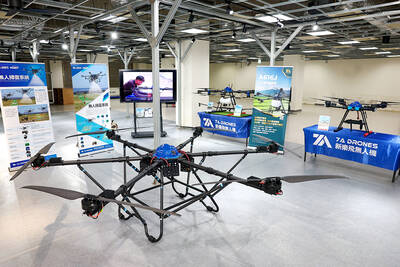
DRONE CENTRAL: Taiwan aims to become Asia’s democratic hub for drones, with most exports focused on high-quality military-grade models, an official said Taiwan’s drone industry is expected to expand significantly by 2030, producing 100,000 units per month and exporting half of them, the Ministry of Economic Affairs said yesterday. Current drone production capacity is about 15,000 units per month, but the industry can quickly scale up as demand increases, Industrial Development Administration Director-General Chiou Chyou-huey (邱求慧) told a news conference in Taipei. Taiwan’s drone output grew 2.5-fold last year to NT$12.9 billion (US$408.3 million) under a government program to develop the uncrewed vehicle sector, he said. The Executive Yuan in October last year approved plans to invest NT$44.2 billion into domestic production of uncrewed aerial
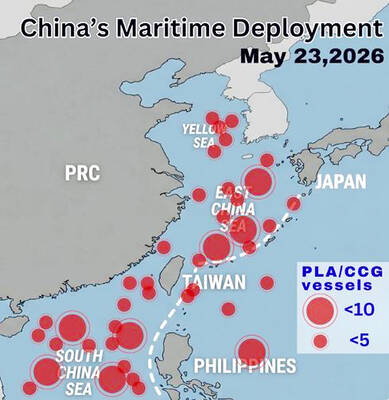
WARNING: China should stop engaging in actions that undermine regional peace and stability, as it would only build resentment among people across the Strait, the CGA said China has deployed more than 100 navy, coast guard and other vessels in waters from the Yellow Sea to the South China Sea and the western Pacific since US President Donald Trump and Chinese President Xi Jinping (習近平) met in Beijing, National Security Council Secretary-General Joseph Wu (吳釗燮) said yesterday. “In this part of the world, #China is the one & only PROBLEM wrecking the #StatusQuo & threatening regional peace & stability,” Wu wrote on X. In a separate post, he said Beijing was coercing Taiwan’s maritime domain, calling it illegal and provocative, after the Coast Guard Administration (CGA) expelled a

VERBOSE VESSELS: A CGA cutter and a China Coast Guard exchanged verbal barbs for more than a day in Taiwanese-controlled waters before the Chinese vessel left The Taiwanese and Chinese coast guards had a standoff near the strategically located Pratas Islands (Dongsha Islands, 東沙群島) in the north of the South China Sea, the Coast Guard Administration (CGA) said yesterday. The two sides engaged in intense radio exchanges over sovereignty claims during the 33-hour standoff. China Coast Guard vessel 3501 eventually left the restricted waters, 26.6 nautical miles (49.2km) west of the Pratas Islands, at 5pm yesterday, the CGA said. Lying approximately between southern Taiwan and Hong Kong, the Taiwan-controlled Pratas are seen by some security experts as vulnerable to Chinese attack due to their distance — more than
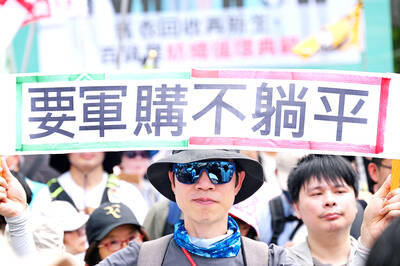
More than 8,000 people took part in a rally in Taipei yesterday to express support for more defense spending, after the opposition slashed the Cabinet’s proposed NT$1.25 trillion (US$39.6 billion) special defense budget and capped it at NT$780 billion. The demonstrators urged the Cabinet to propose another bill. Taiwan Economic Democracy Union convener Lai Chung-chiang (賴中強) said the main problem of the passed budget plan is the removal of funding for critical items, not just that the total amount is smaller. Critical budget items included purchasing or developing uncrewed vehicles, Strong Bow (強弓) missile systems, additional ammunition, artificial intelligence-powered combat systems and Taiwan-US


 RSS
RSS