


Taiwan has been included on a list of countries unwanted at Canada Day events, the Canadian Press news agency reported on Sunday.
The Canadian Trade Office in Taipei was not able to verify the information, which the Canadian Press obtained under the Canadian Access to Information Act, which provides access to information under the Ottawa’s control.
According to the report, the Canadian Department of Foreign Affairs, Trade and Development circulates a persona non grata list in June each year, warning its embassies, consulates and other overseas missions to bar them from local events marking Canada Day, which is on July 1.
North Korea, Fiji, Belarus, Iran, Syria, Guinea-Bissau and Madagascar were the prominent countries on last year’s list, largely because of Canada’s disapproval of unelected or “badly behaved” governments, Canadian Press said.
Taiwan is also on the list this year, though only because Canada does not recognize the nation as a state rather than from any disapproval of its government, the news agency said.
The Canadian Press said that the department has refused to release its list this year, but it added that there were unlikely to be any changes from last year, with the possible inclusion of Russia for the first time.
An accompanying memorandum from Canadian Deputy Minister of Foreign Affairs Morris Rosenberg says the invitation restrictions apply for events being held in Canada as well, the report said.
The Canadian Press said that it asked the department to comment on the list and a spokesperson replied: “It is not our practice to provide lists of country representatives invited or not invited to functions held at our missions abroad.”
“I’m afraid that’s all I have at this point,” Ian Trites, a department spokesperson said in an e-mail, according to the Canadian Press.
The Ministry of Foreign Affairs responded to a Taipei Times request for a response by issuing a three-point statement at 10:20pm.
The ministry said that one, it was the Canadian Press that had stated in its report that Canada’s foreign affairs department did not provide a list for this year; two, it was the Canadian Press that termed the list a persona non grata list; and three — as the Canadian Press had said — Taiwan was on the list last year not because the Canadian government was critical of Taiwan or was displeased with it, but because Ottawa does not recognize Taiwan as a state.
“The ministry found the comments about Taiwan in the report deeply regrettable,” ministry spokesperson Anna Kao (高安) told the Taipei Times.
Kao said the relationship between Taiwan and Canada has been growing steadily closer, evidenced by the signing of the working holiday agreement in April 2010, the inclusion of Taiwan in Canada’s visa waiver program in November that year and the signing of an agreement expanding the number of bilateral direct flights in November last year.
Earlier in the evening, former minister of foreign affairs Cheng Chien-jen (程建人) told the Taipei Times that he has never heard of the list and “it is hard for me to believe that it exists unless I see it with my own eyes.”
“If Canada has such a list, it should revise it. I do not see any reason to put Taiwan on the list because it is a democratic country and the relationship between Taiwan and Canada has [always] been cordial,” Cheng said.
This story has been updated since it was first published.

SILENCING CRITICS: In addition to blocking Taiwan, China aimed to prevent rights activists from speaking out against authoritarian states, a Cabinet department said The Ministry of Foreign Affairs (MOFA) yesterday condemned transnational repression by Beijing after RightsCon, a major digital human rights conference scheduled to be held in Zambia this week, was abruptly canceled due to Chinese pressure over Taiwanese participation. This year’s RightsCon, the world’s largest conference discussing issues “at the intersection of human rights and technology,” was scheduled to take place from tomorrow to Friday in Lusaka, and expected to draw 2,600 in-person attendees from 150 countries, along with 1,100 online participants. However, organizers were forced to cancel the event due to behind-the-scenes pressure from China, the ministry said, expressing its “strongest condemnation”
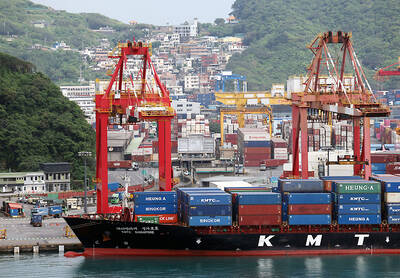
Taiwan’s economy grew far faster than expected in the first quarter, as booming demand for artificial intelligence (AI) applications drove a surge in exports, spilling over into investment and consumption, the Directorate-General of Budget, Accounting and Statistics (DGBAS) said yesterday. GDP growth was 13.69 percent year-on-year during the January-to-March period, beating the DGBAS’ February forecast by 2.23 percentage points and marking the most robust growth in nearly four decades, DGBAS senior official Chiang Hsin-yi (江心怡) told a news conference in Taipei. The result was powered by exports, which remain the backbone of Taiwan’s economy, Chiang said. Outbound shipments jumped 51.12 percent year-on-year to
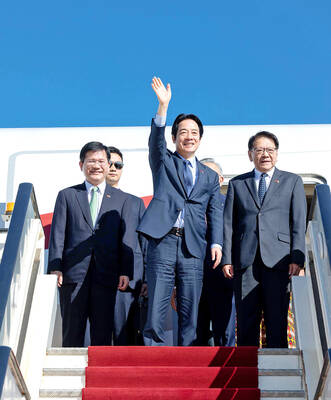
DELAYED BUT DETERMINED: The president’s visit highlights Taiwan’s right to international engagement amid regional pressure from China President Willaim Lai (賴清德) yesterday arrived in Eswatini, more than a week after his planned visit to Taiwan’s sole African ally was suspended because of revoked overflight permits. “The visit, originally scheduled for April 22, was postponed due to unforeseen external factors,” Lai wrote on social media. “After several days of careful arrangements by our diplomatic and national security teams, we successfully arrived today.” Lai said he looked forward to further deepening Taiwan-Eswatini relations through closer cooperation in the economy, agriculture, culture and education, as well as advancing the nation’s international partnerships. The president was initially scheduled to arrive in time to celebrate
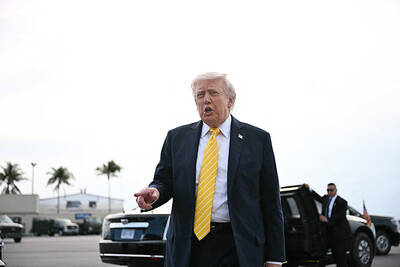
Iran’s Islamic Revolutionary Guard Corp (IRGC) yesterday said the US faced a choice between an “impossible” military operation or a “bad deal” with Tehran, after US President Donald Trump disparaged Iran’s latest peace proposal. Negotiations between the two countries have been deadlocked since a ceasefire came into effect on April 8, with only one round of direct peace talks held so far. Iran’s Tasnim and Fars news agencies reported that Tehran had submitted a 14-point proposal to mediator Pakistan, but Trump was quick to cast doubt on it. “I will soon be reviewing the plan that Iran has just sent to us, but


 RSS
RSS