


Sunflower movement leader Chen Wei-ting (陳為廷) was denied entry to Hong Kong yesterday after he tried to go to the former British colony to participate in the pro-democracy movement there.
After returning to Taiwan Taoyuan International Airport, Chen recounted his experience, saying that immigration officers had taken him aside while he was passing through customs at Hong Kong International Airport and led him to a small room.
Chen said the officials told him that his “Taiwan compatriot’s travel document” (台胞證) — a permit issued by Chinese authorities allowing Taiwanese to travel to China that can also be used to enter Hong Kong — had been nullified.
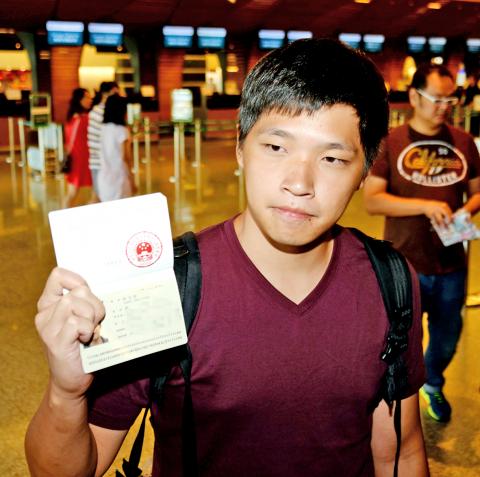
Photo: CNA
However, Chen said the document was not due to expire until 2018.
The Sunflower leader said the officials searched him, which added to his feeling that he was being treated like a terrorist.
He was then escorted by the officers onto a flight bound for Taiwan that departed at 5:45pm and arrived at Taoyuan International Airport at about 7:30pm.
Prior to departing from the Taoyuan airport at 2pm yesterday, Chen said he was going to Hong Kong to join in activists’ fight for democracy.
“I hope that Beijing and the Hong Kong government will not try to block the interaction and exchanges between civic groups in Taiwan and in Hong Kong,” he said. “If Hong Kong decides to deport me, I will have no choice but to come back, but I’d like to see how the Mainland Affairs Council will react, since it once said that it would try to give me a hand in such matters.”
Chen was referring to Hong Kong authorities’ denial of visa applications filed by himself and his fellow Taiwan March cofounders Lin Fei-fan (林飛帆) and Huang Kuo-chang (黃國昌) last week.
The trio had intended to join pro-democracy demonstrations taking place in the territory.
Despite their failure to get visas, Chen decided to travel to Hong Kong anyway using his “Taiwan compatriot’s travel document.”
Lin and Huang could not accompany him, as they do not have the travel permit.
Chinese dissident Wang Dan (王丹), who is living in exile in Taiwan, expressed support for Chen’s efforts on Facebook, writing: “Although he was denied a visa, Chen still decided to go to Hong Kong [yesterday]. He may not be allowed into Hong Kong, but our friends in Hong Kong should get a clear message: Those who participated in Taiwan’s Sunflower movement will be standing firmly together with the force for democracy in Hong Kong.”
“The demonstration on July 1 [tomorrow] is coming — Hong Kongers, you are not alone,” Wang posted.
Additional reporting by Yao Chi-hsiu

A signaling system malfunction disrupted high-speed rail (HSR) services beginning at 8am today, with trains temporarily reduced to three northbound and three southbound trains per hour as authorities conduct inspections. The malfunction occurred on a section of track in Miaoli County during pre-operation checks early this morning, forcing northbound and southbound trains to use a single track, the HSR operator said. The regular schedule has been replaced with three hourly trains offering only nonreserved seating in each direction, stopping at every station, it said, adding that business class cars would still have reserved seating. Departures from terminal stations are scheduled at the top

Taiwan is still in the process of assessing the possibility of recruiting workers from Eswatini, the Ministry of Foreign Affairs said yesterday, adding that its goal is to help Eswatini upgrade its vocational training centers. If there are plans to recruit workers from Eswatini, safeguarding national security, protecting public health and ensuring the employment rights of Taiwanese would be prerequisites, Department of West Asian and African Affairs Director-General Yen Chia-liang (顏嘉良) told a news conference. Key considerations would also include filling labor shortages in specific industries, and fostering bilateral professional and technical exchanges, he said. Yen was asked about the progress of labor

VERBOSE VESSELS: A CGA cutter and a China Coast Guard exchanged verbal barbs for more than a day in Taiwanese-controlled waters before the Chinese vessel left The Taiwanese and Chinese coast guards had a standoff near the strategically located Pratas Islands (Dongsha Islands, 東沙群島) in the north of the South China Sea, the Coast Guard Administration (CGA) said yesterday. The two sides engaged in intense radio exchanges over sovereignty claims during the 33-hour standoff. China Coast Guard vessel 3501 eventually left the restricted waters, 26.6 nautical miles (49.2km) west of the Pratas Islands, at 5pm yesterday, the CGA said. Lying approximately between southern Taiwan and Hong Kong, the Taiwan-controlled Pratas are seen by some security experts as vulnerable to Chinese attack due to their distance — more than
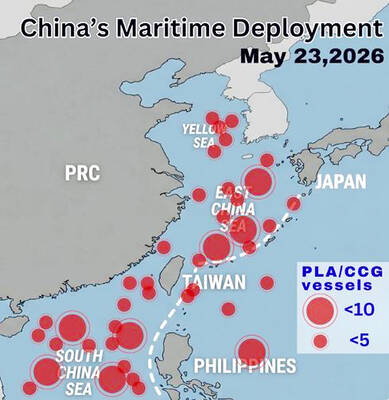
WARNING: China should stop engaging in actions that undermine regional peace and stability, as it would only build resentment among people across the Strait, the CGA said China has deployed more than 100 navy, coast guard and other vessels in waters from the Yellow Sea to the South China Sea and the western Pacific since US President Donald Trump and Chinese President Xi Jinping (習近平) met in Beijing, National Security Council Secretary-General Joseph Wu (吳釗燮) said yesterday. “In this part of the world, #China is the one & only PROBLEM wrecking the #StatusQuo & threatening regional peace & stability,” Wu wrote on X. In a separate post, he said Beijing was coercing Taiwan’s maritime domain, calling it illegal and provocative, after the Coast Guard Administration (CGA) expelled a


 RSS
RSS