


The recently concluded visit of China’s Taiwan Affairs Office (TAO) Minister Zhang Zhijun (張志軍) exposed the danger of the President Ma Ying-jeou (馬英九) administration’s attempt to merge “two distinctively different civilizations and the fragility of Taiwan’s democracy and civic society,” panelists at a symposium said yesterday.
“Never think that the tragedy of the 228 Incident cannot happen in the 21st century,” retired National Taiwan University professor Kenneth Lin (林向愷) told the symposium, organized by the Taiwan Association of University Professors.
The brutal massacre in 1947 — which was violently suppressed by the Chinese Nationalist Party (KMT) government, wiping out almost an entire generation of Taiwanese elites — was a clash of two civilizations, Taiwan and China, Lin said, adding that they were forcibly merged by the KMT regime.
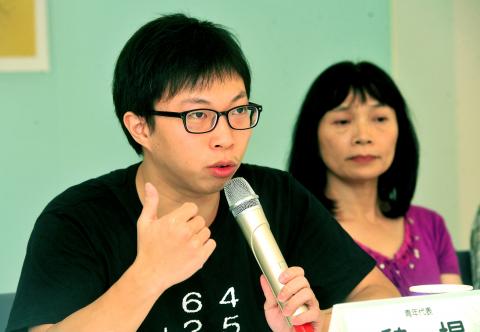
Photo: Chien Jung-fong, Taipei Times
Reviewing the Ma administration’s handling of a series of protests against Zhang, Lin said that while most people had great expectations about the Economic Cooperation Framework Agreement (ECFA) three years ago, many now realize that “ordinary people are not in the winner’s circle in terms of cross-strait economic integration.”
“With growing Chinese influences of their lives, people realize that the economic and political systems across the Taiwan Strait are so different that they could not possibly be integrated. This mentality was shown in the increase in the number of people who upheld the ‘refusal of unification’ after Ma took office in 2008,” Lin added.
Ma would be making a grave mistake if he has not sensed the changing political climate in Taiwan, as most participants in the protests during visits by former Association of Relations Across the Taiwan Straits chairman Chen Yunlin (陳雲林) were senior citizens, but the majority of protesters in the past week were young people, the professor said.
“What I saw was the fragility of Taiwan’s democracy and civil society,” Hsueh Hua-yuan (薛化元), head of the Graduate Institute of Taiwan History at National Chengchi University, said about the aftermath of Zhang’s visit, which saw public discussion focused on the “courtesy and hospitality” of the nation.
Many analysts and politicians concluded that while the motivations behind the protests were just, the means were questionable because they violated Taiwanese tradition.
The issues in question were neither about courtesy nor hospitality, but the state apparatus’ abuse of power and violation of the constitutionally protected right of expression, Hsueh said.
“Saying that the ‘excessive protests’ jeopardized Taiwan’s image is as illogical as talking about free trade with China — an abnormal free economic system from head to toe,” Hsueh said.
“To me, Zhang was anything but a guest. He was an aggressor with a smile on his face,” said Yen Ming-wei (顏銘緯), a high-school graduate who participated in protests in Greater Kaohsiung.
Dennis Wei (魏揚), a student at National Tsing Hua University who was arrested during a protest in New Taipei City, agreed, saying that the discussion of politeness reflected that Taiwan’s democratic movement should be deepened and strengthened.
Wei expressed his “unsurprising disappointment” in the Democratic Progressive Party (DPP), which chose not to organize any protests this time, urging the party to “be clear with its China policy and positions.”
The DPP’s position on several issues, including the proposed free economic pilot zones and the cross-strait service trade agreement, have been vague, but “[the DPP] could not expect to win more votes by its eclecticism,” Wei said.
“The simple fact that students and young people were left protesting on the street alone means that the DPP has not been doing its job and has not worked hard enough,” Wei said.

SILENCING CRITICS: In addition to blocking Taiwan, China aimed to prevent rights activists from speaking out against authoritarian states, a Cabinet department said The Ministry of Foreign Affairs (MOFA) yesterday condemned transnational repression by Beijing after RightsCon, a major digital human rights conference scheduled to be held in Zambia this week, was abruptly canceled due to Chinese pressure over Taiwanese participation. This year’s RightsCon, the world’s largest conference discussing issues “at the intersection of human rights and technology,” was scheduled to take place from tomorrow to Friday in Lusaka, and expected to draw 2,600 in-person attendees from 150 countries, along with 1,100 online participants. However, organizers were forced to cancel the event due to behind-the-scenes pressure from China, the ministry said, expressing its “strongest condemnation”
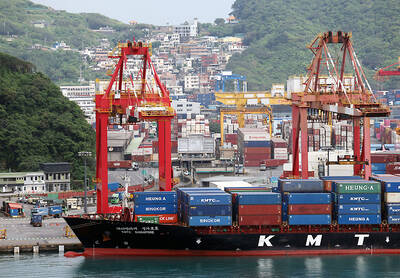
Taiwan’s economy grew far faster than expected in the first quarter, as booming demand for artificial intelligence (AI) applications drove a surge in exports, spilling over into investment and consumption, the Directorate-General of Budget, Accounting and Statistics (DGBAS) said yesterday. GDP growth was 13.69 percent year-on-year during the January-to-March period, beating the DGBAS’ February forecast by 2.23 percentage points and marking the most robust growth in nearly four decades, DGBAS senior official Chiang Hsin-yi (江心怡) told a news conference in Taipei. The result was powered by exports, which remain the backbone of Taiwan’s economy, Chiang said. Outbound shipments jumped 51.12 percent year-on-year to
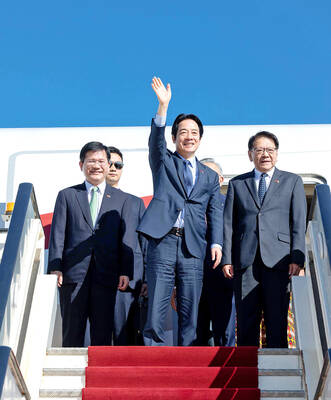
DELAYED BUT DETERMINED: The president’s visit highlights Taiwan’s right to international engagement amid regional pressure from China President Willaim Lai (賴清德) yesterday arrived in Eswatini, more than a week after his planned visit to Taiwan’s sole African ally was suspended because of revoked overflight permits. “The visit, originally scheduled for April 22, was postponed due to unforeseen external factors,” Lai wrote on social media. “After several days of careful arrangements by our diplomatic and national security teams, we successfully arrived today.” Lai said he looked forward to further deepening Taiwan-Eswatini relations through closer cooperation in the economy, agriculture, culture and education, as well as advancing the nation’s international partnerships. The president was initially scheduled to arrive in time to celebrate
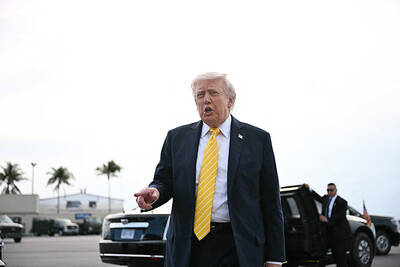
Iran’s Islamic Revolutionary Guard Corp (IRGC) yesterday said the US faced a choice between an “impossible” military operation or a “bad deal” with Tehran, after US President Donald Trump disparaged Iran’s latest peace proposal. Negotiations between the two countries have been deadlocked since a ceasefire came into effect on April 8, with only one round of direct peace talks held so far. Iran’s Tasnim and Fars news agencies reported that Tehran had submitted a 14-point proposal to mediator Pakistan, but Trump was quick to cast doubt on it. “I will soon be reviewing the plan that Iran has just sent to us, but


 RSS
RSS