


The Democratic Progressive Party (DPP) caucus yesterday demanded an explanation from Mainland Affairs Council Minister Wang Yu-chi (王郁琦) on why the government takes what the party says is a strong stance when facing Japan, “yet is so humble when facing China’s Taiwan Affairs Office (TAO) Minister Zhang Zhijun (張志軍).”
The caucus said DPP lawmakers will grill Wang on the matter when he attends a legislative meeting tomorrow during which he is scheduled to make a presentation on Zhang’s four-day visit.
DPP Legislator Chen Chi-mai (陳其邁) said the government protested furiously in its recent demand that the Japanese media should not omit the word “national” from the name of the National Palace Museum when the museum’s collections are exhibited in Japan, but only said that it would expect China to “respect the choice of Taiwanese” when TAO officials, prior to Zhang’s visit, said that the future of Taiwan should be decided by all Chinese.
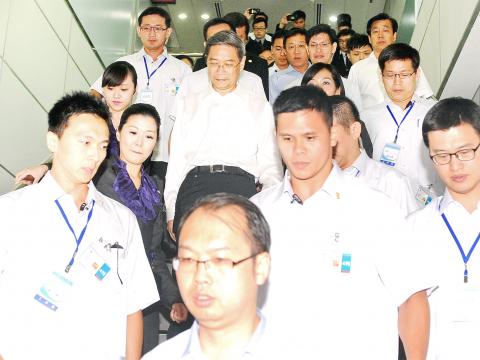
Photo: Chu Pei-hsiung, Taipei Times
Chen said he would ask Wang why the government is taking such a soft stance on China’s claim on Taiwan’s sovereignty, which is a much more serious issue than Japanese media outlets or exhibitions omitting the word “national” in their reporting on the National Palace Museum.
DPP Legislator Lee Chun-yi (李俊俋) said that he plans to ask Wang about the security measures during Zhang’s visit.
While the National Security Bureau denies involvement, security agents could be seen everywhere, he said.
Lee said that there have been too many controversial incidents, for instance, the government should explain why staff at the Novotel Hotel at the Taiwan Taoyuan International Airport, accompanied by the police, could charge into a guest’s room without a warrant.
Separately yesterday, DPP spokesperson Lin Chun-hsien (林俊憲) said the security measures ordered by the National Police Agency (NPA) during Zhang’s visit seriously harmed democracy and human rights in the country, adding that the law enforcement agency’s threats against news reporters were in violation of freedom of the press, and thus the DPP caucus would pursue the responsibilities of relevant government agencies at the legislature.
Lin added that the DPP would support Greater Kaohsiung Mayor Chen Chu’s (陳菊) apologies for injuries caused by the police’s handling of protesting students in Kaohsiung, and her decision to launch a probe into it.
“It has always been our belief that protesting is a right, while security maintenance is a responsibility, however, the proportionality should be take into consideration,” Lin said, and called on the NPA to launch a probe into the issue.
Lin condemned the Chinese Nationalist Party (KMT) for its China-leaning policies despite China’s hostility toward Taiwan, saying that such policies have led to resentment among Taiwanese.

SILENCING CRITICS: In addition to blocking Taiwan, China aimed to prevent rights activists from speaking out against authoritarian states, a Cabinet department said The Ministry of Foreign Affairs (MOFA) yesterday condemned transnational repression by Beijing after RightsCon, a major digital human rights conference scheduled to be held in Zambia this week, was abruptly canceled due to Chinese pressure over Taiwanese participation. This year’s RightsCon, the world’s largest conference discussing issues “at the intersection of human rights and technology,” was scheduled to take place from tomorrow to Friday in Lusaka, and expected to draw 2,600 in-person attendees from 150 countries, along with 1,100 online participants. However, organizers were forced to cancel the event due to behind-the-scenes pressure from China, the ministry said, expressing its “strongest condemnation”
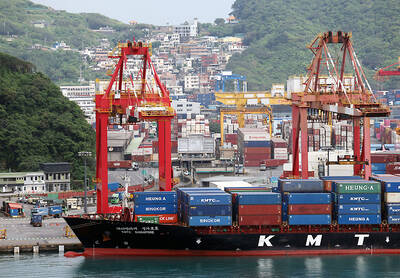
Taiwan’s economy grew far faster than expected in the first quarter, as booming demand for artificial intelligence (AI) applications drove a surge in exports, spilling over into investment and consumption, the Directorate-General of Budget, Accounting and Statistics (DGBAS) said yesterday. GDP growth was 13.69 percent year-on-year during the January-to-March period, beating the DGBAS’ February forecast by 2.23 percentage points and marking the most robust growth in nearly four decades, DGBAS senior official Chiang Hsin-yi (江心怡) told a news conference in Taipei. The result was powered by exports, which remain the backbone of Taiwan’s economy, Chiang said. Outbound shipments jumped 51.12 percent year-on-year to
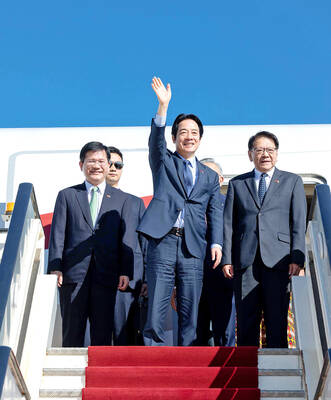
DELAYED BUT DETERMINED: The president’s visit highlights Taiwan’s right to international engagement amid regional pressure from China President Willaim Lai (賴清德) yesterday arrived in Eswatini, more than a week after his planned visit to Taiwan’s sole African ally was suspended because of revoked overflight permits. “The visit, originally scheduled for April 22, was postponed due to unforeseen external factors,” Lai wrote on social media. “After several days of careful arrangements by our diplomatic and national security teams, we successfully arrived today.” Lai said he looked forward to further deepening Taiwan-Eswatini relations through closer cooperation in the economy, agriculture, culture and education, as well as advancing the nation’s international partnerships. The president was initially scheduled to arrive in time to celebrate
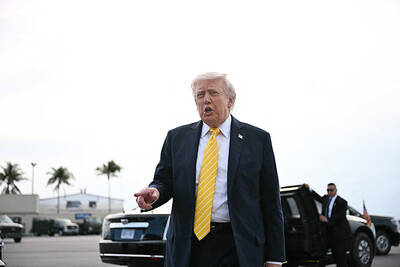
Iran’s Islamic Revolutionary Guard Corp (IRGC) yesterday said the US faced a choice between an “impossible” military operation or a “bad deal” with Tehran, after US President Donald Trump disparaged Iran’s latest peace proposal. Negotiations between the two countries have been deadlocked since a ceasefire came into effect on April 8, with only one round of direct peace talks held so far. Iran’s Tasnim and Fars news agencies reported that Tehran had submitted a 14-point proposal to mediator Pakistan, but Trump was quick to cast doubt on it. “I will soon be reviewing the plan that Iran has just sent to us, but


 RSS
RSS