


Officials yesterday sought to play down leaked test results indicating possible flaws in a containment structure of the Fourth Nuclear Power Plant, saying the problem will be fixed as part of ongoing tests and inspections.
Taiwan Power Co (Tai-power, 台電) chairman Hwang Jung-chiou (黃重球) said that finding and sealing leaks in the primary containment structure of the plant’s first reactor were normal steps in safety inspection procedures.
Hwang said similar leaks were discovered during inspections carried out on the nation’s first, second and third nuclear power plants, all of which are operated by the state-run Taipower.
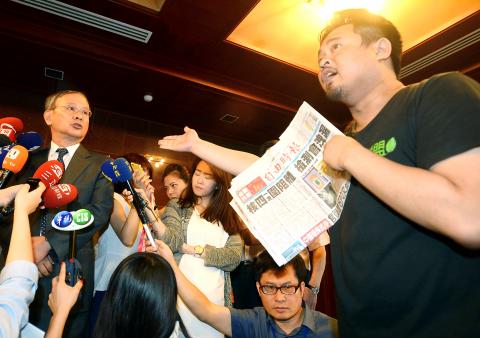
Photo: Wang Yi-sung, Taipei Times
The company is also responsible for the nearly completed Fourth Nuclear Power Plant in New Taipei City’s Gongliao District (貢寮).
Answering questions at a meeting of the legislature’s Education and Culture Committee, Atomic Energy Council (AEC) Minister Tsai Chuen-horng (蔡春鴻) said the council would strictly review Taipower’s safety reports on the plant to ensure the leakage rates of the reactor containment building are within safety standards.
Tsai’s remarks came in response to a report by the Chinese-language Liberty Times (the Taipei Times’ sister newspaper) yesterday which said it received an anonymous report from a person who identified himself as a worker at the plant saying that during the integrated leak rate test (ILRT) and structure integral test (SIT) conducted at the plant’s No. 1 reactor from Feb. 26 through March 5, leakage rates were found to be too high.
The company had reported them as normal.
Meanwhile, outside the committee meeting room, Green Citizen Action Alliance deputy secretary-general Hung Shen-han (洪申翰) criticized Taipower for claiming that the structure had no problems in its publicized safety test report on its Web site last month.
He alleged that the company only reported the good parts, but not flaws, which he said should be considered lying to the public.
Taipower vice president Chen Pu-tsan (陳布燦) said the company had conducted ILRT and SIT on the containment building and the latter was completed and proved to be in compliance with international standards.
Chen added the company will find the problem and make sure it is solved if it finds leak rates exceeding standard during tests.
Tsai said Taipower has been seeking ways to further reinforce the containment structure since then.
Once the flaws have been corrected, Taipower will conduct an ILRT again, he said.
The ILRT and SIT are just two of 307 tests that must be conducted before fuel rods can be installed in the reactor, Tsai said, though he described them as “vital” because of the primary containment structure’s role in minimizing the release of radioactive material into the environment.
The SIT is designed to test the pressure threshold of the steel reinforced concrete structure, he said. The test subjects the structure to 15 percent more pressure than in normal conditions to see if it can withstand the stress.
Tsai said the AEC will “rigorously inspect” Taipower’s test results as soon as his agency receives all the documentation.
The council will make sure problems are solved before giving approval, he added.

A signaling system malfunction disrupted high-speed rail (HSR) services beginning at 8am today, with trains temporarily reduced to three northbound and three southbound trains per hour as authorities conduct inspections. The malfunction occurred on a section of track in Miaoli County during pre-operation checks early this morning, forcing northbound and southbound trains to use a single track, the HSR operator said. The regular schedule has been replaced with three hourly trains offering only nonreserved seating in each direction, stopping at every station, it said, adding that business class cars would still have reserved seating. Departures from terminal stations are scheduled at the top

Taiwan is still in the process of assessing the possibility of recruiting workers from Eswatini, the Ministry of Foreign Affairs said yesterday, adding that its goal is to help Eswatini upgrade its vocational training centers. If there are plans to recruit workers from Eswatini, safeguarding national security, protecting public health and ensuring the employment rights of Taiwanese would be prerequisites, Department of West Asian and African Affairs Director-General Yen Chia-liang (顏嘉良) told a news conference. Key considerations would also include filling labor shortages in specific industries, and fostering bilateral professional and technical exchanges, he said. Yen was asked about the progress of labor

A US uncrewed surface vessel (USV) encountered multiple Chinese warships during an autonomous transit of the Taiwan Strait, US defense company Seasats said in a statement on Wednesday. Seasats announced that a Lightfish USV had completed the first autonomous transit of the Taiwan Strait. Over five days, the USV traversed the entire length of the Strait while constantly monitoring surface vessel traffic, the company said. The Lightfish encountered multiple Chinese warships, one of which was a Chinese People’s Liberation Army Navy (PLAN) Type 056 corvette, it said. The Chinese vessels were operating “well within Taiwan’s exclusive economic zone without transmitting their identity via the

VERBOSE VESSELS: A CGA cutter and a China Coast Guard exchanged verbal barbs for more than a day in Taiwanese-controlled waters before the Chinese vessel left The Taiwanese and Chinese coast guards had a standoff near the strategically located Pratas Islands (Dongsha Islands, 東沙群島) in the north of the South China Sea, the Coast Guard Administration (CGA) said yesterday. The two sides engaged in intense radio exchanges over sovereignty claims during the 33-hour standoff. China Coast Guard vessel 3501 eventually left the restricted waters, 26.6 nautical miles (49.2km) west of the Pratas Islands, at 5pm yesterday, the CGA said. Lying approximately between southern Taiwan and Hong Kong, the Taiwan-controlled Pratas are seen by some security experts as vulnerable to Chinese attack due to their distance — more than


 RSS
RSS