


Nearly 1,000 people unhappy with the forced dispersal of protesters from outside the Legislative Yuan in Taipei early yesterday following the ending of the Sunflower movement occupation attempted to besiege the Zhongzheng First Police Precinct last night, sparking a tense face-off and sporadic clashes with officers.
The stand-off was ongoing as of press time.
The protesters demanded that precinct chief Fang Yang-ning (方仰寧) apologize and step down for reneging on his pledge to not forcibly disperse protesters from the square outside the Legislative Yuan.

Photo: CNA
They also asked that Fang appear before them to explain his actions.
As the number of protesters swelled, hundreds of police officers were deployed to the front gate of the precinct building, and anti-riot police were on standby.
Some of the protesters scattered ghost money, normally seen as currency for the dead, around the precinct doors.
Fang appeared outside the precinct at about 7pm, with Taipei Mayor Hau Lung-bin (郝龍斌) standing behind him, and told the crowd that if he had done anything wrong, he would be willing to be transferred or resign.
He said he would apologize if he had caused a public misunderstanding, and he also said that no one had been injured during the eviction process.
His remarks did little to appease the protesters.
Hau said last night that he would not ask Fang to resign because the officer had done nothing wrong.
Members of the Alliance of Referendum for Taiwan and their supporters remained in the plaza outside the front of the Legislative Yuan overnight after student-led protesters from the Sunflower movement left the legislature’s main chamber early on Thursday evening.
Despite a promise from Fang about 2:30am yesterday that police officers would not use heavy-handed methods to clear the area, police began picking up demonstrators and moving them away from the square at 7am.

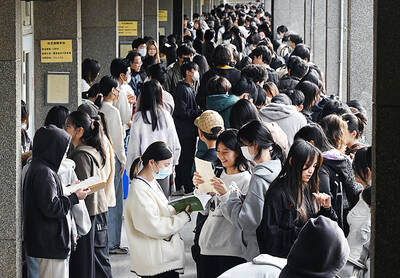
A global survey showed that 60 percent of Taiwanese had attained higher education, second only to Canada, the Ministry of the Interior said. Taiwan easily surpassed the global average of 43 percent and ranked ahead of major economies, including Japan, South Korea and the US, data from the Organisation for Economic Co-operation and Development (OECD) for 2024 showed. Taiwan has a high literacy rate, data released by the ministry showed. As of the end of last year, Taiwan had 20.617 million people aged 15 or older, accounting for 88.5 percent of the total population, with a literacy rate of 99.4 percent, the data

NEW LOW: The council in 2024 based predictions on a pessimistic estimate for the nation’s total fertility rate of 0.84, but last year that rate was 0.69, 17 percent lower An expected National Development Council (NDC) report expects the nation’s population to drop below 12 million by 2065, with the old-age dependency ratio to top 100 percent sooner than 2070, sources said yesterday. The council is slated to release its latest population projections in August, using an ultra-low fertility model, the sources said. The previous report projected that Taiwan’s population would fall to 14.37 million by 2070, but based on a new estimate of the total fertility rate (TFR) — the average number of children born to a woman over her lifetime — the population is expected to reach 12 million by
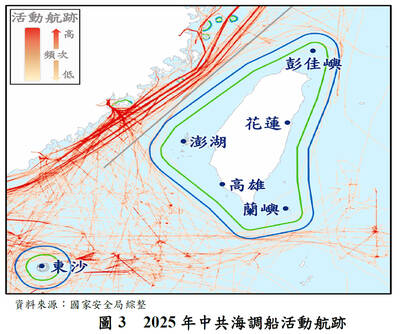
INTENSIFYING THREATS: Beijing’s tactics include massive attacks on the government service network, aircraft and naval vessel incursions and damaging undersea cables China is prepared to interfere in November’s nine-in-one local elections by launching massive attacks on the Taiwanese government’s service network (GSN), a report published by the National Security Bureau showed. The report was submitted to the Legislative Yuan ahead of the bureau’s scheduled briefing at the Foreign Affairs and National Defense Committee tomorrow. The national security team has identified about 13,000 suspicious Internet accounts and 860,000 disputed messages, the bureau said of China’s cognitive warfare against Taiwan. The disputed messages focus on major foreign affairs, national defense and economic issues, which were produced using generative artificial intelligence (AI) and distributed through Chinese

COUNTERING HOSTILITY: The draft bill would require the US to increase diplomatic pressure on China and would impose sanctions on those who sabotage undersea cable networks US lawmakers on Thursday introduced a bipartisan bill to bolster the resilience of Taiwan’s submarine cables to counter China’s hostile activities. The proposal, titled the critical undersea infrastructure resilience initiative act, was cosponsored by Republican representatives Mike Lawler and Greg Stanton, and Democratic Representative Dave Min. US Senators John Curtis and Jacky Rosen also introduced a companion bill in the US Senate, which has passed markup at the chamber’s Committee on Foreign Relations. The House’s version of the bill would prioritize the deployment of sensors to detect disruptions or potential sabotage in real-time and enhance early warning capabilities through global intelligence sharing frameworks,


 RSS
RSS