

A Polish journalist accused Taiwan’s representative office of interfering with the freedom of the press by requesting a Polish media outlet to retract a report on protesters’ occupation of the Executive Yuan.
Having published a series of reports on the occupation of the legislature, the Polish media group Niezalezna — which owns several print and online news outlets in Poland, including the daily Gazeta Polska Codziennie, the weekly Gazeta Polska and the monthly Nowe Panstwo — received a letter from the Taipei Economic and Cultural Bureau in Poland, protesting its use of an analogy between the occupation of the Executive Yuan compound by protesters and the consequent violent crackdown by police and the occupation of the central square, Maidan, in the Ukrainian capital, Kiev, by protesters who were also treated brutally by the police.
While saying that Taiwan is a “robust democracy and the people in Taiwan enjoy a high degree of freedom of speech,” the representative office still requested that an “appropriate retraction can be made to present the current picture of this news story and avoid misunderstanding among people in Poland and Taiwan,” as “making an analogy between a fully fledged democracy and the bloodshed that happened in Ukraine” not only presents a “completely wrong image of Taiwan,” it is also insulting, the letter said.
Hanna Shen, the reporter for the media group who wroted the story, as well as several other stories on the student occupation of the legislature, said she was shocked when she received the letter.
“My newspaper has been publishing articles very critical of the governments of Russia, China and the former Ukrainian government, but we never received any letter from the representative offices of those countries asking us to retract anything,” she told the Taipei Times in a telephone interview in English.
“And those countries can’t be even called democratic,” she added.
“I personally think this letter, as an attempt to influence, to control the way media in free and democratic Poland writes about Taiwan, is not acceptable,” she said.
Shen said that the analogy between Taiwan and Maidan was made by several students taking part in the protest who she interviewed, and that she believed the analogy was suitable after having personally witnessed unarmed students, doctors and journalists being beaten by the police when the government evicted protesters from the Executive Yuan.
“Not to mention that many media outlets around the world — including in Germany and in the US — have also made the same analogy in their reports,” Shen said.
“I wonder if the Taiwanese government has also asked them to retract the analogy,” Shen added.
When asked for a response, Zhang Ming-zhong (張銘忠), director-general of European affairs at the Ministry of Foreign Affairs, said that the ministry’s overseas mission would issue a rebuttal in the event of biased reports.
As for the particular case concerning the Polish journalist’s complaint, Zhang said he is in the midst of contacting the representative office to better understand the matter.
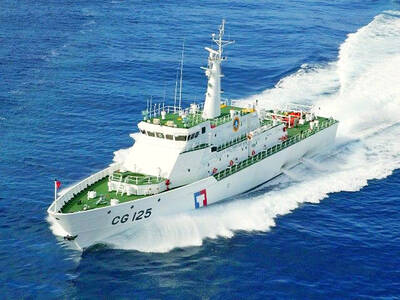
GEOPOLITICAL SIGNIFICANCE: The CGA’s nonmilitary role makes it a tool to avert diplomatic issues, an official said, while confirming the donation of a ship to Manila Coast Guard Administration (CGA) ships are scheduled to sail to the Philippines bearing the words “Taiwan Coast Guard” in a high-profile visit in October next year, the first such visit by a Taiwanese maritime law enforcement vessel to the Southeast Asian nation, the agency said yesterday. The CGA also confirmed that it had donated one of its decommissioned patrol vessels to the Philippines in a rare transfer of a retired ship to a nondiplomatic ally. The Republic of China (ROC) Navy last made such a visit in 1974, shortly before the Philippines switched diplomatic recognition to the People’s Republic of China in
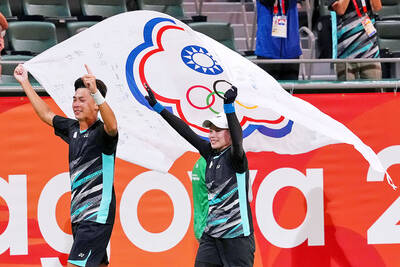
SOFT TENNIS: Yu Kai-wen and Huang Shih-yuan narrowly defeated their Japanese rivals to capture Taiwan’s first gold at the Asian Games in Nagoya Yu Kai-wen (余凱文) and Huang Shih-yuan (黃詩媛) won Taiwan’s first gold of this year’s Asian Games, defeating a Japanese duo in a nail-biter in the soft tennis mixed doubles final in Nagoya, Japan, while Johnny Sun (孫家閎) won silver in wushu and Shih Cheng-chung (石政中) won bronze in men’s kumite. Yu and Huang narrowly defeated Japan’s Toshiki Uematsu and Rena Temma 5-4 (2-4, 5-3, 4-2, 1-4, 1-4, 4-0, 1-4, 4-1, 7-5) to give Taiwan its first gold in soft tennis mixed doubles at an Asian Games since 2018. Sun secured Taiwan’s first wushu medal at this year’s game, with a combined score
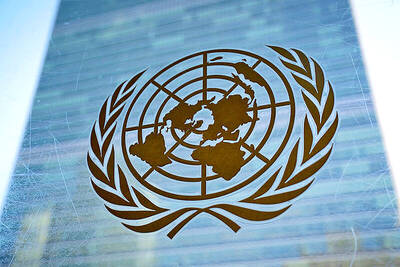
CALL FOR CHANGE: They urged the UN to facilitate Taiwan’s involvement in the body, recognize its peace efforts and to work with members in preventing military conflict Representatives to the UN from five of Taiwan’s diplomatic allies sent a joint letter to UN Secretary-General Antonio Guterres on Friday, calling for the country’s inclusion in the body. Allies in the letter sent ahead of the 81st session of the UN General Assembly General Debate made three demands in support of Taiwan: inclusion, recognition and camaraderie. They implored the UN to seek an appropriate way to facilitate Taiwan’s meaningful involvement in the world governing body, saying that UN Resolution 2758, which accepted the People’s Republic of China (PRC) as a member of the UN, does not exclude Taiwan. Beijing claims that the
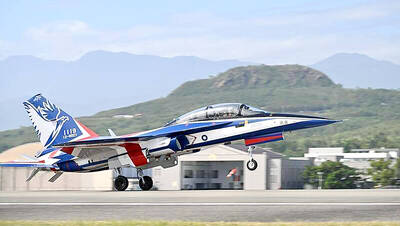
Aerospace Industrial Development Corp (AIDC, 漢翔航空工業) has finished production of the nation’s T-5 Brave Eagle (勇鷹) advanced jet trainers, with the final aircraft scheduled to be formally delivered at a ceremony on Thursday. The delivery of the trainer jets marks the end of the program, which dates back to 2017, with the first prototypes completed in 2019. Fifty-six of the 66 trainers had been delivered as of May. The Brave Eagle was developed and produced by AIDC and the National Chungshan Institute of Science and Technology. The program has provided a foundation for the development of a domestically produced next-generation primary trainer and


 RSS
RSS