


A group of presidents from 52 universities on Friday issued a joint statement calling on President Ma Ying-jeou (馬英九) to respond to student-led protesters’ demands as the standoff between them and the Ma administration over the cross-strait trade service pact continued.
In the statement, the 52-member Associations of National Universities of Taiwan urged Ma to engage in student protest leaders organizing a sit-in at the Legislative Yuan in Taipei in dialogue as soon as possible to defuse the row.
Association director-general Yang Hung-duen (楊弘敦), who heads National Sun Yat-sen University, said that while the president should face up to the protest and talk to the students, the latter also need to remain rational and calm while making their concerns heard.
The Association of National Universities of Science and Technology and the Association of Private Universities and Colleges of Technology also voiced their support for the anti-service trade pact activists, with National Taipei University of Technology President Yao Leeh-ter (姚立德) saying that students’ passion and concerns have been expressed clearly and he believes the Legislative and Executive yuans would reassess the possibility of renegotiating the agreement with China.
However, Yao also asked the students to return to their classrooms and give the legislative floor back to the lawmakers, saying that restoring the operation of the democratic institution it is ultimately the best course of action.
The associations’ statements were followed by another issued by National Taiwan University’s Math Department that also urged the head of state to hold a summit with the students, but was unequivocally supportive of the legislative occupation.
As of the time of its issuance, 25 of the 34 math professors at the National Taiwan University department had signed the statement declaring their support for the protesting students, it said.
The statement added that the professors stand with the students and the public, and support their right to oversee the government and the legitimacy of the demonstrators’ actions.
“We are not against the signing of the service trade agreement per se, since we do live in a world being swept by globalization, but the signing and review processes must be transparent and executed with due process. This is why we support what the students are demanding, which is rejecting any agreement signed ‘in a black box,’” it said.
The professors emphasized that the younger generation are the ones who will be most affected by the pact, so they have the right to voice concerns about, question and supervise how it is singed.
The statement also slammed remarks made earlier by a high-ranking Ministry of Economic Affairs official, who described the agreement as “beneficial to the students because after its implementation, they can work in China and earn NT$52,000 a month, rather than [the] NT$22,000 [they would make in Taiwan].”
“Is sending our educated youth to China for work the government’s only solution for the nation’s low wage and wealth gap problems?” the math academics asked.
Also expressing its unwavering supportive of the students was the National Alliance of Parents Organization, which issued a statement yesterday afternoon calling for dialogue and praising the students’ civic consciousness.
The alliance said that it is deeply worried about the students’ safety, but at the same time “immensely proud” of them.
“The government said you have been instigated to commit ‘irrational violence’ ... but we know that you are autonomous and exercising your civic consciousness. What the students are protesting against is the retreat of democracy forced by a legislative body no longer representing people’s will,” it said.
“Our parents were worried when we stood up against authoritarian rule 30 years ago… Today, we as parents also worry that the protesters’ safety might be at risk. So we demand that the government start a dialogue with the protestors soon and promise that it will not use force to evict the students from the legislature, as well as acquiesce to the demonstrators’ requests for just, democratic procedures,” the parental alliance said.

A signaling system malfunction disrupted high-speed rail (HSR) services beginning at 8am today, with trains temporarily reduced to three northbound and three southbound trains per hour as authorities conduct inspections. The malfunction occurred on a section of track in Miaoli County during pre-operation checks early this morning, forcing northbound and southbound trains to use a single track, the HSR operator said. The regular schedule has been replaced with three hourly trains offering only nonreserved seating in each direction, stopping at every station, it said, adding that business class cars would still have reserved seating. Departures from terminal stations are scheduled at the top

DRONE CENTRAL: Taiwan aims to become Asia’s democratic hub for drones, with most exports focused on high-quality military-grade models, an official said Taiwan’s drone industry is expected to expand significantly by 2030, producing 100,000 units per month and exporting half of them, the Ministry of Economic Affairs said yesterday. Current drone production capacity is about 15,000 units per month, but the industry can quickly scale up as demand increases, Industrial Development Administration Director-General Chiou Chyou-huey (邱求慧) told a news conference in Taipei. Taiwan’s drone output grew 2.5-fold last year to NT$12.9 billion (US$408.3 million) under a government program to develop the uncrewed vehicle sector, he said. The Executive Yuan in October last year approved plans to invest NT$44.2 billion into domestic production of uncrewed aerial

VERBOSE VESSELS: A CGA cutter and a China Coast Guard exchanged verbal barbs for more than a day in Taiwanese-controlled waters before the Chinese vessel left The Taiwanese and Chinese coast guards had a standoff near the strategically located Pratas Islands (Dongsha Islands, 東沙群島) in the north of the South China Sea, the Coast Guard Administration (CGA) said yesterday. The two sides engaged in intense radio exchanges over sovereignty claims during the 33-hour standoff. China Coast Guard vessel 3501 eventually left the restricted waters, 26.6 nautical miles (49.2km) west of the Pratas Islands, at 5pm yesterday, the CGA said. Lying approximately between southern Taiwan and Hong Kong, the Taiwan-controlled Pratas are seen by some security experts as vulnerable to Chinese attack due to their distance — more than
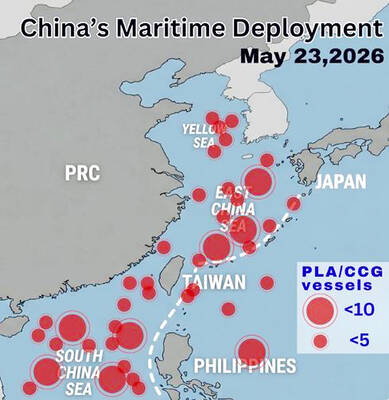
WARNING: China should stop engaging in actions that undermine regional peace and stability, as it would only build resentment among people across the Strait, the CGA said China has deployed more than 100 navy, coast guard and other vessels in waters from the Yellow Sea to the South China Sea and the western Pacific since US President Donald Trump and Chinese President Xi Jinping (習近平) met in Beijing, National Security Council Secretary-General Joseph Wu (吳釗燮) said yesterday. “In this part of the world, #China is the one & only PROBLEM wrecking the #StatusQuo & threatening regional peace & stability,” Wu wrote on X. In a separate post, he said Beijing was coercing Taiwan’s maritime domain, calling it illegal and provocative, after the Coast Guard Administration (CGA) expelled a


 RSS
RSS