


Decisions being taken in Washington on the US Navy’s budget could affect the likelihood or outcome of a conflict with China over Taiwan, a new study from the Congressional Research Service says.
“Some observers consider such a conflict to be very unlikely, in part because of significant US-Chinese economic linkages and the tremendous damage that such a conflict could cause on both sides,” specialist in naval affairs Ronald O’Rourke said in the study, titled China Naval Modernization: Implications for US Navy Capabilities.
O’Rourke’s study says that Beijing wants its military to be capable of acting as an anti-access and area-denial force — “a force that can deter US intervention in a conflict in China’s near-seas region over Taiwan.”
According to the study, China’s naval modernization has several aims, but “addressing the situation with Taiwan militarily, if need be,” is its first goal.
“Decisions that [the US] Congress and the executive branch make regarding US Navy programs for countering improved Chinese maritime capabilities could affect the likelihood or possible outcome of a potential US-Chinese military conflict in the Pacific over Taiwan,” the study read.
O’Rourke cites US Naval Institute reports saying that China is developing new unmanned underwater vehicles and has modernized its substantial inventory of mines.
He also quotes the US Department of Defense as saying that “China has developed torpedo and mine systems capable of area denial in a Taiwan [conflict] scenario.”
According to the department, “estimates of China’s naval mine inventory exceed 50,000 mines, with many capable systems developed in the past 10 years,” O’Rourke’s study says.
“Although aircraft carriers might have some value for China in Taiwan-related conflict scenarios, they are not considered critical for Chinese operations in such scenarios because Taiwan is within range of land-based Chinese aircraft,” it adds.
It says that larger amphibious ships such as the Type 071 and the Type 081 would be valuable in the conduct of amphibious landings in Taiwan, although other observers say Beijing is building them to defend its territorial claims in the East China and South China seas.
In his study, O’Rourke quotes the department as saying that the People’s Liberation Army Navy “currently lacks the massive amphibious lift capability that a large-scale invasion of Taiwan would require.”
It says Beijing does not appear to be building the conventional amphibious lift required to support such a campaign, adding that “China’s navy exhibits limitations or weaknesses in several areas, including antisubmarine warfare and mine countermeasures.”
“Countering China’s naval modernization might thus involve actions to exploit such limitations and weaknesses, such as developing and procuring Virginia class attack submarines, torpedoes, unmanned underwater vehicles and mines,” the report says.
The study suggests that Congress consider whether in the coming years, the US Navy will be large enough to counter improved Chinese anti-access forces.
It also raised questions about the political and security implications that China’s growing naval capabilities — combined with the budget-driven reductions in the size of the US Navy — may have on the Asia-Pacific region.

‘NO SECURITY RISK’: The Railway Bureau reassured the public that the technicians’ activities were limited to technical guidance and did not involve sensitive systems The Railway Bureau yesterday said it had invited eight Chinese technicians to assist with an airport MRT construction project. The bureau issued the confirmation after an Internet user said Chinese nationals had entered the construction zone of Taiwan Taoyuan International Airport’s Terminal 3 project. They asked why “individuals from an enemy state” were allowed access to such a major national infrastructure project, which raised serious concerns over Taiwan’s industrial safety, sensitive systems and information security. The bureau’s Northern Region Engineering Branch Office said subcontractor Taiwan Handle Industrial Co (台灣手把工業) of the Taoyuan airport MRT’s “Contract No. CU05 Project A14 Station Civil, MEP &

A US uncrewed surface vessel (USV) encountered multiple Chinese warships during an autonomous transit of the Taiwan Strait, US defense company Seasats said in a statement on Wednesday. Seasats announced that a Lightfish USV had completed the first autonomous transit of the Taiwan Strait. Over five days, the USV traversed the entire length of the Strait while constantly monitoring surface vessel traffic, the company said. The Lightfish encountered multiple Chinese warships, one of which was a Chinese People’s Liberation Army Navy (PLAN) Type 056 corvette, it said. The Chinese vessels were operating “well within Taiwan’s exclusive economic zone without transmitting their identity via the
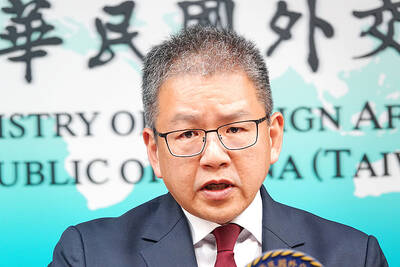
Taiwan is still in the process of assessing the possibility of recruiting workers from Eswatini, the Ministry of Foreign Affairs said yesterday, adding that its goal is to help Eswatini upgrade its vocational training centers. If there are plans to recruit workers from Eswatini, safeguarding national security, protecting public health and ensuring the employment rights of Taiwanese would be prerequisites, Department of West Asian and African Affairs Director-General Yen Chia-liang (顏嘉良) told a news conference. Key considerations would also include filling labor shortages in specific industries, and fostering bilateral professional and technical exchanges, he said. Yen was asked about the progress of labor
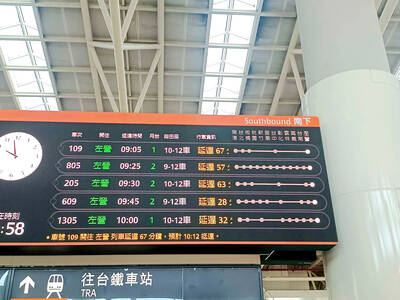
The nation’s usually punctual high-speed rail system yesterday was hit by major disruptions after all scheduled services were canceled and replaced with three hourly trains offering only non-reserved seating, affecting more than 200,000 passengers. Preliminary findings indicate the disruption was caused by a faulty power module in a track switch control cabinet, Taiwan High-Speed Rail Corp (THSRC) said, adding that as a full system inspection could only be conducted after operations end for the day, a decision on whether normal service would resume today would be announced before the first train departs. During a routine inspection early yesterday, a switch signal abnormality


 RSS
RSS