


There is plenty of “room for imagination” about a proposed summit between the leaders of China and Taiwan, including the possibility of holding the meeting in a “third location (第三地),” China’s Association for Relations Across the Taiwan Straits (ARATS) Vice Chairman Sun Yafu (孫亞夫) said yesterday.
On where such a summit might be held, Beijing’s position is “for the two sides of the Strait to find a place” for the meeting, Sun told the Chinese-language United Daily News in an interview in Beijing.
That was the position of China’s Taiwan Affairs Office Minister Zhang Zhijun (張志軍), Sun said, adding that Zhang’s remarks were misinterpreted by some news media in Taiwan.
Zhang did not mean to say the summit should be held either in China or Taiwan, Sun said.
It is “too narrow” to read it that way, Sun said.
When asked whether Zhang meant that while Beijing has ruled out holding the meeting in an international setting, it could be held in a place other than China or Taiwan, such as Singapore, Sun said: “Yes. That’s it.”
The first high-level meeting between Taiwan and China took place in Singapore in April 1993, when then-ARATS chairman Wang Daohan (汪道涵) held talks with his Taiwanese counterpart, Straits Exchange Foundation chairman Koo Chen-fu (辜振甫).
There has been much speculation about President Ma Ying-jeou (馬英九) meeting Chinese President Xi Jinping (習近平) to improve relations between the two sides.
It has been mooted that such a meeting could be held at the APEC leaders’ summit in Beijing later this year, but China has been cool to the idea, worried that Ma’s appearance at the international gathering would suggest Taiwan’s sovereignty.
China has consistently blocked Taiwan’s presidents from attending APEC meetings, forcing them to send envoys instead.
In the interview, Sun seemed to attach additional conditions to a Ma-Xi meeting, saying that in addition to a suitable venue, “we also need to think about the purpose of a top meeting, what problems it is to resolve and what topics will be on the agenda.”
“If the purpose of the meeting is to seek development in cross-strait relations, rather than just to shake hands, and if we plan a full program for our leaders’ meeting, then the room for imagination can be even bigger,” he said.
Sun gave the interview as he prepared to attend the Chinese People’s Political Consultative Conference as a member of the advisory body.
In response, Taiwan’s Mainland Affairs Council said that Taipei’s position remains the same: that the annual APEC forum offered the most appropriate setting for a Ma-Xi meeting.
Democratic Progressive Party spokesman Lin Chun-hsien (林俊憲) said Ma should brief the Taiwanese public on any issues relating to a Ma-Xi meeting, “as the president represents the country and must uphold Taiwan’s sovereignty.”
“What’s the definition of a ‘third location? Does it mean a third country or a cross-strait third territory, such as Hong Kong or Macau?” Lin asked.
He said the Ma administration should conduct cross-strait affairs in a transparent manner.
Additional reporting by Lee Hsin-fang

‘NO SECURITY RISK’: The Railway Bureau reassured the public that the technicians’ activities were limited to technical guidance and did not involve sensitive systems The Railway Bureau yesterday said it had invited eight Chinese technicians to assist with an airport MRT construction project. The bureau issued the confirmation after an Internet user said Chinese nationals had entered the construction zone of Taiwan Taoyuan International Airport’s Terminal 3 project. They asked why “individuals from an enemy state” were allowed access to such a major national infrastructure project, which raised serious concerns over Taiwan’s industrial safety, sensitive systems and information security. The bureau’s Northern Region Engineering Branch Office said subcontractor Taiwan Handle Industrial Co (台灣手把工業) of the Taoyuan airport MRT’s “Contract No. CU05 Project A14 Station Civil, MEP &

A US uncrewed surface vessel (USV) encountered multiple Chinese warships during an autonomous transit of the Taiwan Strait, US defense company Seasats said in a statement on Wednesday. Seasats announced that a Lightfish USV had completed the first autonomous transit of the Taiwan Strait. Over five days, the USV traversed the entire length of the Strait while constantly monitoring surface vessel traffic, the company said. The Lightfish encountered multiple Chinese warships, one of which was a Chinese People’s Liberation Army Navy (PLAN) Type 056 corvette, it said. The Chinese vessels were operating “well within Taiwan’s exclusive economic zone without transmitting their identity via the

Taiwan is still in the process of assessing the possibility of recruiting workers from Eswatini, the Ministry of Foreign Affairs said yesterday, adding that its goal is to help Eswatini upgrade its vocational training centers. If there are plans to recruit workers from Eswatini, safeguarding national security, protecting public health and ensuring the employment rights of Taiwanese would be prerequisites, Department of West Asian and African Affairs Director-General Yen Chia-liang (顏嘉良) told a news conference. Key considerations would also include filling labor shortages in specific industries, and fostering bilateral professional and technical exchanges, he said. Yen was asked about the progress of labor
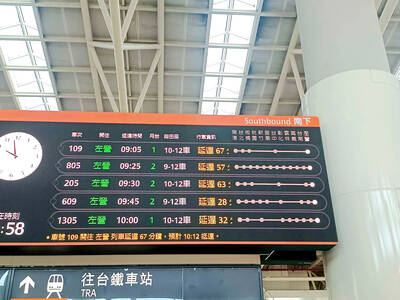
The nation’s usually punctual high-speed rail system yesterday was hit by major disruptions after all scheduled services were canceled and replaced with three hourly trains offering only non-reserved seating, affecting more than 200,000 passengers. Preliminary findings indicate the disruption was caused by a faulty power module in a track switch control cabinet, Taiwan High-Speed Rail Corp (THSRC) said, adding that as a full system inspection could only be conducted after operations end for the day, a decision on whether normal service would resume today would be announced before the first train departs. During a routine inspection early yesterday, a switch signal abnormality


 RSS
RSS