


US President Barack Obama was to host the Dalai Lama yesterday at the White House over the stern objection of China, which warned the meeting would “inflict grave damages” on the US’ relationship with the Asian powerhouse.
Obama was to greet the Tibetan spiritual leader and fellow Nobel laureate, who is in the US on a speaking tour. The White House did not announce the meeting until late Thursday, prompting a gruff complaint from Beijing in what has become something of a diplomatic ritual whenever Obama meets with the exiled Buddhist monk.
Urging Obama to cancel the meeting, Beijing accused the US president of letting the Dalai Lama use the White House as a podium to promote anti-Chinese activities.
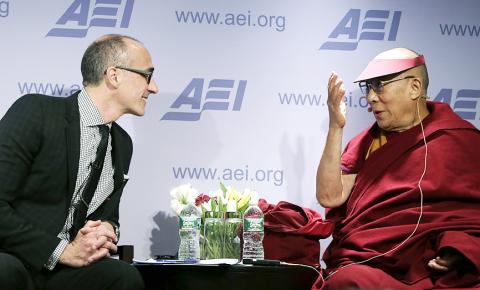
Photo: Reuters
“The US leader’s planned meeting with Dalai is a gross interference in China’s domestic politics,” said Hua Chunying (華春瑩), a spokeswoman for China’s Ministry of Foreign Affairs. “It is a severe violation of the principles of international relations. It will inflict grave damages upon the China-US relationship.”
Beijing routinely protests when world leaders grant an audience to the Dalai Lama, including when Obama met with him in 2010 and again in 2011. Chinese officials denounce the Dalai Lama as a separatist responsible for instigating self-immolations by Tibetans inside China, but he is widely respected around the world for his advocacy of peace and tolerance.
Obama was to host the Dalai Lama in the White House’s Map Room, rather than the Oval Office, where the president traditionally brings a visiting leader for a round of photographs. The private meeting, closed to reporters, suggested an attempt to avoid the appearance of a formal meeting between two heads of state.
The US had no immediate response to the rebuke from China.
However, in announcing the meeting earlier on Thursday, the White House said Obama was meeting with the Dalai Lama in his capacity as a cultural and religious leader.
As if to indicate an overreaction had been expected, officials reiterated that the US recognizes Tibet as part of China and does not support Tibetan independence.
“The United States supports the Dalai Lama’s ‘Middle Way’ approach of neither assimilation nor independence for Tibetans in China,” said Caitlin Hayden, a spokeswoman for the White House’s National Security Council.
She added that presidents of both parties have met with the Dalai Lama for decades.
At the same time, officials said they were concerned about tensions and deteriorating human rights in China’s Tibetan areas, urging Beijing to resume talks with the Dalai Lama or his followers without preconditions.

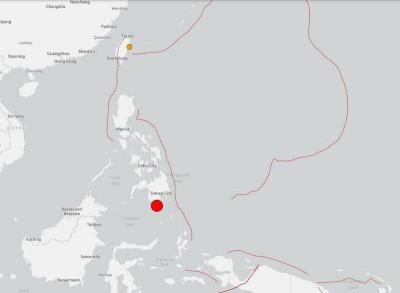
A magnitude 7.8 earthquake struck off the southern coast of Mindanao in the Philippines at 7:38am today, prompting the US Tsunami Warning System to issue an alert for neighboring countries, including Taiwan. The system issued a purple alert indicating a "tsunami threat." The potential threat zone includes Taiwan, the Philippines, Papua New Guinea, Yap and Palau. There were no immediate reports of major damage in the Philippines or Indonesia. The quake struck at a depth of 10km, said the German Research Centre for Geosciences, which had earlier pegged the earthquake at magnitude 8.2. Phivolcs, the Philippine agency, said the quake was magnitude 7 and

RESILIENCE: Taiwan plays a key role in semiconductors, energy, information infrastructure and advanced manufacturing, AIT Director Raymond Greene said Taiwan’s continued investment in deterrence and resilience remains vital, especially in uncrewed systems and other emerging technologies, American Institute in Taiwan (AIT) Director Raymond Greene said yesterday. Greene made the remarks at the annual National Strategic Summit on Supply Chain Resilience held by the Research Institute for Democracy, Society and Emerging Technology (DSET), a government-backed think tank. As Taiwan last year became the US’ fourth-largest trading partner and supply chain security is becoming more important, cooperation in emerging technologies continues to deepen between the two countries, he said. The US is committed to accelerating innovation, building key infrastructure, strengthening cooperation

The National Chungshan Institute of Science and Technology yesterday showcased its locally developed variants of the Vision 60 robotic patrol dog, which it plans to deploy on the nation’s outlying territories in the South China Sea. The variants were produced under the Joint Lab project — created by the institute and domestic companies — and assembled with domestically produced motors, lenses and artificial intelligence (AI) systems alongside licensed tech from the US, Missile and Rocket Systems Research Division deputy director Jen Kuo-kang (任國光) told the media event at a military base in Taipei’s Dazhi (大直) area. Taiwan has built up its strengths

RIGHT DIRECTION: Taiwan’s efforts to prevent forced labor include a proposal to ‘fully prohibit’ employers from withholding workers’ documents, an official said Taiwan is to establish a mechanism to restrict imports of goods linked to forced labor, the Executive Yuan said yesterday, after the US proposed imposing additional tariffs on Taiwanese goods over labor concerns. “The Ministry of Labor and the Ministry of Economic Affairs are to establish an interministerial review procedure,” Executive Yuan spokesperson Michelle Lee (李慧芝) said at a news briefing in Taipei. “The government is to use the Foreign Trade Act [貿易法] as the legal basis to restrict imports of goods produced with forced labor” and bring its supply chain governance more in line with international standards on human rights, resilience


 RSS
RSS