


Opposition protesters yesterday blocked voting at thousands of polling stations in Thailand, triggering angry scenes in the capital over an election that plunged the strife-racked kingdom into political limbo.
Despite weeks of mass street demonstrations aimed at forcing her from office, Thai Prime Minister Yingluck Shinawatra was widely expected to extend her billionaire family’s decade-long winning streak at the ballot box.
However, widespread disruption to voting meant that the results are not expected for weeks at least.
Moreover, few believe the polls will end the political turmoil that has plagued the kingdom since her elder brother, former Thai prime minister Thaksin Shinawatra, was ousted in a military coup in 2006.
Yingluck’s opponents say she is a mere puppet for the ousted leader, a hugely controversial figure who lives in Dubai to avoid prison for a corruption conviction.
The main opposition Democrat Party, which boycotted the vote, said it was gathering legal evidence to seek an annulment of the election.
About 10,000 out of nearly 94,000 polling stations were unable to open, according to the Election Commission, affecting millions of people, although it was unclear how many had planned to vote.
An angry crowd gathered outside one voting center in the Bangkok district of Din Daeng, holding their ID cards in the air and chanting “Vote! Vote!” before storming inside.
They later filed complaints with police about the blockade.
“I came to vote, but they have denied my rights,” said Praneet Tabtimtong, 57, clutching a large wooden club. “I am begging them to let me vote.”
The disruption means that even if Yingluck wins, she will remain in a caretaker role with limited power over government policy until elections are held in the troubled areas, because there will not be enough lawmakers to convene parliament.
“Normally even if one polling station is blocked we cannot announce the result,” Election Commission member Somchai Srisutthiyakorn said. “As long as there are protests and no negotiation, then parliament cannot open.”
Experts say a protracted period of political uncertainty and possible street violence could set the scene for a military or judicial coup. The army chief has repeatedly refused to rule out seizing power, while Yingluck is under investigation by an anti-corruption panel.
At least 10 people have been killed and hundreds injured in clashes, grenade attacks and drive-by shootings since the opposition rallies began, with victims on both sides.
Tensions were running high after a dramatic gun battle between rival protesters on the streets of the capital on the eve of the election that left at least seven people wounded, but there were no reports of serious violence on election day by the time polls closed.
The demonstrators want Yingluck to step down and make way for an unelected “people’s council” to oversee reforms to tackle corruption and alleged vote-buying.
In many parts of the south, a stronghold of the anti-government movement, protesters stopped post offices from distributing ballot sheets and boxes.
Sunai Phasuk, a senior researcher with New York-based Human Rights Watch, accused the demonstrators of “thuggery and intimidation.”
However, in the government’s heartland in north and northeast Thailand, as well as some areas of the capital, voting went ahead without major disruption in a boost to Yingluck’s hopes of re-election.
“I did my duty today as I came to vote — it’s my right,” said Pui, 43, who cast his ballot at a polling station in Bangkok’s historic district where a handful of police watched over voters.
Authorities said about 130,000 police were deployed around the country for the vote, but with tens of thousands of polling stations, many had only a light security presence.

The National Chungshan Institute of Science and Technology yesterday showcased its locally developed variants of the Vision 60 robotic patrol dog, which it plans to deploy on the nation’s outlying territories in the South China Sea. The variants were produced under the Joint Lab project — created by the institute and domestic companies — and assembled with domestically produced motors, lenses and artificial intelligence (AI) systems alongside licensed tech from the US, Missile and Rocket Systems Research Division deputy director Jen Kuo-kang (任國光) told the media event at a military base in Taipei’s Dazhi (大直) area. Taiwan has built up its strengths

RIGHT DIRECTION: Taiwan’s efforts to prevent forced labor include a proposal to ‘fully prohibit’ employers from withholding workers’ documents, an official said Taiwan is to establish a mechanism to restrict imports of goods linked to forced labor, the Executive Yuan said yesterday, after the US proposed imposing additional tariffs on Taiwanese goods over labor concerns. “The Ministry of Labor and the Ministry of Economic Affairs are to establish an interministerial review procedure,” Executive Yuan spokesperson Michelle Lee (李慧芝) said at a news briefing in Taipei. “The government is to use the Foreign Trade Act [貿易法] as the legal basis to restrict imports of goods produced with forced labor” and bring its supply chain governance more in line with international standards on human rights, resilience

NOT IMMEDIATE: Taiwan has a chance to appeal the proposed 10 percent tariff before it starts, while other countries face a 12.5 percent tariff from the trade office Taiwan is among 60 economies determined by the US to have failed to impose or enforce a ban on the importation of goods produced with forced labor, according to a notice released on Tuesday by the Office of the US Trade Representative (USTR), which proposed imposing an additional 10 percent or more tariff on them. The USTR in a statement said that following an investigation, it had determined under Section 301 of the Trade Act of 1974 that the failure of the 60 economies to impose and effectively enforce a prohibition on the importation of goods produced with forced labor is
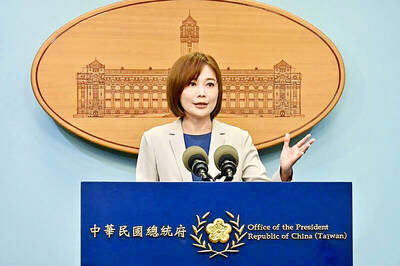
TIT-FOR-TAT: The US allegedly revoked the visa of a Chinese national working at Xinhua News Agency in the US in response to Beijing’s expulsion of Vivian Wang The Presidential Office yesterday condemned China for expelling a New York Times correspondent from Beijing following the newspaper’s interview with President William Lai (賴清德), saying the move highlighted Beijing’s suppression of press freedom and its threat to international news media. Taiwan has noted a series of recent incidents in which Beijing used similar tactics to “threaten and pressure international media outlets and journalists,” Presidential Office spokeswoman Karen Kuo (郭雅慧) said in a statement. “This concerns not only press freedom and freedom of expression, but also the safety of journalists, and Taiwan and relevant partners are paying close attention to the situation,” she


 RSS
RSS