


Mainland Affairs Council (MAC) Minister Wang Yu-chi (王郁琦) announced yesterday that he is to meet with his Chinese counterpart, China’s Taiwan Affairs Office (TAO) Director Zhang Zhijung (張志軍), in Nanking, China, on Feb. 11, and said political issues would not be on the agenda of their talks.
During their meeting, Chang and Wang will address cross-strait issues and seek to improve mutual understanding between the two sides, Wang said.
The officials are not scheduled to discuss cross-strait political issues or other sensitive topics such as human rights, he said.
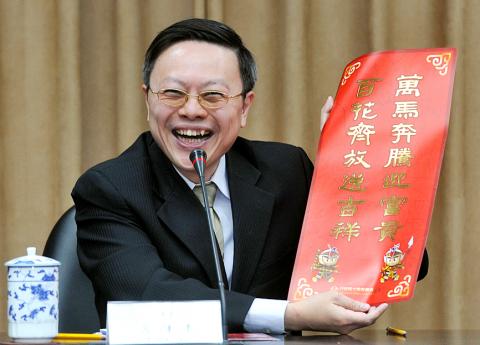
Photo: Chien Jung-fong, Taipei Times
“The trip aims to promote regular interactions between the MAC and the TAO, and deepen mutual understanding. I think it’s better to make this meeting simple,” Wang told a press conference at the council’s offices.
According to the Chinese-language United Daily News, Chinese authorities have imposed many restrictions on the topics that will be addressed at the meeting between Wang and Zhang.
Beijing has stipulated a number of requirements for Wang’s visit, including that no talks be held on political matters, Taiwan’s national title — “the Republic of China” (ROC) — and no mention is made of terms such as “freedom,” “democracy,” “rule of law” or “president,” the United Daily News quoted an unnamed source as saying.
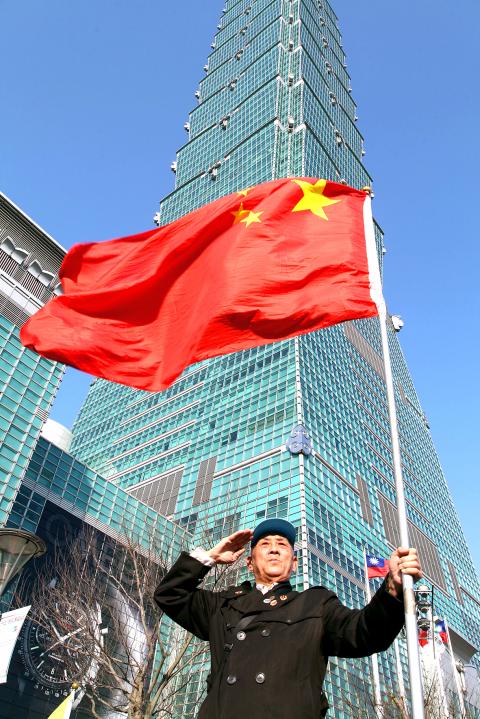
Photo: EPA
Wang yesterday did not confirm whether China demanded that sensitive terms, including the ROC and the minister’s official title, should not be mentioned during his meeting with Zhang, but insisted that the MAC will defend the nation’s sovereignty.
“I will say what I need to say on appropriate occasions. Please wait and see… However, I will be disappointed if the TAO does not address me using my official title,” he said.
The Wang-Zhang meeting will be the first official meeting in 65 years between top officials from both sides of the Strait.
Wang and Zhang first met in October last year when they sat in on a meeting between former vice president Vincent Siew (蕭萬長) and Chinese President Xi Jinping (習近平) on the sidelines of an APEC meeting in Bali, Indonesia.
Topics on the agenda for the Wang-Zhang meeting will include a communication mechanism between the two governments, the creation of representative offices on either side of the Taiwan Strait, regional economic integration and Taiwanese students’ health insurance policies when studying in China.
Wang dismissed concerns that his meeting with Zhang would pave the way for President Ma Ying-jeou (馬英九) to meet with Chinese President Xi Jinping (習近平), and said the visit aimed to enhance communication between the MAC and the TAO.
Wang is scheduled to depart for China on Feb. 11 and return to Taiwan on Feb. 14.
He is to meet with Zhang in Nanjing on Feb. 11, and visit the mausoleum of Sun Yat-sen (孫逸仙), the founding father of the ROC, on Feb. 12.
He is to travel to Shanghai on Feb. 13 and meet with local think tanks before returning to Taiwan on Feb. 14.
The Democratic Progressive Party (DPP) yesterday warned Wang against touching upon “unnecessary political issues” during his upcoming trip.
“Wang should have a perfect understanding of what he should and should not raise during his visit based on three principles: protection of Taiwan’s sovereignty, transparency and legislative monitoring,” said Joseph Wu (吳釗燮), executive director of the DPP’s Policy Research Committee.
What Wang should be discussing with Zhang includes human rights and freedom, renegotiation of the cross-strait service trade agreement, implementation of the joint fight against crime and a mutual legal assistance agreement, as well as an investment protection agreement, Wu said.
Issues with political implications and sensitivity, including the “one China” principle, a termination of hostility, a peace agreement, a military confidence-building mechanism as well as unification or a political arrangement prior to eventual unification should not be raised, Wu said.
Wu also called on the Chinese government to release all imprisoned rights activists, naming in particular Xu Zhiyong (許志永), who was sentenced to four years in prison on Sunday, before the Lunar New Year holiday if Beijing is sincere in showing the international community that it adheres to universal values.
Additional reporting by CNA
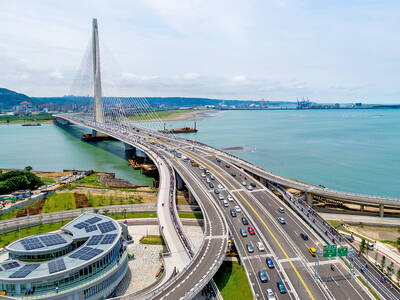
The Ministry of Transportation and Communications yesterday inaugurated the Danjiang Bridge across the Tamsui River in New Taipei City, saying that the structure would be an architectural icon and traffic artery for Taiwan. Feted as a major engineering achievement, the Danjiang Bridge is 920m long, 211m tall at the top of its pylon, and is the longest single-pylon asymmetric cable-stayed bridge in the world, the government’s Web site for the structure said. It was designed by late Iraqi-British architect Zaha Hadid. The structure, with a maximum deck of 70m, accommodates road and light rail traffic, and affords a 200m navigation channel for boats,
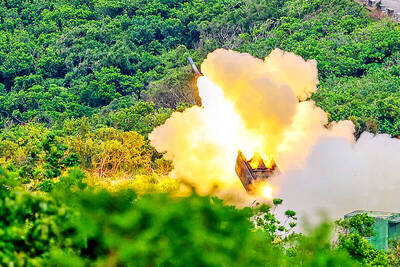
PRECISION STRIKES: The most significant reason to deploy HIMARS to outlying islands is to establish a ‘dead zone’ that the PLA would not dare enter, a source said A High Mobility Artillery Rocket System (HIMARS) would be deployed to Penghu County and Dongyin Island (東引) in Lienchiang County (Matsu) to force the Chinese military to retreat at least 100km from the coastline, a military source said yesterday. Taiwan has been procuring HIMARS and Army Tactical Missile Systems (ATACMS) from the US in batches. Once all batches have been delivered, Taiwan would possess 111 HIMARS units and 504 ATACMS, which have a range of 300km. Considering that “offense is the best defense,” the military plans to forward-deploy the systems to outlying islands such as Penghu and Dongyin so that
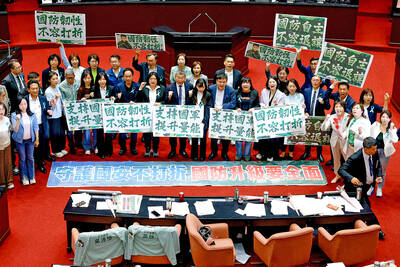
WHAT WAS ALL THAT FOR? Jaw Shaw-kong said that Cheng Li-wen had pushed for more drastic cuts and attacked him, just for the outcome to be nearly identical to his bill The legislature yesterday passed a supplementary budget bill to fund the purchase of separate packages of US military equipment, with the combined amount of spending capped at NT$780 billion (US$24.8 billion). The Chinese Nationalist Party (KMT) and Taiwan People’s Party (TPP) used their legislative majority to pass the bill, which runs until 2033 and has two main funding provisions. One was for NT$300 billion of arms sales already approved by the US for Taiwan on Dec. 17 last year, the other was for NT$480 billion for another arms package expected to be announced by Washington. The bill, which fell short of the NT$1.25
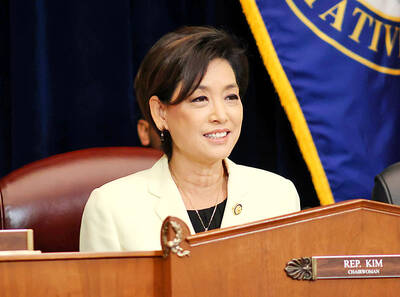
‘CLEAR MESSAGE’: The bill would set up an interagency ‘tiger team’ to review sanctions tools and other economic options to help deter any Chinese aggression toward Taiwan US Representative Young Kim has introduced a bill to deter Chinese aggression against Taiwan, calling for an interagency “tiger team” to preplan coordinated sanctions and economic measures in response to possible Chinese military or political action against Taiwan. “[Chinese President] Xi Jinping [習近平] has directed the People’s Liberation Army to be ready to invade Taiwan by 2027. China has a plan. America should have one too,” Kim said in a news release on Thursday last week. She introduced the “Deter PRC [People’s Republic of China] aggression against Taiwan act” to “ensure the US has a coordinated sanctions strategy ready should


 RSS
RSS