


The world’s first state-licensed marijuana retailers legally permitted to sell pot for recreational use to the general public opened for business in Colorado on Wednesday with long lines of customers, marking a new chapter in the US’ drug culture.
About three dozen former medical marijuana dispensaries newly cleared by state regulators to sell pot to consumers who are interested in nothing more than its mind and mood-altering properties began welcoming customers as early as 8am.
The highly anticipated New Year’s Day opening launched an unprecedented commercial cannabis market that Colorado officials expect will ultimately gross US$578 million in annual revenues, including US$67 million in tax receipts for the state.

Photo: AFP
Possession, cultivation and private personal consumption of marijuana by adults for the sake of just getting high has already been legal in Colorado for more than a year under a state constitutional amendment approved by voters. However, as of Wednesday, cannabis was being legally produced, sold and taxed in a system modeled after a regime many states have in place for alcohol sales — but which exists for marijuana nowhere in the world outside of Colorado.
Scores of customers lined up in the cold and snow outside at least two Denver-area stores on Wednesday morning to wait for doors to open.
“I wanted to be one of the first to buy pot and no longer be prosecuted for it. This end of prohibition is long overdue,” said Jesse Phillips, 32, an assembly-line worker who was the day’s first patron at Botana Care in the Denver suburb of Northglenn.
He had camped outside the shop since 1am.
A cheer from about 100 fellow customers waiting in line to buy went up as Phillips made his purchase, an eighth-of-an-ounce (3.5g) sampler pack containing four strains of weed — labeled with names such as “King Tut Kush” and “Gypsy Girl” — that sold for US$45, including tax.
He also bought a child-proof carry pouch that is required by state regulations to transport his purchase out of the store.
Robin Hackett, 51, co-owner of Botana Care, said before the opening that she expected between 800 and 1,000 first-day customers, and hired a private security firm to help with any traffic and parking issues that might arise.
Voters in Washington State voted to legalize marijuana at the same time Colorado did, in November 2012, but Washington is not slated to open its first retail establishments until later this year.
Supporters and detractors alike see the states as embarking on an experiment that could mark the beginning of the end for marijuana prohibition at the national level.
“By legalizing marijuana, Colorado has stopped the needless and racially biased enforcement of marijuana prohibition laws,” said Ezekiel Edwards, director of the American Civil Liberties Union’s Criminal Law Reform Project.
Cannabis remains classified as an illegal narcotic under US federal law, though US President Barack Obama’s administration has said it will give states leeway.
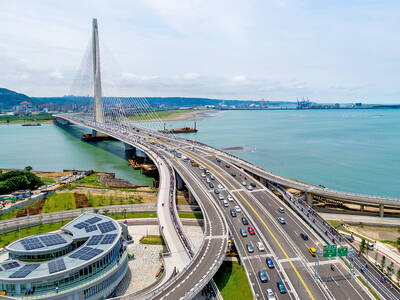
The Ministry of Transportation and Communications yesterday inaugurated the Danjiang Bridge across the Tamsui River in New Taipei City, saying that the structure would be an architectural icon and traffic artery for Taiwan. Feted as a major engineering achievement, the Danjiang Bridge is 920m long, 211m tall at the top of its pylon, and is the longest single-pylon asymmetric cable-stayed bridge in the world, the government’s Web site for the structure said. It was designed by late Iraqi-British architect Zaha Hadid. The structure, with a maximum deck of 70m, accommodates road and light rail traffic, and affords a 200m navigation channel for boats,
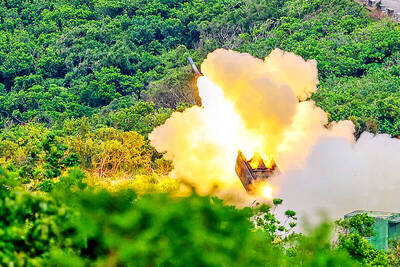
PRECISION STRIKES: The most significant reason to deploy HIMARS to outlying islands is to establish a ‘dead zone’ that the PLA would not dare enter, a source said A High Mobility Artillery Rocket System (HIMARS) would be deployed to Penghu County and Dongyin Island (東引) in Lienchiang County (Matsu) to force the Chinese military to retreat at least 100km from the coastline, a military source said yesterday. Taiwan has been procuring HIMARS and Army Tactical Missile Systems (ATACMS) from the US in batches. Once all batches have been delivered, Taiwan would possess 111 HIMARS units and 504 ATACMS, which have a range of 300km. Considering that “offense is the best defense,” the military plans to forward-deploy the systems to outlying islands such as Penghu and Dongyin so that

Taiwan Semiconductor Manufacturing Co (TSMC, 台積電), the world’s largest foundry service provider, yesterday said that global semiconductor revenue is projected to hit US$1.5 trillion in 2030, after the figure exceeds US$1 trillion this year, as artificial intelligence (AI) demand boosts consumption of token and compute power. “We are still at the beginning of the AI revolution, but we already see a significant impact across the whole semiconductor ecosystem,” TSMC deputy cochief operating officer Kevin Zhang (張曉強) said at the company’s annual technology symposium in Hsinchu City. “It is fair to say that in the past decade, smartphones and other mobile devices were

‘CLEAR MESSAGE’: The bill would set up an interagency ‘tiger team’ to review sanctions tools and other economic options to help deter any Chinese aggression toward Taiwan US Representative Young Kim has introduced a bill to deter Chinese aggression against Taiwan, calling for an interagency “tiger team” to preplan coordinated sanctions and economic measures in response to possible Chinese military or political action against Taiwan. “[Chinese President] Xi Jinping [習近平] has directed the People’s Liberation Army to be ready to invade Taiwan by 2027. China has a plan. America should have one too,” Kim said in a news release on Thursday last week. She introduced the “Deter PRC [People’s Republic of China] aggression against Taiwan act” to “ensure the US has a coordinated sanctions strategy ready should


 RSS
RSS