

Keeping a mostly low profile as a US fugitive in Moscow, former US National Security Agency (NSA) contractor Edward Snowden has suddenly resurfaced in the media, saying he is confident his personal “mission is already accomplished” and he has “already won” after leaking NSA secrets. The challenge now, he believes, is to stress the importance of privacy and urge an end to mass government surveillance.
Snowden gave a more than 14-hour interview to the Washington Post, which said it is the first he has conducted in person since arriving in the Russian capital in June. He followed that up by speaking directly to the British public in a televised message that was to be broadcast yesterday as an alternative to Queen Elizabeth II’s annual Christmas speech.
Snowden told the Post he was satisfied because journalists have been able to tell the story of the US government’s collection of bulk Internet and telephone records, an activity that has grown dramatically since the terror attacks on Sept. 11, 2001.
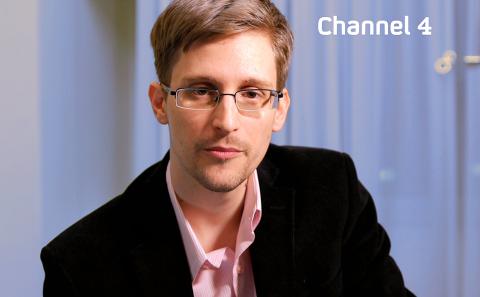
Photo: AFP
“For me, in terms of personal satisfaction, the mission’s already accomplished,” he said in the interview, which was published online. “I already won.”
“As soon as the journalists were able to work, everything that I had been trying to do was validated,” Snowden told the Post. “Because, remember, I didn’t want to change society. I wanted to give society a chance to determine if it should change itself.”
Snowden also gave an insight into his life in Russia, suggesting that he is not getting out much by being “an indoor cat.”
He then explained why he believes mass surveillance by governments is wrong.
“The conversation occurring today will determine the amount of trust we can place both in the technology that surrounds us and the government that regulates it,” he said, according to excerpts from the message released by the UK’s Channel 4.
“Together we can find a better balance, end mass surveillance and remind the government that if it really wants to know how we feel, asking is always cheaper than spying,” Snowden said.
The queen delivers Britain’s Royal Christmas Message, but Channel 4 has used its annual alternative version to give a platform to people as diverse as then-Iranian president Mahmoud Ahmedinejad in 2008, and fictional characters including Ali G and Marge Simpson in 1999 and 2004 respectively.
In his UK message, Snowden called modern surveillance more invasive than any envisioned by 1984 author George Orwell, saying that children today would grow up without knowing what it means to have an unrecorded or private moment.
“That’s a problem because privacy matters, privacy is what allows us to determine who we are and who we want to be,” he said.
Snowden, now 30, said he is not being disloyal to the US or to his former employer.
“I am not trying to bring down the NSA, I am working to improve the NSA,” he said. “I am still working for the NSA right now. They are the only ones who don’t realize it.”
Snowden was interviewed by the Post in Moscow over two days by reporter Barton Gellman, who has received numerous leaks from Snowden. The interview was conducted six months after Snowden’s revelations first appeared in the Post and the Guardian newspaper.
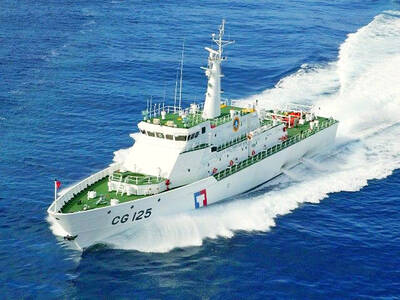
GEOPOLITICAL SIGNIFICANCE: The CGA’s nonmilitary role makes it a tool to avert diplomatic issues, an official said, while confirming the donation of a ship to Manila Coast Guard Administration (CGA) ships are scheduled to sail to the Philippines bearing the words “Taiwan Coast Guard” in a high-profile visit in October next year, the first such visit by a Taiwanese maritime law enforcement vessel to the Southeast Asian nation, the agency said yesterday. The CGA also confirmed that it had donated one of its decommissioned patrol vessels to the Philippines in a rare transfer of a retired ship to a nondiplomatic ally. The Republic of China (ROC) Navy last made such a visit in 1974, shortly before the Philippines switched diplomatic recognition to the People’s Republic of China in

SOFT TENNIS: Yu Kai-wen and Huang Shih-yuan narrowly defeated their Japanese rivals to capture Taiwan’s first gold at the Asian Games in Nagoya Yu Kai-wen (余凱文) and Huang Shih-yuan (黃詩媛) won Taiwan’s first gold of this year’s Asian Games, defeating a Japanese duo in a nail-biter in the soft tennis mixed doubles final in Nagoya, Japan, while Johnny Sun (孫家閎) won silver in wushu and Shih Cheng-chung (石政中) won bronze in men’s kumite. Yu and Huang narrowly defeated Japan’s Toshiki Uematsu and Rena Temma 5-4 (2-4, 5-3, 4-2, 1-4, 1-4, 4-0, 1-4, 4-1, 7-5) to give Taiwan its first gold in soft tennis mixed doubles at an Asian Games since 2018. Sun secured Taiwan’s first wushu medal at this year’s game, with a combined score
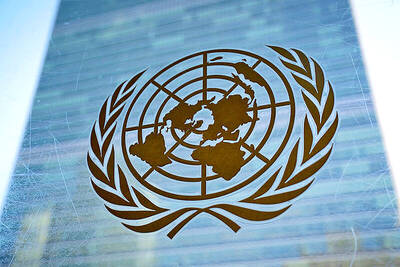
CALL FOR CHANGE: They urged the UN to facilitate Taiwan’s involvement in the body, recognize its peace efforts and to work with members in preventing military conflict Representatives to the UN from five of Taiwan’s diplomatic allies sent a joint letter to UN Secretary-General Antonio Guterres on Friday, calling for the country’s inclusion in the body. Allies in the letter sent ahead of the 81st session of the UN General Assembly General Debate made three demands in support of Taiwan: inclusion, recognition and camaraderie. They implored the UN to seek an appropriate way to facilitate Taiwan’s meaningful involvement in the world governing body, saying that UN Resolution 2758, which accepted the People’s Republic of China (PRC) as a member of the UN, does not exclude Taiwan. Beijing claims that the
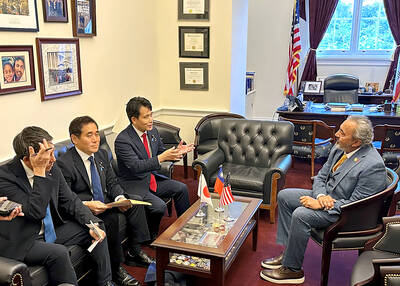
WASHINGTON MEETING: Japan’s Hirofumi Takinami said participants rejected the idea that the US should limit its defensive perimeter to the Second Island Chain US and Japanese lawmakers agree that the US must defend the First Island Chain, including Taiwan, and should not fall back to the Second Island Chain, while “a Taiwan contingency is a Japan contingency and therefore a US-Japan alliance contingency,” media reported after a meeting between officials of the two nations in Washington on Tuesday. A delegation of Japanese lawmakers from the Liberal Democratic Party met with US Senator Thom Tillis, co-chair of the Senate Taiwan Caucus, and US Representative Ami Bera, co-chair of the US Congressional Taiwan caucus, to discuss issues concerning East Asia and the Taiwan Strait. The Japanese and


 RSS
RSS