


The US-China Economic and Security Review Commission has recommended that the US Congress keep a closer eye on US arms sales to Taiwan. It also wants the White House to report to Congress on every decision to “reject, delay or alter” arms sales requests from Taipei.
The recommendations are contained in a draft copy of the commission’s annual report, which is to be released later this month.
While the report could still be changed, it is unlikely that the formal conclusions will be altered at this stage. The section of the report dealing with Taiwan contains eight recommendations from the congressionally appointed commission.
It recommends that Congress amend the US National Defense Authorization Act to direct the Pentagon to include more information about Taiwan in its annual report, including “detailed assessments” of the nation’s military’s current and probable future strategies, force structures, capabilities and technology development.
It also recommends the White House give Congress unclassified details of each of Taiwan’s requests to purchase US weapons and describe Taiwan’s justification for each request, as well as the administration’s response.
The commission wants Congress to direct the US Department of State to provide an unclassified report that explains how the department’s approach to diplomatic relations with Taiwan is affected by the nation’s “unique status.”
“The report should address how these constraints and restraints impact the US’ ability to carry out the rebalance to Asia,” the commission said.
The commission also recommended Congress encourage the White House to continue discussion between Taiwan and the US concerning a bilateral investment agreement.
Once the Trans-Pacific Partnership trade deal is signed, Congress should support Taiwan’s membership, and Cabinet-level US officials should be encouraged to visit Taiwan to promote commercial, technical and people-to-people exchanges, it said.
The commission said Congress should permit official travel to Taiwan by senior State Department and Pentagon officials and Congress should require anyone appointed to be director of the American Institute in Taiwan to be confirmed by the Senate.
It is a list of potentially significant changes in the relationship that could bring the two countries closer, it said.
While gathering information for its report, the commission met with Taiwanese officials in Washington and Taipei, and held talks with President Ma Ying-jeou (馬英九) in July.
“The opposition DPP [Democratic Progressive Party] has increased engagement with the US to repair perceived damage to bilateral ties and to rebrand the party’s image as a ‘responsible’ alternative to the ruling KMT [Chinese Nationalist Party],” the report said.
“Since the late 1990s, China’s military modernization has focused on improving its capabilities for Taiwan conflict scenarios that include US intervention,” the report added.
“The key shortcoming in Taiwan’s defensive capabilities is its inability to survive initial Chinese air and missile strikes due to insufficient infrastructure hardening and lack of mobile systems,” the report said.

‘NO SECURITY RISK’: The Railway Bureau reassured the public that the technicians’ activities were limited to technical guidance and did not involve sensitive systems The Railway Bureau yesterday said it had invited eight Chinese technicians to assist with an airport MRT construction project. The bureau issued the confirmation after an Internet user said Chinese nationals had entered the construction zone of Taiwan Taoyuan International Airport’s Terminal 3 project. They asked why “individuals from an enemy state” were allowed access to such a major national infrastructure project, which raised serious concerns over Taiwan’s industrial safety, sensitive systems and information security. The bureau’s Northern Region Engineering Branch Office said subcontractor Taiwan Handle Industrial Co (台灣手把工業) of the Taoyuan airport MRT’s “Contract No. CU05 Project A14 Station Civil, MEP &

A US uncrewed surface vessel (USV) encountered multiple Chinese warships during an autonomous transit of the Taiwan Strait, US defense company Seasats said in a statement on Wednesday. Seasats announced that a Lightfish USV had completed the first autonomous transit of the Taiwan Strait. Over five days, the USV traversed the entire length of the Strait while constantly monitoring surface vessel traffic, the company said. The Lightfish encountered multiple Chinese warships, one of which was a Chinese People’s Liberation Army Navy (PLAN) Type 056 corvette, it said. The Chinese vessels were operating “well within Taiwan’s exclusive economic zone without transmitting their identity via the

Taiwan is still in the process of assessing the possibility of recruiting workers from Eswatini, the Ministry of Foreign Affairs said yesterday, adding that its goal is to help Eswatini upgrade its vocational training centers. If there are plans to recruit workers from Eswatini, safeguarding national security, protecting public health and ensuring the employment rights of Taiwanese would be prerequisites, Department of West Asian and African Affairs Director-General Yen Chia-liang (顏嘉良) told a news conference. Key considerations would also include filling labor shortages in specific industries, and fostering bilateral professional and technical exchanges, he said. Yen was asked about the progress of labor
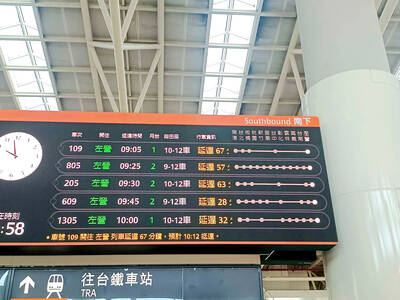
The nation’s usually punctual high-speed rail system yesterday was hit by major disruptions after all scheduled services were canceled and replaced with three hourly trains offering only non-reserved seating, affecting more than 200,000 passengers. Preliminary findings indicate the disruption was caused by a faulty power module in a track switch control cabinet, Taiwan High-Speed Rail Corp (THSRC) said, adding that as a full system inspection could only be conducted after operations end for the day, a decision on whether normal service would resume today would be announced before the first train departs. During a routine inspection early yesterday, a switch signal abnormality


 RSS
RSS