


Japan is putting missiles on islands marking the gateway to the Pacific, officials said yesterday, as part of a huge military drill that has unsettled Beijing.
The exercise, aimed at bolstering Japan’s defense of remote islands, has already seen a launching system and a loader for Type-88 surface-to-ship missiles installed on Miyako Island, complete with two missiles.
Four more missiles were due to arrive on the main island of Okinawa later yesterday. It was not clear how long they would remain in place.
“This is the first time” that missile systems have been taken to Miyako, a spokesman for Japan’s Joint Staff of the Self Defense Forces said, adding that the missiles could not be fired in their present state.
“The drill is designed for the defense of islands,” he said.
While the Japanese military makes no secret of the fact these missiles are not operable, observers say their deployment serves to remind anyone watching of Japan’s capabilities.
The Self Defense Forces began their 18 days of war games on Nov. 1, with 34,000 military personnel, six vessels and 360 aircraft.
The exercise comes amid growing nervousness in Japan and other parts of Asia over China’s surging military might, which has seen it expand its naval reach into the Pacific Ocean as it squabbles with Tokyo over the ownership of islands in the East China Sea.
Beijing also has separate disputes with numerous countries over competing claims in the South China Sea. It claims most of the sea as its territory.
Chinese naval assets stationed in the north of the country are somewhat hemmed in by the chain of Japanese islands that separate the East China Sea and the Pacific. The strait between Miyako and the main island of Okinawa offers one of the few direct access points to the ocean.
The Japanese drill would bring the roughly 300km stretch between the main Okinawa Island and Miyako under the missiles’ presumed range, Japanese media reported.
Tokyo has said the drill is not aimed at any specific nation, but Japanese leaders have openly expressed disquiet as China escalates its territorial claims.
The Self Defense Forces are also preparing to form a special amphibious unit, much like the US Marine Corps, whose remit would be to defend small islands and recapture them in case of enemy attacks.
Beijing has routinely sent government vessels to disputed islands in the East China Sea, staging dangerous face-offs between the two nations’ coast guards.
In the latest incident, four Chinese coastguard vessels yesterday entered territorial waters off one of the Tokyo-controlled Senkaku Islands — also known as the Diaoyutais (釣魚台) and claimed by Taiwan and China. They remained for about 90 minutes, Japanese coast guards said.
The ongoing Japanese drill has irritated Beijing, where local media said there was no doubt it was aimed at China.
The Global Times newspaper reported on its front page yesterday that Japan’s decision to take the missiles to Miyako was “an unprecedented move that experts say is targeted at blocking the Chinese navy.”
“The missile deployment is mainly set against China and it can pose real threats to the Chinese navy,” Li Jie, an expert on China’s navy, told the paper.

The Tourism Administration yesterday announced that it would reward repeat international visitors with incentives of up to NT$8,000 to boost inbound tourism. The incentives are available to all international tourists, it said, adding that repeat visitors would be rewarded with NT$5,000 and would receive an additional NT$3,000 if they bring travel companions. The nation received 2,990,657 inbound visitors during the first quarter, marking a 3.8 percent increase from the same period last year, agency data showed. Japanese nationals are among groups visiting Taiwan the most. About 1.48 million Japanese tourists arrived last year, a year-on-year increase of more than 12
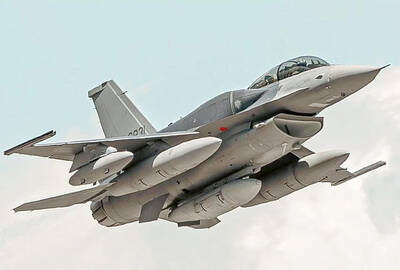
66 FIGHTER JETS: The aircraft is likely undergoing preparations for its transfer to Taiwan — a significant step forward in the nation’s modernization program, a lawmaker said The first of Taiwan’s order of F-16V Block 70 aircraft has been sighted in Texas ahead of delivery, Democratic Progressive Party (DPP) Legislator Wang Ting-yu (王定宇) said. Taiwan’s first F-16V Block 70 two-seat aircraft, tail number 6831, was seen flying from Lockheed Martin’s production facility in Greenville, South Carolina, to Naval Air Station Joint Reserve Base Fort Worth in Texas, Wang wrote on Facebook yesterday. The plane is likely undergoing preparations for its transfer to Taiwan, marking a significant step forward in the Republic of China Air Force’s modernization program, Wang said, citing military analysts. The F-16V Block 70 is a new-build version
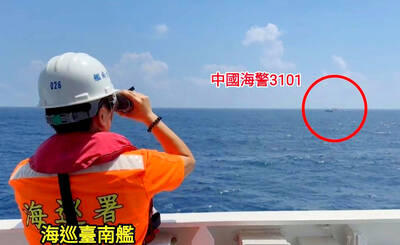
‘BRAZEN’: The holiday did not stop China from activities that infringe on Taiwan’s maritime jurisdiction, but the CGA is ready to defend the nation, Kuan Bi-ling said Beijing is intensifying maritime pressure on Taiwan, but the nation will never yield, Ocean Affairs Council Deputy Minister Sung Chen-en (宋承恩) said. The Coast Guard Administration (CGA) has adopted a “shadowing and monitoring” approach to avoid falling into a Chinese trap to escalate tensions and deepen the conflict, Sung said in an interview published yesterday in the Chinese-language Liberty Times (the Taipei Times’ sister newspaper). China Coast Guard formations patrolling waters east of Taiwan, as well as official Chinese vessels entering areas around Itu Aba Island (Taiping Island, 太平島) and Pratas Islands (Dongsha Islands, 東沙群島) show Beijing’s attempts to significantly step up
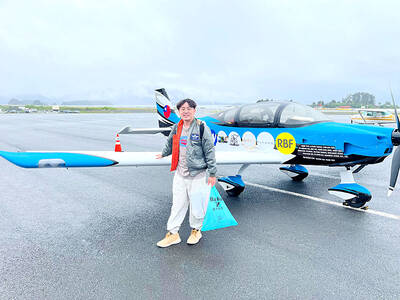
Taiwanese aviator Roger Lin (林睿哲) returned to Taiwan on Saturday after completing a nine-day round-the-world journey in a single-engine aircraft, becoming the first Taiwanese pilot to achieve the feat. Lin departed on June 5 from Los Angeles, California, and continued through Alaska, Japan, Taiwan, the Philippines, Indonesia, Malaysia, Thailand, Nepal, Jordan, Norway, Iceland and Canada before landing at the Taipei International Airport (Songshan) via Los Angeles and Japan. Lin shared numerous photos and videos of his journey on a Facebook page titled “Pilot Roger’s Around the World Flight,” including a video showing his aircraft flying over the Danjiang Bridge and


 RSS
RSS