

The Ministry of Foreign Affairs (MOFA) is negotiating with the International Civil Aviation Organization (ICAO) over its denial of media accreditation to Taiwanese journalists because of the UN’s “one China” policy, a ministry official said yesterday.
“We are taking this very seriously. We will make use of every possible means to solve the problem,” Department of International Organizations Director-General Kelly Hsieh (謝武樵) said in response to questions at a regular news briefing.
Hsieh declined to go into details when asked whether the ministry has gained some ground in the negotiations since the UN-affiliated agency cited its adherence to the UN’s “one China” policy in its rejection of requests for media accreditation by Taiwanese journalists based in Washington.
Since the 38th ICAO General Assembly is due to start on Tuesday in Montreal, Canada, “we understand that it’s a matter of urgency” to assist Taiwanese media outlets in making arrangements to cover the event, Hsieh said.
“We have been holding dialogues with concerned parties using various channels so that the ICAO can provide media access to as many Taiwanese reporters intending to cover the event,” he added.
Taiwan received an invitation to attend the triennial event as a guest of ICAO Council president Roberto Kobeh Gonzalez on Thursday last week. It will be the first time Taiwan will participate in the assembly since the nation lost its UN seat to the People’s Republic of China in 1971.
On the same day, Taiwanese reporters based in Washington received a reply from the ICAO rejecting their request for media accrediation to cover the event.
The Chinese-language Liberty Times (the Taipei Times’ sister newspaper) reported that the ICAO said that it follows the “one China” policy adopted by the UN and therefore it is not permitted to issue media credentials to Taiwanese media outlets as long as the policy stands.
The Association of Taiwan Journalists issued a statement on Friday last week demanding that the ICAO treat journalists from all countries equally and refrain from infringing upon the freedom of press for the sake of politics.
That the ICAO declined to allow access to Taiwanese journalists is an infringement of their right to gather news and information and goes against the universal democratic norm of freedom of the press, the association said.
It demanded that the ministry write a letter to the ICAO asking that Taiwanese journalists be treated on the same footing as those from other countries and be granted media credentials immediately.
While the ministry gave extensive publicity to Taiwan’s invitation to the event, it did not say anything about Taiwanese journalists being denied credentials, the statement said.
The association said the ministry had belittled itself by dancing to Beijing’s “one China” tune, while being indifferent to the trampling of the rights of Taiwanese journalists.
However, the ministry said it remained hopeful that Taiwan would be able to expand its participation in the ICAO.
The invitation to attend the assembly as a special guest fell short of Taiwan’s hopes of being given observer status at the triennial assembly.
Being granted “observer status is still our goal,” Hsieh said.
“This [invitation] was just the first step in our bid for meaningful participation in the ICAO,” Hsieh said, adding that Taiwan would continue to seek participation in other ICAO-related meetings, such as technical and regional meetings that do not require observer status.
Taiwan has sought to participate in the ICAO, which promotes safe and efficient air travel, as an observer since 2009 to achieve its goal of “professional, pragmatic, dignified and meaningful” participation, the ministry said.
While gaining admission as an observer is hard, as is the case for the ICAO assembly, Taiwan can accept other special arrangements to achieve the goal of meaningful participation in the agency, the ministry said.
For a non-UN member state to gain observer status, it needs the support of four-fifths of ICAO members, a barrier that has proved too high to scale considering the clout of China, which frequently opposes Taiwan’s participation in the international community.
Civil Aeronautics Administration Director-General Jean Shen (沈啟) will lead a delegation to the Montreal meeting using the designation “Chinese Taipei,” Hsieh said.
Taiwan has sought international support for its bid to participate in the ICAO to help promote international civil aviation safety and the orderly development of global aviation services, the ministry said.
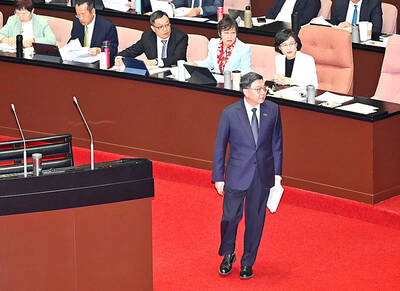
The government is monitoring online rumors that a pneumonic plague outbreak has spread from Russia into China, and it might enhance quarantine measures, Premier Cho Jung-tai (卓榮泰) said yesterday. During a legislative meeting, Democratic Progressive Party Legislator Wang Ting-yu (王定宇) said that rumors had circulated that the disease had spread across several Chinese provinces. He asked Cho whether the government was prepared to prevent the disease spreading to Taiwan, given the volume of traffic between the two sides, and how concerned the government was about the alleged outbreak. The Ministry of Health and Welfare had implemented border quarantine measures after briefing the Executive
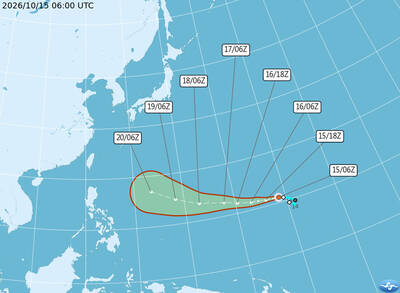
EAST OF GUAM: Tropical Storm Champi is forecast to strengthen into a typhoon, but its effect on Taiwan is uncertain due to the presence of a high-pressure system Tropical Storm Champi formed yesterday and has the potential to increase in strength, the Central Weather Administration (CWA) said yesterday. Forecasters are closely monitoring a Pacific high-pressure system that would dictate whether the storm turns north or moves toward Taiwan next week, the CWA said. The most likely scenario is that it turns northward after passing the Ryukyu Islands, CWA forecaster Cheng Chieh-jen (鄭傑仁) said. As of 8pm yesterday, Champi was east of Guam moving west-northwest at 20kph, CWA data showed. It had maximum sustained winds near the center of 72kph and gusts of up to 101kph, the data showed. If the Pacific high-pressure system
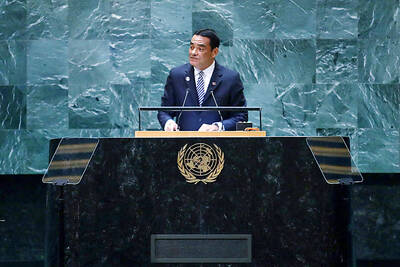
RIGHT TO DIPLOMACY: Under the UN Charter, every state has the right to conduct foreign policy free from external pressure, Belize said in a statement Belize and Paraguay on Monday condemned Beijing sanctions over their countries’ ties with Taiwan, saying China’s actions create unnecessary tensions. Earlier on Monday, Beijing announced sanctions against Paraguayan Minister of Information and Communication Technologies Gustavo Villate and Belizean Minister of Foreign Affairs Francis Fonseca. The Paraguayan Ministry of Foreign Affairs said it rejected the sanctions, writing on X that they created unnecessary friction. It added that it reaffirmed its support for Taiwan and its commitment to democratic values and principles. Villate told the Spanish-language Paraguayan daily ABC Color the sanctions were “predictable” and linked them to several cooperation projects between Taiwan and Paraguay. The projects
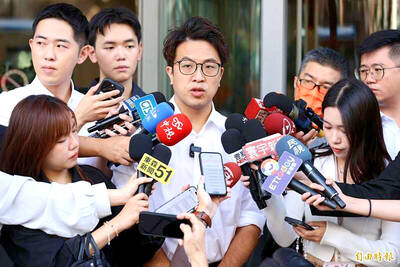
Sanctions imposed by China’s Taiwan Affairs Office (TAO) on a firm owned by Democratic Progressive Party (DPP) Legislator Puma Shen’s (沈伯洋) father are an egregious attempt to pressure Taiwanese society and interfere with Taiwan’s democratic elections, the Mainland Affairs Council (MAC) said yesterday. Hong Kong’s Ta Kung Pao (大公報) and Wen Wei Po (文匯報) on Tuesday reported that VWAY Co — a company owned by Shen’s father, Shen Tu-cheng (沈土城) — was still earning money in China after Sicuens International Co (兆億), also owned by Shen Tu-cheng, was sanctioned in June last year. VWAY trade totaled about US$700,000 in about 10 months


 RSS
RSS