


A survey conducted by the Democratic Progressive Party (DPP) found that more than 60 percent of workers in the industries covered by the new cross-strait service trade agreement were unaware that their sectors have been liberalized.
The DPP’s poll center surveyed five categories of people in the service industry: business owners, high earning white-collar workers, low earning white-collar workers, high earning blue-collar workers and low earning blue-collar workers.
The poll results are a grave concern, DPP spokesperson Wang Min-sheng (王閔生) told a press conference yesterday, because 62.6 percent of respondents mistakenly assumed that their industry were not included on the list of 64 Taiwanese industries that would be open to Chinese investments.
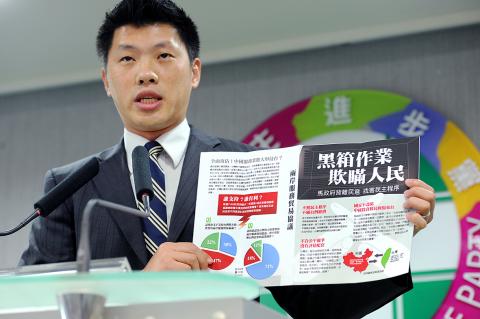
Photo: Lo Pei-der, Taipei Times
Only 24.7 percent of small business owners knew that their industry would be opened to Chinese investments, while 57.6 percent falsely assumed their industry remained protected, the poll showed.
The percentage of those unaware of potential challenges from Chinese investment was surprisingly high, with 58.9 percent of high earning white-collar workers, 58.1 percent of low earning white-collar workers, 70.6 percent of high earning blue-collar workers and 75 percent of low earning blue-collar workers not knowing their sectors would be liberalized.
“It seemed to us that most people in the service trade industry, which accounts for 60 percent of the total workforce, or 5 million people, and more than 70 percent of Taiwan’s GDP, have no idea about the potential impact of the agreement due to the government’s intentional deception and concealment,” Wang said.
Two officials from the Ministry of Economic Affairs surprised the DPP by showing up for the news conference to take notes. The pair, both ministry legislative liaison personnel, only identified themselves after being asked by party officials.
“While the DPP has always prided itself on its transparency and accessibility and welcomes communication with the government, we would like to receive prior notice from government officials planning to attend our press conferences,” Wang said.
The DPP survey, conducted from Tuesday to Thursday last week, collected 1,184 valid samples and had a margin of error of 2.91 percentage points.
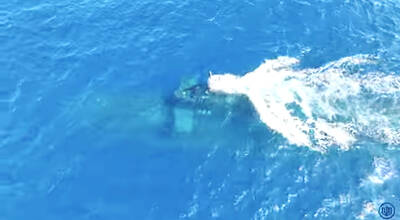
CSBC Corp, Taiwan (台灣國際造船) yesterday released the first video documenting the submerged sea trials of Taiwan’s indigenous defense submarine prototype, the Hai Kun (海鯤), or Narwhal, showing underwater navigation and the launch of countermeasures. The footage shows the vessel’s first dive, steering and control system tests, and the raising and lowering of the periscope and antenna masts. It offered a rare look at the progress in the submarine’s sea acceptance tests. The Hai Kun carried out its first shallow-water diving trial late last month and has since completed four submerged tests, CSBC said. The newly released video compiles images recorded from Jan. 29 to
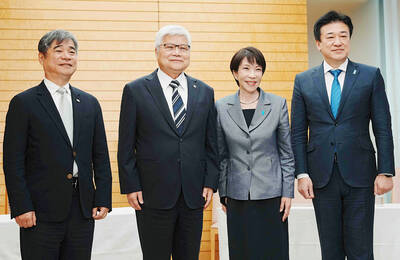
Taiwan Semiconductor Manufacturing Co (TSMC, 台積電) plans to make advanced 3-nanometer chips in Japan, stepping up its semiconductor manufacturing roadmap in the country in a triumph for Japanese Prime Minister Sanae Takaichi’s technology ambitions. TSMC is to adopt cutting-edge technology for its second wafer fab in Kumamoto, company chairman C.C. Wei (魏哲家) said yesterday. That is an upgrade from an original blueprint to produce 7-nanometer chips by late next year, people familiar with the matter said. TSMC began mass production at its first plant in Japan’s Kumamoto in late 2024. Its second fab, which is still under construction, was originally focused on
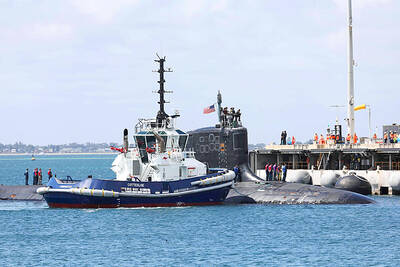
DETERRENCE EFFORTS: Washington and partners hope demonstrations of force would convince Beijing that military action against Taiwan would carry high costs The US is considering using HMAS Stirling in Western Australia as a forward base to strengthen its naval posture in a potential conflict with China, particularly over Taiwan, the Wall Street Journal reported on Saturday. As part of its Indo-Pacific strategy, Washington plans to deploy up to four nuclear-powered submarines at Stirling starting in 2027, providing a base near potential hot spots such as Taiwan and the South China Sea. The move also aims to enhance military integration with Pacific allies under the Australia-UK-US trilateral security partnership, the report said. Currently, US submarines operate from Guam, but the island could
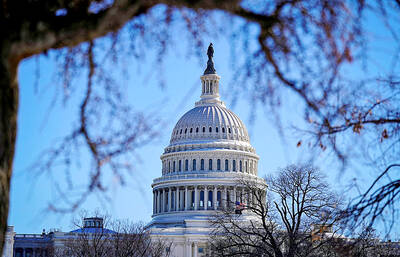
RESTRAINTS: Should China’s actions pose any threat to Taiwan’s security, economic or social systems, China would be excluded from major financial institutions, the bill says The US House of Representatives on Monday passed the PROTECT Taiwan Act, which states that Washington would exclude China from participating in major global financial organizations if its actions directly threaten Taiwan’s security. The bill, proposed by Republican Representative Frank Lucas, passed with 395 votes in favor and two against. It stipulates that if China’s actions pose any threat to Taiwan’s security, economic or social systems, the US would, “to the maximum extent practicable,” exclude Beijing from international financial institutions, including the G20, the Bank for International Settlements and the Financial Stability Board. The bill makes it clear that China must be prepared


 RSS
RSS