


Rejecting the term “Taiwan” as the nation’s name, former premier Hau Pei-tsun (郝柏村) said yesterday that Taiwan is not an independent, sovereign nation and that unification between Taiwan and China would eventually happen.
The assertions “Taiwan is already an independent country named the Republic of China (ROC)” and “the ROC is Taiwan” are both forms of “self-depreciation,” Hau said when addressing a forum organized by the government-funded Taiwan Foundation for Democracy (TFD).
Hau said this kind of rhetoric was a “politically motivated tactic” aimed at “fooling voters.”
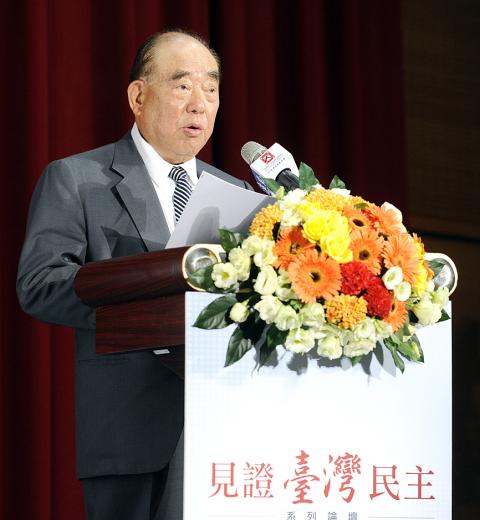
Photo: George Tsorng, Taipei Times
“They represented a step backward for democracy and have become major obstacles to the quality of the nation’s democracy,” he said.
“Former US secretary of state Colin Powell had made it clear [when he was] in China that Taiwan is not an independent, sovereign country,” Hsu said.
However, no one in the world would say that the ROC is not a sovereign country, he added.
Hau was referring to a statement made by Powell during an interview with Phoenix TV on Oct. 25, 2004, in Beijing saying that “Our [the US’] policy is clear. There is only one China. Taiwan is not independent. It does not enjoy sovereignty as a nation, and that remains our policy, our firm policy.”
The state department later explained that Powell had misspoken and said that there had been no change in US policy toward Taiwan.
Hau was the fourth speaker invited to address the “Witness Taiwan Democracy” series forum, following former president Lee Teng-hui (李登輝), former vice president Vincent Siew (蕭萬長) and vice president Annette Lu (呂秀蓮).
In his speech, the 95-year-old Hau expressed his wish that leaders of younger generations will devote themselves to improving the quality of democracy in Taiwan, saying that democracy gives Taiwan an advantage over China to advance the peace process with China and to bring about cross-strait unification.
“There is no democratic country in the world that has two different democratic systems. When people of both sides of the Strait have a consensus on their political system, unification will come to fruition naturally,” he said.
When China stopped shelling Kinmen in 1979, the tragedy of war among Chinese people was brought to an end, while the lifting of martial law in Taiwan in 1987 marked the end of an era when “political power came from the barrel of a gun,” Hau said.
When political power does not come from the barrel of a gun and a consensus on a political system is reached among people on both sides of the Strait, “we will certainly attain unification,” Hau said.
Taiwan could have become a base for fostering democracy in China, but the division among Taiwanese on the issue of national identity has impeded Taiwan’s democratic development, Hau said.
In response to his speech, Control Yuan President Wang Chien-shien (王建煊), who also attended the forum, said he has been thinking about the state of Taiwan’s democracy.
When Taiwan was ruled by former presidents Chiang Kai-shek (蔣介石) and Chiang Ching-kuo (蔣經國), democracy did not thrive as it does now, but the country achieved an economic miracle, Wang said.
In the following 25 years, since the nation’s leaders were selected by the public, the country “has been living off its last reserves” and no one knows whether the worst is yet to come, Wang said.
Wang said he did not mean that people lived a better life under the rule of Chiang Kai-shek and Chiang Ching-kuo than they did now.
Soviet leader Joseph Stalin once asked a soldier how the October Revolution has changed his life and the soldier replied that he used to have two suits of clothes and then he had just one, Wang said.
“Will there be a day in the future when we [Taiwanese] won’t even have a full suit of clothes but just a pair of pants left?” Wang said.

NATIONAL SECURITY THREAT: An official said that Guan Guan’s comments had gone beyond the threshold of free speech, as she advocated for the destruction of the ROC China-born media influencer Guan Guan’s (關關) residency permit has been revoked for repeatedly posting pro-China content that threatens national security, the National Immigration Agency said yesterday. Guan Guan has said many controversial things in her videos posted to Douyin (抖音), including “the red flag will soon be painted all over Taiwan” and “Taiwan is an inseparable part of China,” while expressing hope for expedited “reunification.” The agency received multiple reports alleging that Guan Guan had advocated for armed reunification last year. After investigating, the agency last month issued a notice requiring her to appear and account for her actions. Guan Guan appeared as required,
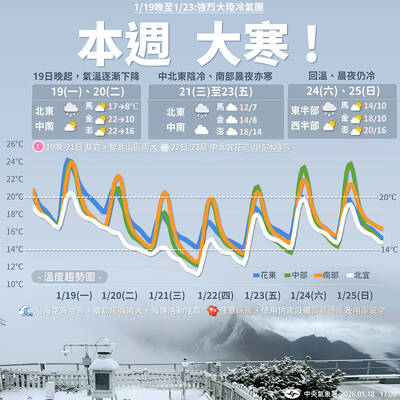
A strong cold air mass is expected to arrive tonight, bringing a change in weather and a drop in temperature, the Central Weather Administration (CWA) said. The coldest time would be early on Thursday morning, with temperatures in some areas dipping as low as 8°C, it said. Daytime highs yesterday were 22°C to 24°C in northern and eastern Taiwan, and about 25°C to 28°C in the central and southern regions, it said. However, nighttime lows would dip to about 15°C to 16°C in central and northern Taiwan as well as the northeast, and 17°C to 19°C elsewhere, it said. Tropical Storm Nokaen, currently
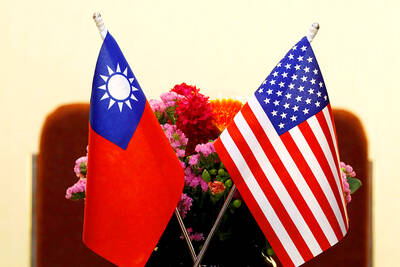
‘NATO-PLUS’: ‘Our strategic partners in the Indo-Pacific are facing increasing aggression by the Chinese Communist Party,’ US Representative Rob Wittman said The US House of Representatives on Monday released its version of the Consolidated Appropriations Act, which includes US$1.15 billion to support security cooperation with Taiwan. The omnibus act, covering US$1.2 trillion of spending, allocates US$1 billion for the Taiwan Security Cooperation Initiative, as well as US$150 million for the replacement of defense articles and reimbursement of defense services provided to Taiwan. The fund allocations were based on the US National Defense Authorization Act for fiscal 2026 that was passed by the US Congress last month and authorized up to US$1 billion to the US Defense Security Cooperation Agency in support of the
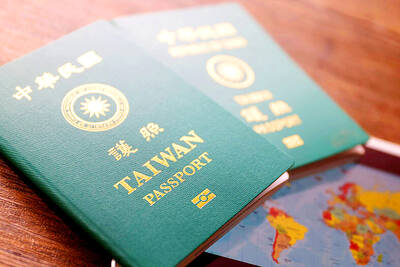
PAPERS, PLEASE: The gang exploited the high value of the passports, selling them at inflated prices to Chinese buyers, who would treat them as ‘invisibility cloaks’ The Yilan District Court has handed four members of a syndicate prison terms ranging from one year and two months to two years and two months for their involvement in a scheme to purchase Taiwanese passports and resell them abroad at a massive markup. A Chinese human smuggling syndicate purchased Taiwanese passports through local criminal networks, exploiting the passports’ visa-free travel privileges to turn a profit of more than 20 times the original price, the court said. Such criminal organizations enable people to impersonate Taiwanese when entering and exiting Taiwan and other countries, undermining social order and the credibility of the nation’s


 RSS
RSS