


A group of families demanding justice for the victims of China’s 1989 Tiananmen Square crackdown has denounced Chinese President Xi Jinping (習近平) for failing to launch political reforms, saying he was taking China “backwards toward Maoist orthodoxy.”
The Tiananmen Mothers activist group has long urged the leadership to open a dialogue and provide a reassessment of the 1989 pro-democracy movement, bloodily suppressed on June 4 that year by the government, which labeled it “counter-revolutionary.”
In an open letter released yesterday through New York-based Human Rights in China, the group said Xi “has mixed together the things that were most unpopular and most in need of repudiation” during the time of former Chinese leaders Mao Zedong (毛澤東) and Deng Xiaoping (鄧小平), the latter who oversaw the suppression of the protests.
“This has caused those individuals who originally harbored hopes in him in carrying out political reform to fall into sudden disappointment and despair,” the group said.
Xi became Chinese Communist Party (CCP) general secretary in November and Chinese president in March, at a time of growing public pressure to launch long-stalled political reforms.
Some intellectuals had predicted that Xi would follow in the footsteps of his father, Xi Zhongxun (習仲勛), a reformist former Chinese vice premier and parliament vice chairman. Xi has tried to project a softer and more open image than his predecessor, former Chinese president Hu Jintao (胡錦濤).
However, Xi’s government has clamped down on free expression on the Internet and detained anti-corruption activists, giving no sign the party will ever brook dissent to its rule.
The Tiananmen Mothers said they had not seen Xi “reflect upon or show remorse in the slightest for the sins committed during the three decades of Maoist communism.”
“What we see, precisely, are giant steps backwards towards Maoist orthodoxy,” they said.
The leader of the Tiananmen Mothers group, Ding Zilin (丁子霖), called on Xi to “be courageous enough to take up the responsibility of history and pay the debts left by his predecessors.”
“Everyone knows that a just resolution to the June 4 issue, a re-evaluation of June 4, will not happen by itself. It needs to be tied to progress in China’s political reform and democratization,” said Ding, 77.
Asked about the letter, Chinese Ministry of Foreign Affairs spokesman Hong Lei (洪磊) said China had long ago “reached a clear conclusion” about June 4.
The successes of the past two decades “shows that the path we have chosen serves the interest of the Chinese people,” he added.
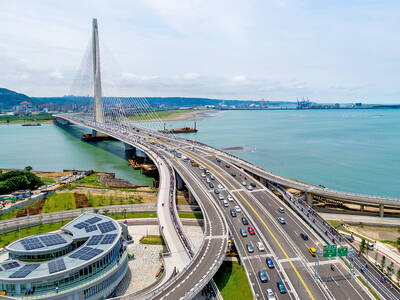
The Ministry of Transportation and Communications yesterday inaugurated the Danjiang Bridge across the Tamsui River in New Taipei City, saying that the structure would be an architectural icon and traffic artery for Taiwan. Feted as a major engineering achievement, the Danjiang Bridge is 920m long, 211m tall at the top of its pylon, and is the longest single-pylon asymmetric cable-stayed bridge in the world, the government’s Web site for the structure said. It was designed by late Iraqi-British architect Zaha Hadid. The structure, with a maximum deck of 70m, accommodates road and light rail traffic, and affords a 200m navigation channel for boats,
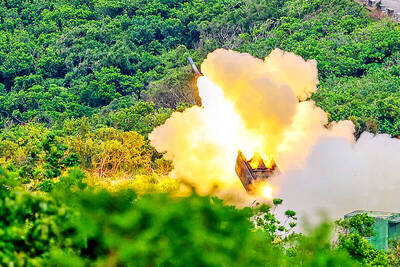
PRECISION STRIKES: The most significant reason to deploy HIMARS to outlying islands is to establish a ‘dead zone’ that the PLA would not dare enter, a source said A High Mobility Artillery Rocket System (HIMARS) would be deployed to Penghu County and Dongyin Island (東引) in Lienchiang County (Matsu) to force the Chinese military to retreat at least 100km from the coastline, a military source said yesterday. Taiwan has been procuring HIMARS and Army Tactical Missile Systems (ATACMS) from the US in batches. Once all batches have been delivered, Taiwan would possess 111 HIMARS units and 504 ATACMS, which have a range of 300km. Considering that “offense is the best defense,” the military plans to forward-deploy the systems to outlying islands such as Penghu and Dongyin so that

Taiwan Semiconductor Manufacturing Co (TSMC, 台積電), the world’s largest foundry service provider, yesterday said that global semiconductor revenue is projected to hit US$1.5 trillion in 2030, after the figure exceeds US$1 trillion this year, as artificial intelligence (AI) demand boosts consumption of token and compute power. “We are still at the beginning of the AI revolution, but we already see a significant impact across the whole semiconductor ecosystem,” TSMC deputy cochief operating officer Kevin Zhang (張曉強) said at the company’s annual technology symposium in Hsinchu City. “It is fair to say that in the past decade, smartphones and other mobile devices were
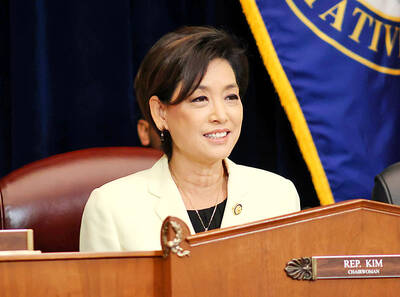
‘CLEAR MESSAGE’: The bill would set up an interagency ‘tiger team’ to review sanctions tools and other economic options to help deter any Chinese aggression toward Taiwan US Representative Young Kim has introduced a bill to deter Chinese aggression against Taiwan, calling for an interagency “tiger team” to preplan coordinated sanctions and economic measures in response to possible Chinese military or political action against Taiwan. “[Chinese President] Xi Jinping [習近平] has directed the People’s Liberation Army to be ready to invade Taiwan by 2027. China has a plan. America should have one too,” Kim said in a news release on Thursday last week. She introduced the “Deter PRC [People’s Republic of China] aggression against Taiwan act” to “ensure the US has a coordinated sanctions strategy ready should


 RSS
RSS