


Hundreds of people, including farmers and farming activists from Taiwan, Thailand, Indonesia, South Korea, Japan and Malaysia, yesterday rallied against the globalization of agriculture on Ketagalan Boulevard in front of the Presidential Office, protesting against the government’s plans to lift more bans on agricultral imports.
“We gather here today to express our anger, we want to tell the government that we’re fed up with their compromises on our food sovereignty, it’s a serious problem that our food self-sufficiency has dropped to 33 percent now,” Taiwan Rural Front (TRF) spokeswoman Tsai Pei-hui (蔡培慧) told the crowd at the rally. “You’ve put our dining tables and refrigerators in other people’s homes, we want to keep them in our own places.”
In addition to a series of heated protests against land expropriations that have been going on for years, farmers and farming activists are worried that the government may soon lift the bans on imports of 830 categories of farm products from China, as well as pork products from the US, despite President Ma Ying-jeou’s (馬英九) repeated promises that he would not do so.
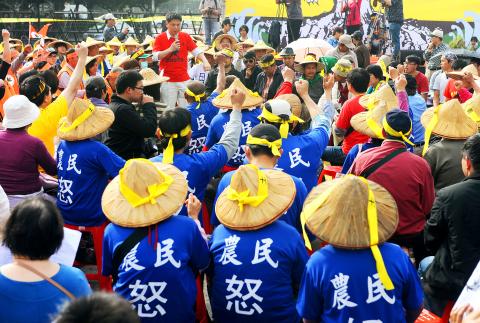
Photo: Liao Chen-huei, Taipei Times
“During the presidential campaign, Ma promised numerous times that he would not lift the bans on imports of 830 categories of farm products from China, but now, Council of Agriculture Minister Chen Bao-ji (陳保基) is saying that the bans ‘may’ be lifted,” said National Cheng Chi University land economics professor Hsu Shih-jung (徐世榮), a long-time advocate of farmers’ rights. “When the government decided to lift the ban on imports of certain US beef products amid strong opposition from the public, Ma also firmly promised that the imports of US pork products would remain banned — yet the US government is now pressuring the Ma administration to lift the ban.”
Hsu said farmers across the country now “have little confidence in this incapable government” and therefore gathered to voice their opposition to free trade in the agricultural sector and to call on the government to insist on agricultural sovereignty.
Henry Saragih, the general coordinator of the Jakarta, Indonesia, office of international small farmers’ organization La Via Campesina, said that the problems that Taiwanese farmers encounter are the same for farmers across the world.
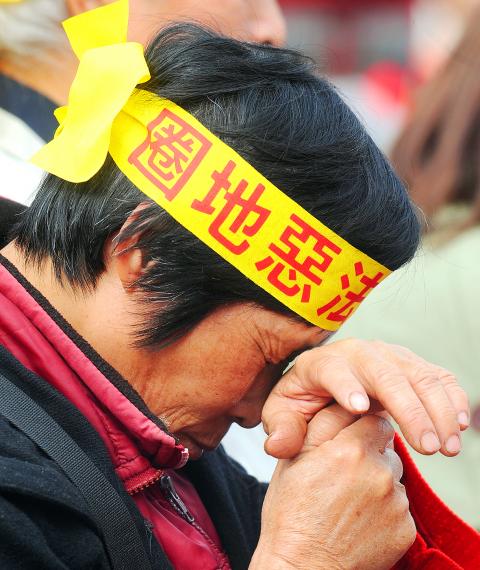
Photo: Liao Chen-huei, Taipei Times
La Via Campesina is an international coalition of peasants’ movements with 148 member groups in 69 countries around the world.
“Land grabbing, loss of food sovereignty and an increasing number of people threatened by famine — now reaching more than 1 billion — are problems created by the WTO, globalization and neo-liberalism,” Saragih said.
He said that Thailand, for instance, which originally had a diverse agricultural sector, now specializes in producing rice for export, and has to import other produce.
South Korea has become an exporter of electronic products, “and since most of its farmland has been taken by the industrial sector, some South Korean agricultural companies now grab land in Africa — especially Madagascar — to grow produce to be imported back to South Korea, leaving Madagascan farmers landless,” Saragih said.
Wirat Phromson, a member of the Northern Peasants’ Federation Thailand, urged farmers in Taiwan to continue their struggle.
Citing the farming rights movement in Thailand, Phromson said that despite the seeming flexibility of the Thai government and its promise to revise laws, “the [Thai] government eventually amended laws concerning the agricultural sector, but not for the interests of the peasants. Rather, it was for the interests of big corporations.”
“We want to tell our brothers and sisters in Taiwan and in Via Campesina: Do not believe those empty promises of the government,” he said. “We can’t let people from outside take valuable resources from us and impose on us the sufferings of hunger.”
Following performances by musicians in the evening, the rally ended with protesters throwing bundles of straw toward the Presidential Office.


RESILIENCE: Taiwan plays a key role in semiconductors, energy, information infrastructure and advanced manufacturing, AIT Director Raymond Greene said Taiwan’s continued investment in deterrence and resilience remains vital, especially in uncrewed systems and other emerging technologies, American Institute in Taiwan (AIT) Director Raymond Greene said yesterday. Greene made the remarks at the annual National Strategic Summit on Supply Chain Resilience held by the Research Institute for Democracy, Society and Emerging Technology (DSET), a government-backed think tank. As Taiwan last year became the US’ fourth-largest trading partner and supply chain security is becoming more important, cooperation in emerging technologies continues to deepen between the two countries, he said. The US is committed to accelerating innovation, building key infrastructure, strengthening cooperation

The National Chungshan Institute of Science and Technology yesterday showcased its locally developed variants of the Vision 60 robotic patrol dog, which it plans to deploy on the nation’s outlying territories in the South China Sea. The variants were produced under the Joint Lab project — created by the institute and domestic companies — and assembled with domestically produced motors, lenses and artificial intelligence (AI) systems alongside licensed tech from the US, Missile and Rocket Systems Research Division deputy director Jen Kuo-kang (任國光) told the media event at a military base in Taipei’s Dazhi (大直) area. Taiwan has built up its strengths

RIGHT DIRECTION: Taiwan’s efforts to prevent forced labor include a proposal to ‘fully prohibit’ employers from withholding workers’ documents, an official said Taiwan is to establish a mechanism to restrict imports of goods linked to forced labor, the Executive Yuan said yesterday, after the US proposed imposing additional tariffs on Taiwanese goods over labor concerns. “The Ministry of Labor and the Ministry of Economic Affairs are to establish an interministerial review procedure,” Executive Yuan spokesperson Michelle Lee (李慧芝) said at a news briefing in Taipei. “The government is to use the Foreign Trade Act [貿易法] as the legal basis to restrict imports of goods produced with forced labor” and bring its supply chain governance more in line with international standards on human rights, resilience

NOT IMMEDIATE: Taiwan has a chance to appeal the proposed 10 percent tariff before it starts, while other countries face a 12.5 percent tariff from the trade office Taiwan is among 60 economies determined by the US to have failed to impose or enforce a ban on the importation of goods produced with forced labor, according to a notice released on Tuesday by the Office of the US Trade Representative (USTR), which proposed imposing an additional 10 percent or more tariff on them. The USTR in a statement said that following an investigation, it had determined under Section 301 of the Trade Act of 1974 that the failure of the 60 economies to impose and effectively enforce a prohibition on the importation of goods produced with forced labor is


 RSS
RSS