


Taiwan and the US have agreed to resume talks under the Trade and Investment Framework Agreement (TIFA) next month after a six-year-long delay and discuss new approaches to fostering bilateral trade and investment, the Ministry of Economic Affairs said yesterday.
The talks are scheduled to resume by the end of next month, the ministry said.
The TIFA was signed in 1994 as a framework for Taiwan and US to discuss their trade ties, but talks have been stalled since 2007 because of a long-standing dispute over US beef products, including a Taiwanese ban on beef products containing residues of the leanness-enhancing drug ractopamine. Taiwan eased the ban on beef imports containing ractopamine residue in July last year.
Vice Minister of Economic Affairs Bill Cho (卓士昭) will meet Deputy US Trade Representative Demetrios Marantis in Taipei next month to resume the talks, the ministry said.
On the top of the ministry’s agency would be soliciting US support for Taiwan to join the US’ Trans-Pacific Partnership (TPP) to avoid Taiwan being marginalized in the global market, Cho said.
“As regional markets become much more connected and the world’s focus shifts to Asia, we don’t want to see Taiwan miss any opportunity in the global market,” Cho said, adding that his negotiating team would stress Taiwan’s willingness to join regional economic blocs and try to make Taiwan a TPP member in less than eight years.
“It has been our position that everybody, not only Taiwan, should allow these products to come in without discrimination,” American Institute in Taiwan (AIT) Chairman Raymond Burghardt told reporters in Taipei yesterday.
Burghardt declined to answer whether pork imports would be on the table for next month’s TIFA talks because “two sides are still negotiating on the precise agenda.”
The aspects of Taiwan’s market “which are not completely open yet” are what the US would like to talk about in trade talks, Burghardt said.
US pork producers will not export pork containing ractopamine residue to Taiwan as long as Taiwan prohibits such products, but “we have the permanent position” that food policy and regulations should follow international standards and scientific rules, he said.
The safety standards used to set maximum residue levels for ractopamine, adopted last year by the Codex Alimentarius Commission, the international food standards setting body, “was not specifically about beef,” he said.
In response to a question on whether the resumption of TIFA talks would be the first step toward the US negotiating a free-trade agreement (FTA) with Taiwan, Burghardt said TIFA was “a vehicle for regaining confidence in our bilateral trade relations.”
“It’s premature this time to talk about FTA. It really is. Let’s get the TIFA talks started. Let’s see how things go. Let’s see [if] confidence is really restored,” he said.
Burghardt said that the issue of Taiwan joining the TPP seemed to be “a less urgent question than some other [bilateral trade] issues,” because President Ma Ying-jeou (馬英九) said that it might take eight years.
If Taiwan was really serious about joining the TPP in the future, it needs to consider what kinds of steps it needs to take and what kinds of reforms it needs to make to its economy, “all of which could be necessary to be a credible candidate for that kind of tough, comprehensive agreement on trade and investment,” he said.

A signaling system malfunction disrupted high-speed rail (HSR) services beginning at 8am today, with trains temporarily reduced to three northbound and three southbound trains per hour as authorities conduct inspections. The malfunction occurred on a section of track in Miaoli County during pre-operation checks early this morning, forcing northbound and southbound trains to use a single track, the HSR operator said. The regular schedule has been replaced with three hourly trains offering only nonreserved seating in each direction, stopping at every station, it said, adding that business class cars would still have reserved seating. Departures from terminal stations are scheduled at the top
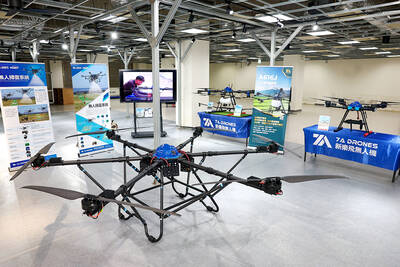
DRONE CENTRAL: Taiwan aims to become Asia’s democratic hub for drones, with most exports focused on high-quality military-grade models, an official said Taiwan’s drone industry is expected to expand significantly by 2030, producing 100,000 units per month and exporting half of them, the Ministry of Economic Affairs said yesterday. Current drone production capacity is about 15,000 units per month, but the industry can quickly scale up as demand increases, Industrial Development Administration Director-General Chiou Chyou-huey (邱求慧) told a news conference in Taipei. Taiwan’s drone output grew 2.5-fold last year to NT$12.9 billion (US$408.3 million) under a government program to develop the uncrewed vehicle sector, he said. The Executive Yuan in October last year approved plans to invest NT$44.2 billion into domestic production of uncrewed aerial

Taiwan is still in the process of assessing the possibility of recruiting workers from Eswatini, the Ministry of Foreign Affairs said yesterday, adding that its goal is to help Eswatini upgrade its vocational training centers. If there are plans to recruit workers from Eswatini, safeguarding national security, protecting public health and ensuring the employment rights of Taiwanese would be prerequisites, Department of West Asian and African Affairs Director-General Yen Chia-liang (顏嘉良) told a news conference. Key considerations would also include filling labor shortages in specific industries, and fostering bilateral professional and technical exchanges, he said. Yen was asked about the progress of labor

VERBOSE VESSELS: A CGA cutter and a China Coast Guard exchanged verbal barbs for more than a day in Taiwanese-controlled waters before the Chinese vessel left The Taiwanese and Chinese coast guards had a standoff near the strategically located Pratas Islands (Dongsha Islands, 東沙群島) in the north of the South China Sea, the Coast Guard Administration (CGA) said yesterday. The two sides engaged in intense radio exchanges over sovereignty claims during the 33-hour standoff. China Coast Guard vessel 3501 eventually left the restricted waters, 26.6 nautical miles (49.2km) west of the Pratas Islands, at 5pm yesterday, the CGA said. Lying approximately between southern Taiwan and Hong Kong, the Taiwan-controlled Pratas are seen by some security experts as vulnerable to Chinese attack due to their distance — more than


 RSS
RSS