


Representatives from the trade unions of state-owned banks and government-owned enterprises under the Ministry of Finance yesterday delivered a petition to Minister of Finance Chang Sheng-ford (張盛和) to express their displeasure over year-end bonus cuts.
More than 20 state-owned enterprises are planning to protest on Jan. 30 on Ketagalan Boulevard in front of the Presidential Office in Taipei to demand that the government come up with measures to supplement its plan to cap employees’ bonuses.
“The government should focus more on rooting out institutional corruption among high-ranking officials of state-owned enterprises, instead of slashing grassroots employee’s bonuses,” said Tsai Kui-hua (蔡桂華), president of the Land Bank of Taiwan (土地銀行) trade union, before taking the petition to Chang.
Tsai said that state-run bank employees deserve encouragement and support from the government, because the banks have to coordinate their business with government policies, but have still been able to generate higher-than-expected profits amid a challenging financial situation.
However, the government’s move to cut the performance bonuses of all workers in state-owned enterprises without discussing the move with trade unions was unfair, and could hurt the nation’s economy further by dragging down private consumption, she added.
Tsai said state-owned enterprises are willing to ride out the dire economic period with the public, but the government has to devise new, comprehensive principles for determining their bonuses.
“We should not receive bonuses if state-owned banks and enterprises do not meet their profitability targets,” Tsai said. “Likewise, employees at these institutions should be given higher bonuses if they generate higher-than-expected income.”
After talking with Chang, trade union representatives expressed their appreciation of the minister’s promise to speak to the Cabinet and lawmakers about the issue.
However, employees of state-owned enterprises may still carry out their plan to protest on Jan. 30 if the government cannot give them a satisfactory response.
The trade unions may also consider suing Premier Sean Chen and Minister of Economic Affairs Shih Yen-shiang (施顏祥) for dereliction of duty.
Earlier this month, the legislature reached a consensus on slashing performance bonuses for workers at state-owned enterprises to the equivalent of 1.2 months’ salary, from the original 2.6 months’ salary level.
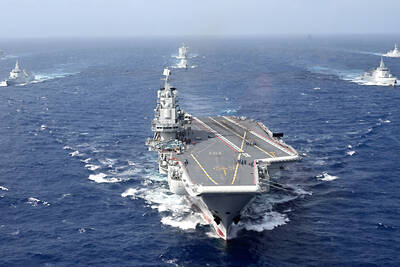
PROVOCATIVE: Chinese Deputy Ambassador to the UN Sun Lei accused Japan of sending military vessels to deliberately provoke tensions in the Taiwan Strait China denounced remarks by Japan and the EU about the South China Sea at a UN Security Council meeting on Monday, and accused Tokyo of provocative behavior in the Taiwan Strait and planning military expansion. Ayano Kunimitsu, a Japanese vice foreign minister, told the Council meeting on maritime security that Tokyo was seriously concerned about the situation in the East China and South China seas, and reiterated Japan’s opposition to any attempt to change the “status quo” by force, and obstruction of freedom of navigation and overflight. Stavros Lambrinidis, head of the EU delegation to the UN, also highlighted South China Sea
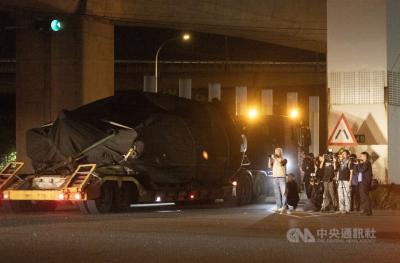
The final batch of 28 M1A2T Abrams tanks purchased from the US arrived at Taipei Port last night and were transported to the Armor Training Command in Hsinchu County’s Hukou Township (湖口), completing the military’s multi-year procurement of 108 of the tanks. Starting at 12:10am today, reporters observed more than a dozen civilian flatbed trailers departing from Taipei Port, each carrying an M1A2T tank covered with black waterproof tarps. Escorted by military vehicles, the convoy traveled via the West Coast Expressway to the Armor Training Command, with police implementing traffic control. The army operates about 1,000 tanks, including CM-11 Brave Tiger
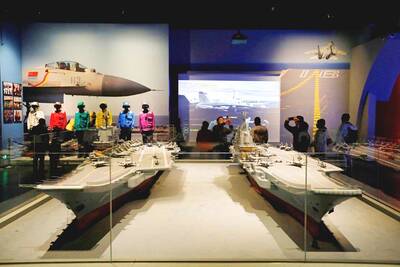
China on Wednesday teased in a video an aircraft carrier that could be its fourth, and the first using nuclear power, while making an allusion to Taiwan and vowing to further build up its islands, as it looks to boost maritime power, secure resources and bolster territorial claims. The video, issued on the eve of the 77th founding anniversary of the Chinese People’s Liberation Army Navy, featured fictional officers with names that are homophones of three commissioned aircraft carriers, the Liaoning (遼寧), Shandong (山東) and Fujian (福建). Titled Into the Deep, it showed a 19-year-old named “Hejian” (何劍) joining the group, sparking
Taiwan Semiconductor Manufacturing Co (TSMC, 台積電), the world’s largest contract chipmaker, said it expects its 2-nanometer (2nm) chip capacity to grow at a compound annual rate of 70 percent from this year to 2028. The projection comes as five fabs begin volume production of 2-nanometer chips this year — two in Hsinchu and three in Kaohsiung — TSMC senior vice president and deputy cochief operating officer Cliff Hou (侯永清) said at the company’s annual technology symposium in Silicon Valley, California, last week. Output in the first year of 2-nanometer production, which began in the fourth quarter of last year, is expected to


 RSS
RSS