


The UN General Assembly on Thursday overwhelmingly voted to make Palestine a non-member state, inflicting a major diplomatic defeat on the US and Israel.
The victory for Palestinian President Mahmoud Abbas triggered scenes of joy in the occupied West Bank, where thousands celebrated with bursts of gunfire and cheers in the city of Ramallah.
Abbas claimed what he called a UN “birth certificate” for a Palestinian state and got the backing of 138 countries in the 193-member assembly. Nine voted against and 41 abstained, while five did not participate.
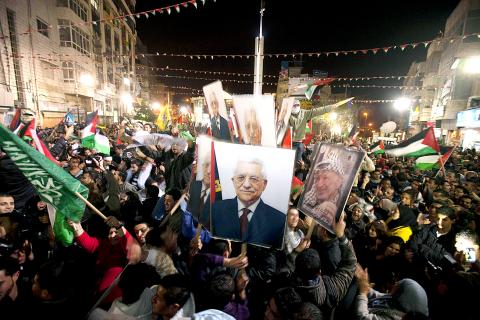
Photo: AFP
The limited diplomatic upgrade came on the 65th anniversary of the UN partition vote, when the world body first divided the Holy Land between Jews and Arabs, who have battled over it ever since, most recently in this month’s deadly Gaza fighting.
A Palestinian flag was unfurled in the General Assembly as the victory was pronounced.
However, Israeli Prime Minister Benjamin Netanyahu condemned what he called a “venomous” speech by the Palestinian leader.
The vote lifts the Palestinian Authority from an observer entity in the UN to a “non-member observer state” on a par with the Vatican.
Palestine has no vote in the General Assembly, but can now join UN agencies and potentially the International Criminal Court (ICC), where it could ask for a probe of Israeli actions, including during the recent fighting in Gaza.
Abbas said he hoped to use the status upgrade as a launchpad for renewed direct talks with Israel — frozen for more than two years — calling the resolution “the last chance to save the two-state solution.”
In a 22-minute speech laced with references to Israel’s battle with Gaza’s Hamas rulers this month, Abbas said time for an accord is running out.
“The rope of patience is shortening and hope is withering,” he said.
Afterwards, he said the vote had been “historic.”
“Tomorrow we begin the real war,” Abbas said at a celebration reception. “We have a long road and difficult road ahead of us. I don’t want to spoil our victory tonight, but the road ahead is still difficult.”
The US and Israel immediately condemned the vote, which US Secretary of State Hillary Rodham Clinton called “counterproductive.”
US Ambassador Susan Rice sternly told the General Assembly that the resolution would be “an obstacle to peace” because it would not lead to a return to direct talks between the Israelis and Palestinians.
The US blocked a Palestinian application for full UN membership — made by Abbas in September last year — at the Security Council.
The Palestinian leader did not make any reference to the possibility of joining the ICC — a major worry for Israel, which fears a possible investigation.
However, Abbas said: “We will act responsibly and positively in our next steps, and we will work to strengthen cooperation with the countries and peoples of the world for the sake of a just peace.”
The vote could give a boost to Abbas, who faces a mounting challenge from Hamas after the Israeli offensive on Gaza, diplomats said.
Hamas welcomed the vote, calling it a “victory.”
“This is a new victory on the road to the liberation of Palestine and we congratulate ourselves,” Hamas official Ahmed Yussef said.
The Palestinians still face an uncertain future on the diplomatic stage.
Despite their greater access to the UN system, it is unclear whether they will be able to automatically join the ICC.

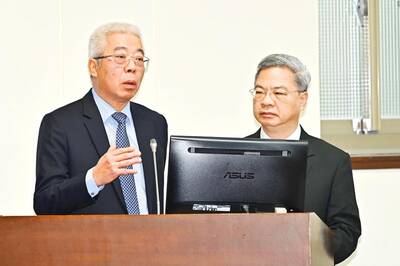
Taiwan has arranged for about 8 million barrels of crude oil, or about one-third of its monthly needs, to be shipped from the Red Sea this month to bypass the Strait of Hormuz and ease domestic supply pressures, CPC Corp, Taiwan (CPC, 台灣中油) said yesterday. The state-run oil company has worked with Middle Eastern suppliers to secure routes other than the Strait of Hormuz, through which about 20 percent of the world’s oil and liquefied natural gas typically passes, CPC chairman Fang Jeng-zen (方振仁) said at a meeting of the legislature’s Economics Committee in Taipei. Suppliers in Saudi Arabia have indicated they

South Korea has adjusted its electronic arrival card system to no longer list Taiwan as a part of China, a move that the Ministry of Foreign Affairs said would help facilitate exchanges between the two sides. South Korea previously listed “Taiwan” as “Taiwan (China)” in the drop-down menus of its online arrival card system, where people had to fill out where they came from and their next destination. The ministry had requested South Korea make a revision and said it would change South Korea’s name on Taiwan’s online immigration system from “Republic of Korea” to “Korea (South),” should the issue not be

Tainan, Taipei and New Taipei City recorded the highest fines nationwide for illegal accommodations in the first quarter of this year, with fines issued in the three cities each exceeding NT$7 million (US$220,639), Tourism Administration data showed. Among them, Taipei had the highest number of illegal short-term rental units, with 410. There were 3,280 legally registered hotels nationwide in the first quarter, down by 14 properties, or 0.43 percent, from a year earlier, likely indicating operators exiting the market, the agency said. However, the number of unregistered properties rose to 1,174, including 314 illegal hotels and 860 illegal short-term rental

AIR ALERT: China’s reservation of airspace over the Yellow Sea and East China Sea could be an attempt to test the US’ response ahead of a Trump-Xi meeting, the NSB head said China’s attempts to infiltrate Taiwan are systematic, planned and targeted, with activity shifting from recruiting mid-level military officers to rank-and-file enlisted personnel, National Security Bureau (NSB) Director-General Tsai Ming-yen (蔡明彥) said yesterday. The Chinese Communist Party’s (CCP) integrates national security, intelligence operations and “united front” efforts into a dense network to conduct intelligence gathering and espionage in Taiwan, Tsai said at a meeting of the legislature’s Foreign Affairs and National Defense Committee. It uses specific networks to screen targets through exchange activities and recruiting local collaborators to establish intelligence-gathering organizations, he said. China is also shifting who it targets to lower-ranking military personnel,


 RSS
RSS