


Millions of people across the US Northeast stricken by massive storm Sandy were attempting to resume normal lives yesterday as companies, markets and airports reopened, despite grim projections of power and mass transit outages lasting several more days.
With six days to go before the Nov. 6 elections, US President Barack Obama was scheduled to visit storm-ravaged areas of the New Jersey shore, where Sandy made landfall on Monday. His guide will be Republican Governor Chris Christie, a vocal backer of presidential challenger Mitt Romney who has nevertheless praised Obama and the federal response to the storm.
Sandy, which has killed 40 people in the US, pushed inland and dumped snow in the Appalachian Mountains. Its remains slowed over Pennsylvania and it was expected to move north toward western New York and Canada, the National Weather Service said.
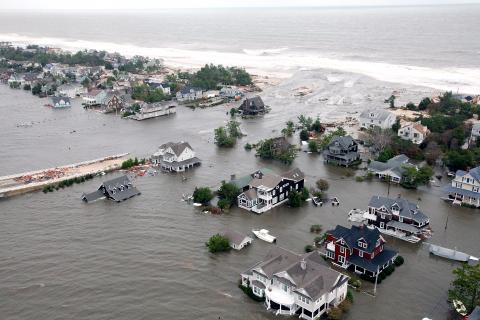
Photo: EPA / Master Sergeant Mark Olsen / US Air Force
Blizzard warnings and coastal flood warnings for the shores of the Great Lakes were in effect.
Battered by a record storm surge of nearly 4.2m of water, swaths of New York City remained submerged under several meters of water. In the city’s borough of Staten Island, police used helicopters to pluck stranded residents from rooftops.
Across the Hudson River in Hoboken, New Jersey, National Guard members arrived to help residents pump floodwater from their homes, the city said on Twitter.
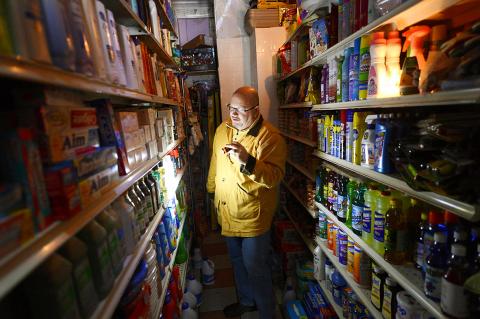
Photo: AFP
More than 8.2 million homes and businesses remained without electricity across several states as trees toppled by fierce winds tore down power lines.
In New Jersey, Christie said it could take seven to 10 days before power is restored statewide. Subway tracks and commuter tunnels under New York City, which carry several million people a day, were under several meters of water.
In the lower half of Manhattan, a quarter-million residents remained without power after a transformer explosion at a Con Edison substation on Monday night. In Greenwich Village, where downed trees littered the streets, residents gathered around a neighborhood police station to use its power outlets to charge their cellphones.
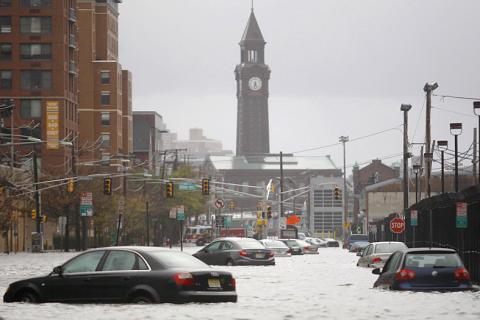
Photo: Reuters
New York City likely will struggle without subways for days, authorities said. Buses were operating on a limited basis and many residents were walking long distances or scrambling to grab scarce taxicabs on the streets.
Two of the area’s major airports — John F. Kennedy International in New York and Newark Liberty International — planned to reopen with limited service yesterday.
Despite much of the city’s financial district being damaged by flooding, financial markets were scheduled to reopen yesterday as well. How much activity could take place remained to be seen, however, as many workers may be unlikely to get to work without subways and commuter railroads from the suburbs.
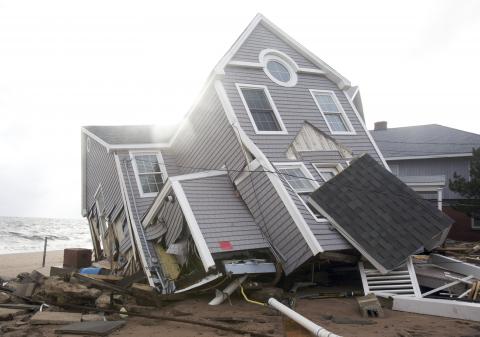
Photo: Reuters
In New Jersey, Christie took a helicopter tour of devastation on Tuesday along the shore, where boats were adrift, boardwalks were washed away and roads were blocked by massive sand drifts. He stopped in the badly damaged resort towns of Belmar and Avalon.
“I was just here walking this place this summer and the fact that most of it is gone is just incredible,” he said at one stop.
Obama and Romney put campaigning on hold for a second day on Tuesday, but Romney planned to hold rallies in the battleground state of Florida yesterday and Obama seemed likely to resume campaigning today.
Sandy became the biggest storm to hit the US in generations when it crashed ashore with hurricane-force winds on Monday near Atlantic City.


Japan has deployed long-range missiles in a southwestern region near China, the Japanese defense minister said yesterday, at a time when ties with Beijing are at their lowest in recent years. The missiles were installed in Kumamoto in the southern region of Kyushu, as Japan is attempting to shore up its military capacity as China steps up naval activity in the East China Sea. “Standoff defense capabilities enable us to counter the threat of enemy forces attempting to invade our country ... while ensuring the safety of our personnel,” Japanese Minister of Defense Shinjiro Koizumi said. “This is an extremely important initiative for

MORE POPULAR: Taiwan Pass sales increased by 59 percent during the first quarter compared with the same period last year, the Tourism Administration said The Tourism Administration yesterday said that it has streamlined the Taiwan Pass, with two versions available for purchase beginning today. The tourism agency has made the pass available to international tourists since 2024, allowing them to access the high-speed rail, Taiwan Railway Corp services, four MRT systems and four Taiwan Tourist Shuttles. Previously, five types of Taiwan Pass were available, but some tourists have said that the offerings were too complicated. The agency said only two types of Taiwan Pass would be available, starting from a three-day pass with the high-speed rail and a three-day pass with Taiwan Railway Corp. The former costs NT$2,800

NEW LOW: The council in 2024 based predictions on a pessimistic estimate for the nation’s total fertility rate of 0.84, but last year that rate was 0.69, 17 percent lower An expected National Development Council (NDC) report expects the nation’s population to drop below 12 million by 2065, with the old-age dependency ratio to top 100 percent sooner than 2070, sources said yesterday. The council is slated to release its latest population projections in August, using an ultra-low fertility model, the sources said. The previous report projected that Taiwan’s population would fall to 14.37 million by 2070, but based on a new estimate of the total fertility rate (TFR) — the average number of children born to a woman over her lifetime — the population is expected to reach 12 million by

COUNTERING HOSTILITY: The draft bill would require the US to increase diplomatic pressure on China and would impose sanctions on those who sabotage undersea cable networks US lawmakers on Thursday introduced a bipartisan bill to bolster the resilience of Taiwan’s submarine cables to counter China’s hostile activities. The proposal, titled the critical undersea infrastructure resilience initiative act, was cosponsored by Republican representatives Mike Lawler and Greg Stanton, and Democratic Representative Dave Min. US Senators John Curtis and Jacky Rosen also introduced a companion bill in the US Senate, which has passed markup at the chamber’s Committee on Foreign Relations. The House’s version of the bill would prioritize the deployment of sensors to detect disruptions or potential sabotage in real-time and enhance early warning capabilities through global intelligence sharing frameworks,


 RSS
RSS