


A mild tsunami hit Hawaii late on Saturday after a powerful earthquake off the west coast of Canada, forcing a state-wide evacuation, but apparently failing to cause major damage.
TV images from the island of Oahu showed relatively small waves peacefully rolling toward shore.
Shortly after, forecasters lifted a tsunami warning issued in the wake of the quake.
“Based on all available data, the tsunami threat has decreased and is now at the advisory level and not expected to increase,” the Hawaii-based Pacific Tsunami Warning Center announced.
Highways and roads in coastal areas were reopened, allowing thousands of residents and hundreds of tourists to return to their homes and hotel rooms.
However, the tsunami, set off by a powerful 7.7 magnitude earthquake that struck off the west coast of Canada, succeeded in disrupting the weekend activities of many tourists and residents.
Countless Halloween parties were interrupted, restaurants, bars and movie theaters emptied, and highways quickly filled with cars heading away from beach areas.
Tourists from Waikiki to Turtle Bay in Honolulu were evacuated to higher floors in their hotels, and major tourist centers looked abandoned for several hours.
Haiwaii Governor Neil Abercrombie declared a state of emergency when the first alert was sounded.
Initially, the Pacific Tsunami Warning Center said there was no “destructive widespread tsunami threat” after the 7.7 magnitude quake shook the Queen Charlotte Islands off the west coast of Canada.
However, later it issued a warning, saying a tsunami had been generated by the earthquake and that it was headed toward Hawaii.
Sirens blared across the archipelago as local officials took to the airwaves, urging residents to head for higher ground — or higher floors if they were in multi-story buildings.
The epicenter of the Canadian quake, which occurred at 8:04pm on Saturday, was located 139km south of the town of Masset, the US Geological Survey said.
Numerous aftershocks, some as strong as magnitude 4.6, followed the initial quake, Canadian officials reported.
Emergency officials in British Columbia urged residents in low-lying coastal areas to be alert to instructions from local officials and be prepared to move to higher ground.
However, officials in Canada sought to calm the population.
“We would not be expecting any widespread damage or inundation,” Kelli Kryzanowski of Emergency Management British Columbia told reporters during a teleconference.
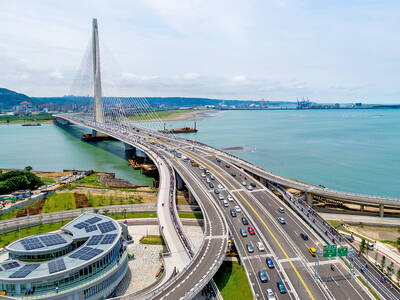
The Ministry of Transportation and Communications yesterday inaugurated the Danjiang Bridge across the Tamsui River in New Taipei City, saying that the structure would be an architectural icon and traffic artery for Taiwan. Feted as a major engineering achievement, the Danjiang Bridge is 920m long, 211m tall at the top of its pylon, and is the longest single-pylon asymmetric cable-stayed bridge in the world, the government’s Web site for the structure said. It was designed by late Iraqi-British architect Zaha Hadid. The structure, with a maximum deck of 70m, accommodates road and light rail traffic, and affords a 200m navigation channel for boats,

Taiwan Semiconductor Manufacturing Co (TSMC, 台積電), the world’s largest foundry service provider, yesterday said that global semiconductor revenue is projected to hit US$1.5 trillion in 2030, after the figure exceeds US$1 trillion this year, as artificial intelligence (AI) demand boosts consumption of token and compute power. “We are still at the beginning of the AI revolution, but we already see a significant impact across the whole semiconductor ecosystem,” TSMC deputy cochief operating officer Kevin Zhang (張曉強) said at the company’s annual technology symposium in Hsinchu City. “It is fair to say that in the past decade, smartphones and other mobile devices were
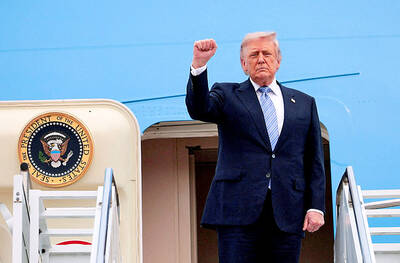
US-CHINA SUMMIT: MOFA welcomed US reassurance of no change in its Taiwan policy; Trump said he did not comment when Xi talked of opposing independence US President Donald Trump yesterday said he has not made a decision on whether to move forward with a major arms package for Taiwan after hearing concerns about it from Chinese President Xi Jinping (習近平). Trump’s comments on Taiwan came as he flew back to Washington after wrapping up critical talks in which both leaders said important progress was made in stabilizing US-China relations even as deep differences persist between the world’s two biggest powers on Iran and Taiwan. “I will make a determination,” Trump said, adding: “I’ll be making decisions. But, you know, I think the last thing we need right

TAIWAN ISSUE: US treasury secretary Scott Bessent said on the first day of meetings that ‘it wouldn’t be a US-China summit without the Taiwan issue coming up’ There were no surprises on the first day of the summit between US President Donald Trump and Chinese President Xi Jinping (習近平), the Mainland Affairs Council (MAC) said yesterday, as the government reiterated that cross-strait stability is crucial to the Asia-Pacific region, as well as the world. As the two presidents met for a highly anticipated summit yesterday, Chinese state media reported that Xi warned Trump that missteps regarding Taiwan could push their two countries into “conflict.” Trump arrived in China with accolades for his host, calling Xi a “great leader” and “friend,” and extending an invitation to visit the White House


 RSS
RSS