


President Ma Ying-jeou (馬英九) yesterday called for a trilateral dialogue between Taiwan, Japan and China to resolve sovereignty disputes over the Diaoyutai Islands (釣魚台), while stressing that the nation would not recognize Japan’s plan to purchase three of the islands.
“The Japanese government’s move violates international laws and is an act of invasion and theft. The Republic of China (ROC) government will not recognize any of Japan’s moves to either nationalize or privatize the islands,” he said during a trip to Pengjia Islet (彭佳嶼).
Ma visited Pengjia, which lies 56km off Keelung and 141km west of the Diaoyutais, apparently to assert the nation’s sovereignty over the island chain.
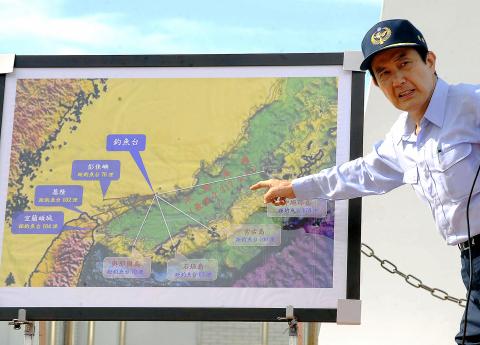
Photo: Reuters
The trip came amid media reports that the Japanese government has planned to claim sovereignty over the Diaoyutais by purchasing three islets in the Diaoyutai chain from private owners.
In defending Taiwan’s sovereignty over the Diaoyutai Islands, Ma yesterday proposed the dialogue between Taiwan, China and Japan to address the issue, calling on the interested parties to shelve their differences, pursue peace and reciprocity and jointly explore the natural resources in the area.
As a follow-up to his “East China Sea peace initiative,” Ma said the three competing nations could start with what he called “three-sided bilateral dialogues” before moving on to trilateral dialogues, to discuss cooperation in the fishing and mining industries, as well as on environmental and security issues.
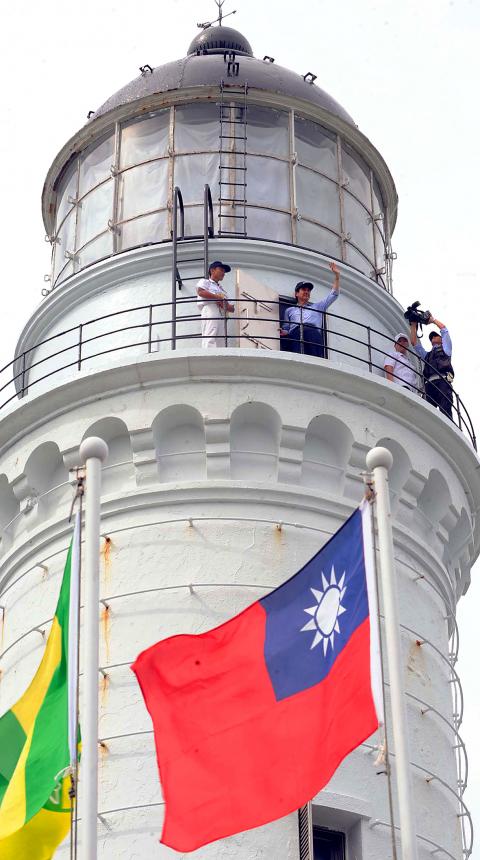
Photo: AFP
“We will not make any concessions on national sovereignty, but the three parties could share the natural resources and jointly develop the areas … There could be more serious confrontations or wars if we do not resolve the dispute peacefully and I hope we can work together to find a solution,” he said.
While stressing the government’s efforts to improve bilateral relations with Japan, Ma said the government will not rule out resolving the dispute via international meditation or lawsuits if necessary.
In response to opposition parties’ calls for Ma to visit the Diaoyutais instead if he meant to underscore the nation’s sovereignty over the islands, Ma said he has no plans to set foot on the Diaoyutais yet, but insisted that the government would seek to resolve the dispute through negotiations.
“I urge the opposition to work with the government on this issue. The Diaoyutais have been part of our offshore islands since the Ming Dynasty and asserting our sovereignty over them is vital to protecting the rights of our fishermen. It’s important to stop wasting time on unnecessary confrontations,” he said.
The helicopter trip was Ma’s first visit to Pengjia. Accompanied by Minister of the Interior Lee Hong-yuan (李鴻源), Minister of National Defense Kao Hua-chu (高華柱) and National Security Council Secretary-General Hu Wei-jen (胡為真), as well as six Chinese Nationalist Party (KMT) lawmakers, he inspected the islet’s weather station and lighthouse and chatted with Coast Guard Administration personnel (CGA).
Upon Ma’s arrival, two Mirage 2000 fighter jets flew by to pay tribute to the president. Two F-16 fighter jets also flew by when he made the speech about the Diaoyutai Islands in front of the Pengjia Islet monument.
The monument was commissioned by then-president Chen Shui-bian (陳水扁) when he visited the disputed islet in 2005. Ma was careful to avoid making the speech in front of the side that is marked with Chen’s signature on it.
In preparation of Ma’s visit, the coast guard dispatched seven vessels to patrol the waters off the nation’s northern and northeastern coasts, and sent a vessel to transport about 50 reporters who had been invited to cover the event.
The coast guard said it has conducted emergency rescue drills and prepared for the activity for over a month.
Ma yesterday thanked the CGA for defending the nation’s waters since its establishment 12 years ago. Citing geographic reasons as well as historical documents to defend Taiwan’s sovereignty over the Diaoyutais, Ma said that the islands have long been traditional fishing grounds of fishermen in Yilan and Keelung. The president also pledged that the coast guard would continue to protect Taiwanese fishermen operating in the waters there.

‘NO SECURITY RISK’: The Railway Bureau reassured the public that the technicians’ activities were limited to technical guidance and did not involve sensitive systems The Railway Bureau yesterday said it had invited eight Chinese technicians to assist with an airport MRT construction project. The bureau issued the confirmation after an Internet user said Chinese nationals had entered the construction zone of Taiwan Taoyuan International Airport’s Terminal 3 project. They asked why “individuals from an enemy state” were allowed access to such a major national infrastructure project, which raised serious concerns over Taiwan’s industrial safety, sensitive systems and information security. The bureau’s Northern Region Engineering Branch Office said subcontractor Taiwan Handle Industrial Co (台灣手把工業) of the Taoyuan airport MRT’s “Contract No. CU05 Project A14 Station Civil, MEP &

A US uncrewed surface vessel (USV) encountered multiple Chinese warships during an autonomous transit of the Taiwan Strait, US defense company Seasats said in a statement on Wednesday. Seasats announced that a Lightfish USV had completed the first autonomous transit of the Taiwan Strait. Over five days, the USV traversed the entire length of the Strait while constantly monitoring surface vessel traffic, the company said. The Lightfish encountered multiple Chinese warships, one of which was a Chinese People’s Liberation Army Navy (PLAN) Type 056 corvette, it said. The Chinese vessels were operating “well within Taiwan’s exclusive economic zone without transmitting their identity via the

Taiwan is still in the process of assessing the possibility of recruiting workers from Eswatini, the Ministry of Foreign Affairs said yesterday, adding that its goal is to help Eswatini upgrade its vocational training centers. If there are plans to recruit workers from Eswatini, safeguarding national security, protecting public health and ensuring the employment rights of Taiwanese would be prerequisites, Department of West Asian and African Affairs Director-General Yen Chia-liang (顏嘉良) told a news conference. Key considerations would also include filling labor shortages in specific industries, and fostering bilateral professional and technical exchanges, he said. Yen was asked about the progress of labor
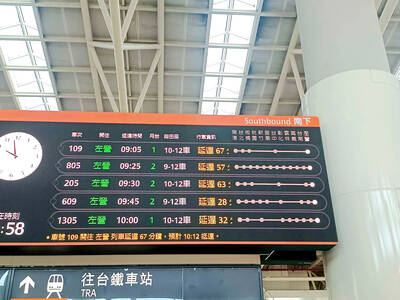
The nation’s usually punctual high-speed rail system yesterday was hit by major disruptions after all scheduled services were canceled and replaced with three hourly trains offering only non-reserved seating, affecting more than 200,000 passengers. Preliminary findings indicate the disruption was caused by a faulty power module in a track switch control cabinet, Taiwan High-Speed Rail Corp (THSRC) said, adding that as a full system inspection could only be conducted after operations end for the day, a decision on whether normal service would resume today would be announced before the first train departs. During a routine inspection early yesterday, a switch signal abnormality


 RSS
RSS