

Despite repeated threats that he would file a lawsuit against National Tsing Hua University student Chen Wei-ting (陳為廷) over an image posted on Facebook, China Times Weekly deputy editor-in-chief Lin Chao-hsin (林朝鑫) had yet to act on his threat yesterday, while Chen said he was ready to defend freedom of speech on the Internet.
“Instead of finding out the truth about the ‘walking fee incident,’ Want Want China Times Media Group chose to [threaten to] file a lawsuit against a college student for posting an image on Facebook,” Chen told a news conference in Taipei yesterday morning. “The lawsuit is not only against me, it’s against all netizens, and Taiwanese civil society.”
Chen was referring to a lawsuit that Lin has repeatedly vowed to bring against him for posting a snapshot of a CTiTV news report of a student protest against the merger of Want Want and cable TV service provider China Network Systems (CNS) on Wednesday.
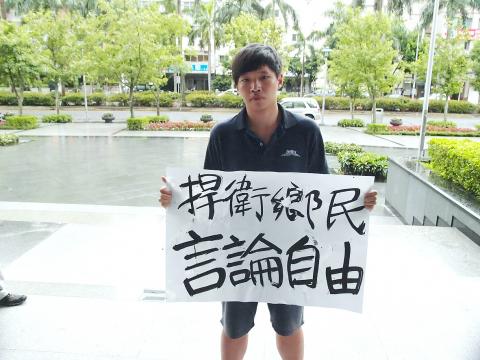
Photo: Chen Ping-hung, Taipei Times
On Friday, Want Want Group’s media outlets — the Chinese--language China Times, China Times Weekly and CTiTV — all reported that the student crowd was paid to stage the protest, and implied, without providing evidence, that Academia Sinica research fellow Huang Kuo-chang (黃國昌), who organized a separate protest earlier, was behind the incident.
Netizens took a snapshot from the CTiTV report on the protest that showed Lin among the crowd and questioned whether the media group was actually the one behind it.
Although Chen was only one of the hundreds of netizens who posted the image online, Lin seems to believe that Chen was the person who originally produced the image, since he was quoted by the China Times yesterday as saying that Chen was the person who took the photograph.
“Most of the people opposed to the merger of Want Want and CNS feel that way because they worry that a media giant ... threatens the freedoms of the press and of speech,” Chen said. “What Lin and the media group have been doing these past few days just proves that our worries are not baseless.”
“As a mere student, I feel helpless, but I’m determined to fight on, not only for myself, but also for freedom of speech on the Internet,” Chen said.
Lin said in a telephone interview that he would sue Chen to defend his reputation. Although he originally said he would file the lawsuit against Chen because he believed Chen was the one who took the snapshot, Lin later said that Chen was not his ultimate target.
“The purpose of the lawsuit is not to do something against a student, rather, it is to find out who’s behind the entire incident,” he said.
Lin told media that he would file the lawsuit at 2pm. As of press time, he had yet to file anything.

FRIDAY, SATURDAY: While Typhoon Champi might weaken, officials warned about large waves, while some transport services and tourist spots have been affected Typhoon Champi is forecast to have the greatest effect on Taiwan tomorrow and on Saturday, with a sea warning issued late last night and a land warning expected afternoon today, the Central Weather Administration (CWA) said yesterday. The storm’s projected track has shifted slightly westward and it could begin moving away from Taiwan toward Japan’s Kyushu island on Saturday, with the warnings potentially lifted as early as Saturday afternoon, CWA forecaster Chang Cheng-chuan (張承傳) said. As of yesterday afternoon, Champi was about 910km east-southeast of Oluanpi (鵝鑾鼻), Taiwan proper’s southernmost point, CWA data showed. Its maximum sustained winds had weakened slightly to
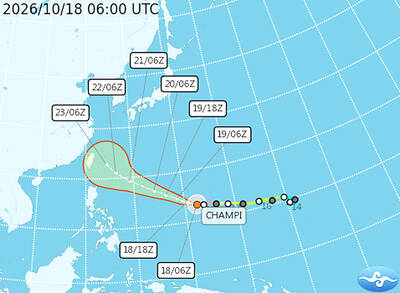
A sea warning for Typhoon Champi could be issued as early as Wednesday night, possibly followed by a land warning on Thursday night or Friday, as the storm approaches Taiwan, the Central Weather Administration (CWA) said yesterday. The typhoon is expected to have its greatest impact on Taiwan on Friday and Saturday, bringing heavy rain to central and northern Taiwan and to Yilan and Hualien counties in the east, CWA forecaster Liu Pei-teng (劉沛滕) said. As of 2pm yesterday, Champi was about 2,470km east-southeast of Oluanpi (鵝鑾鼻), Taiwan’s southernmost tip, moving westnorthwest at 20kph. It had maximum sustained winds of 191kph and a
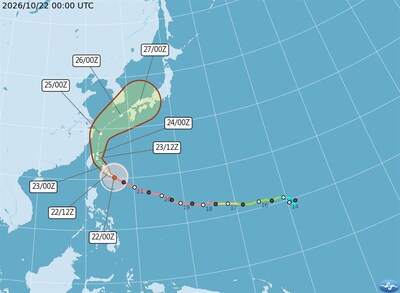
The Central Weather Administration (CWA) today issued a land warning for Typhoon Champi, which is expected to bring heavy rain and strong winds to Taiwan through Saturday. The land warning covered Yilan, Hualien, Taitung and Pingtung counties, CWA data showed. The CWA also issued a sea warning for Typhoon Champi, urging vessels operating in the Bashi Channel, in the south of the Taiwan Strait, as well as waters north, northeast and southeast of Taiwan, to remain on high alert. As of 11am today, Champi was centered about 520km east-southeast of Oluanpi (鵝鑾鼻), Taiwan's southernmost point, moving northwest at 15kph to 20kph, CWA data

ORIGINS: A Taiwanese doctor practicing in Japan said he no longer needed to cover the nationality label on his license with a sticker, as it used to confuse his patients Starting this month, Taiwanese professionals working in Japan can list “Taiwan” as their place of origin following Tokyo’s easing of rules on “nationality” in official licensing documents. The change was announced yesterday by the Japan-Taiwan Friendship Parliamentarians’ League in Tokyo. The license revision covers 322 professions, including doctors and nurses. Previously, Taiwanese had to list “China” as their nationality on professional certifications and licenses, but the new rules updated the “nationality” to “nationality and region” or “nationality, etc,” allowing Taiwanese to use the name “Taiwan.” The league held a meeting about the revision at the House of Representatives Members’ Office Building in Tokyo


 RSS
RSS