


Taiwan continues to be the “principal focus and driver” of China’s extensive military modernization and expansion, a senior Pentagon official said on Friday. US acting Assistant Secretary of Defense for East Asia David Helvey said that even though cross-strait relations have improved greatly, “China’s military shows no sign of slowing its efforts to prepare for Taiwan Strait contingencies.”
At a US Department of Defense briefing, called to release the Pentagon’s annual report to the US Congress on China’s military and security developments, Helvey stressed Beijing’s commitment to a long-term comprehensive military program.
Above all else it was designed to improve the capacity of the People’s Liberation Army (PLA) to “fight and win” local wars under conditions of high intensity, he said.
At the same time, China’s leaders have — over the past 12 months — sustained investment in nuclear forces, short and medium-range conventional ballistic missiles, advanced aircraft and integrated air defenses, he added. The PLA has also engaged in the advanced development of cruise missiles, submarines, surface warships and counter-space and cyberwarfare capabilities.
Such developments appeared to be designed “to enable what we call anti-access and area-denial missions, or what PLA strategists refer to as counterintervention operations,” Helvey said
Other Pentagon sources said that this was a reference to Beijing’s plan to prevent the US from intervening in the case of an attack on Taiwan.
The 50-page report said that over the past year, the PLA had continued to expand its capabilities and develop a doctrine it considered necessary to stop Taiwan from declaring independence.
In its overview of the situation, the report said that China intended increased cross-strait economic and cultural ties “to promote progress toward eventual unification.”
“Simultaneously, the PRC [People’s Republic of China] is developing military capabilities to give it the ability to settle the dispute on Beijing’s terms. However, Beijing still lacks these capabilities and recognizes the costs and risks -associated with a decision to -escalate the dispute to the point of conflict,” the report said.
Beijing and Taipei have taken little action, according to the report, to develop political and security confidence-building measures.
“Although Beijing wants to further develop these ties, it takes into account political sensitivities in Taiwan,” it said, adding that “Beijing appears to be comfortable with current initiatives and hopeful that, over the long term, economic, social and cultural integration will dilute pro-independence sentiment in Taiwan and will make the prospect of peaceful unification a more attractive proposition.”
The report said that Beijing appeared prepared to defer the use of force as long as it believed unification remained possible and the costs of conflict outweighed the benefits. Meanwhile, the cross-Strait military balance — in terms of personnel, force structure, weapons and developments in military doctrine — “continues to trend in Beijing’s favor.”
Although the PLA still faced limitations in its ability to conduct a full-scale amphibious invasion of Taiwan, its growing capabilities have enhanced its ability to strike economic and military targets on the island.
“Should Beijing decide to use military force against Taiwan, it is possible the PLA would mobilize forces in a manner that optimizes preparation in favor of tactical surprise,” the report said.
The goal would be to force a quick military or political resolution before other countries could respond.
“Currently, the PRC probably could not enforce a full military blockade, particularly in the face of third party intervention,” the report said.
However, China’s ability to execute such a blockade “will improve steadily through 2020.”
Other than an all-out military attack, China could also use “disruptive, punitive, or lethal military actions in a limited campaign” against Taiwan, the report said.
“Such a campaign could include computer network or limited kinetic attacks against Taiwan’s political, military and economic infrastructure to induce fear in Taiwan and degrade the populace’s confidence in their leadership,” the report said.
“Similarly, PLA special operations forces could infiltrate Taiwan and conduct attacks against infrastructure or leadership targets,” it added.
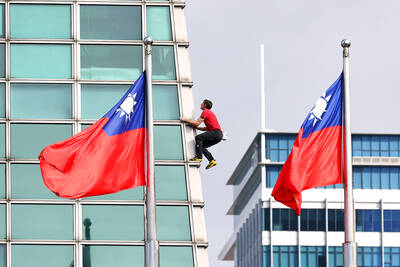
DAREDEVIL: Honnold said it had always been a dream of his to climb Taipei 101, while a Netflix producer said the skyscraper was ‘a real icon of this country’ US climber Alex Honnold yesterday took on Taiwan’s tallest building, becoming the first person to scale Taipei 101 without a rope, harness or safety net. Hundreds of spectators gathered at the base of the 101-story skyscraper to watch Honnold, 40, embark on his daredevil feat, which was also broadcast live on Netflix. Dressed in a red T-shirt and yellow custom-made climbing shoes, Honnold swiftly moved up the southeast face of the glass and steel building. At one point, he stepped onto a platform midway up to wave down at fans and onlookers who were taking photos. People watching from inside
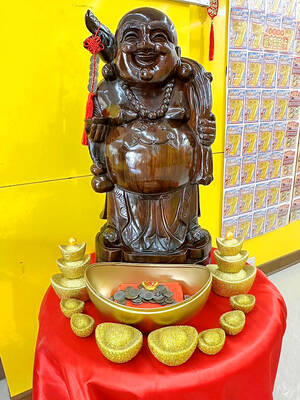
A Vietnamese migrant worker yesterday won NT$12 million (US$379,627) on a Lunar New Year scratch card in Kaohsiung as part of Taiwan Lottery Co’s (台灣彩券) “NT$12 Million Grand Fortune” (1200萬大吉利) game. The man was the first top-prize winner of the new game launched on Jan. 6 to mark the Lunar New Year. Three Vietnamese migrant workers visited a Taiwan Lottery shop on Xinyue Street in Kaohsiung’s Gangshan District (崗山), a store representative said. The player bought multiple tickets and, after winning nothing, held the final lottery ticket in one hand and rubbed the store’s statue of the Maitreya Buddha’s belly with the other,
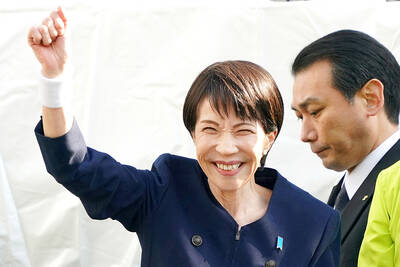
Japan’s strategic alliance with the US would collapse if Tokyo were to turn away from a conflict in Taiwan, Japanese Prime Minister Sanae Takaichi said yesterday, but distanced herself from previous comments that suggested a possible military response in such an event. Takaichi expressed her latest views on a nationally broadcast TV program late on Monday, where an opposition party leader criticized her for igniting tensions with China with the earlier remarks. Ties between Japan and China have sunk to the worst level in years after Takaichi said in November that a hypothetical Chinese attack on Taiwan could bring about a Japanese

‘COMMITTED TO DETERRENCE’: Washington would stand by its allies, but it can only help as much as countries help themselves, Raymond Greene said The US is committed to deterrence in the first island chain, but it should not bear the burden alone, as “freedom is not free,” American Institute in Taiwan Director Raymond Greene said in a speech at the Institute for National Defense and Security Research’s “Strengthening Resilience: Defense as the Engine of Development” seminar in Taipei yesterday. In the speech, titled “Investing Together and a Secure and Prosperous Future,” Greene highlighted the contributions of US President Donald Trump’s administration to Taiwan’s defense efforts, including the establishment of supply chains for drones and autonomous systems, offers of security assistance and the expansion of


 RSS
RSS