


China, Japan and South Korea warned North Korea yesterday that they would not tolerate further nuclear tests, the South Korean president said, amid fears that Pyongyang is preparing a third atomic blast.
South Korean President Lee Myung-bak made the remark after talks in Beijing with Chinese Premier Wen Jiabao (溫家寶) and Japanese Prime Minister Yoshihiko Noda that also saw the trio decide to start free-trade area negotiations before the end of this year.
“Our three countries agreed that we will not accept further nuclear tests or further provocations from North Korea,” Lee told reporters after meeting with his two counterparts for 90 minutes.
The Northeast Asian leaders had been expected to put Pyongyang’s nuclear and rocket programs high on the agenda for yesterday’s summit.
Fears of a third North Korean nuclear test have grown after a failed rocket launch by Pyongyang last month that the US and its allies said was a disguised ballistic missile test banned under UN resolutions.
Satellite photographs have recently shown work in progress at the Punggye-ri nuclear test site.
Noda called on the three countries to strengthen cooperation in order to “further prevent provocations” by North Korea in future.
Wen warned earlier yesterday that the region faced many “unstable” factors that made the situation hard to predict.
“The various parties need to use their wisdom, keep patient, and display goodwill to the greatest extent so as to ease confrontation and return to the right track of dialogue and negotiations,” the Chinese premier said.
China, long the North’s key ally, has been an advocate of seeking to put a stop to the isolated regime’s nuclear ambitions via multilateral talks.
The three leaders also agreed to start talks this year on a free-trade area, saying it would boost the economies of the entire region.
The issue has been on the trilateral agenda for the past decade, beginning with an agreement among the three in late 2002 to launch a feasibility study on a free-trade area.
Wen said closer regional economic integration, in response to a slow global recovery and an overall rise in trade protectionism, would help unlock new growth potential.
“Northeast Asia is the most economically vibrant region in the world. So there is huge potential for our three countries to have closer trade and investment cooperation,” he told reporters. “The establishment of a free-trade area will unleash the economic vitality of our region and give a strong boost to economic integration in East Asia.”
China, Japan and South Korea combined would have the world’s largest economy — ahead of the EU — when measured by purchasing power parity, which takes into account differences in living costs across nations.
“Today, as we look at the global financial crisis, some countries are still pursuing protectionist ideas and have expanded them,” Lee said. “I’m worried about this. By comparison, I believe the agreement between the three countries is an important thing.”
In yesterday’s meeting, the three nations also signed an investment agreement concluded earlier this year after 13 rounds of negotiations over five years.

The National Chungshan Institute of Science and Technology yesterday showcased its locally developed variants of the Vision 60 robotic patrol dog, which it plans to deploy on the nation’s outlying territories in the South China Sea. The variants were produced under the Joint Lab project — created by the institute and domestic companies — and assembled with domestically produced motors, lenses and artificial intelligence (AI) systems alongside licensed tech from the US, Missile and Rocket Systems Research Division deputy director Jen Kuo-kang (任國光) told the media event at a military base in Taipei’s Dazhi (大直) area. Taiwan has built up its strengths

RIGHT DIRECTION: Taiwan’s efforts to prevent forced labor include a proposal to ‘fully prohibit’ employers from withholding workers’ documents, an official said Taiwan is to establish a mechanism to restrict imports of goods linked to forced labor, the Executive Yuan said yesterday, after the US proposed imposing additional tariffs on Taiwanese goods over labor concerns. “The Ministry of Labor and the Ministry of Economic Affairs are to establish an interministerial review procedure,” Executive Yuan spokesperson Michelle Lee (李慧芝) said at a news briefing in Taipei. “The government is to use the Foreign Trade Act [貿易法] as the legal basis to restrict imports of goods produced with forced labor” and bring its supply chain governance more in line with international standards on human rights, resilience
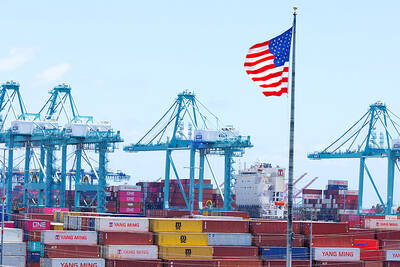
NOT IMMEDIATE: Taiwan has a chance to appeal the proposed 10 percent tariff before it starts, while other countries face a 12.5 percent tariff from the trade office Taiwan is among 60 economies determined by the US to have failed to impose or enforce a ban on the importation of goods produced with forced labor, according to a notice released on Tuesday by the Office of the US Trade Representative (USTR), which proposed imposing an additional 10 percent or more tariff on them. The USTR in a statement said that following an investigation, it had determined under Section 301 of the Trade Act of 1974 that the failure of the 60 economies to impose and effectively enforce a prohibition on the importation of goods produced with forced labor is

TIT-FOR-TAT: The US allegedly revoked the visa of a Chinese national working at Xinhua News Agency in the US in response to Beijing’s expulsion of Vivian Wang The Presidential Office yesterday condemned China for expelling a New York Times correspondent from Beijing following the newspaper’s interview with President William Lai (賴清德), saying the move highlighted Beijing’s suppression of press freedom and its threat to international news media. Taiwan has noted a series of recent incidents in which Beijing used similar tactics to “threaten and pressure international media outlets and journalists,” Presidential Office spokeswoman Karen Kuo (郭雅慧) said in a statement. “This concerns not only press freedom and freedom of expression, but also the safety of journalists, and Taiwan and relevant partners are paying close attention to the situation,” she


 RSS
RSS