


US Secretary of State Hillary Rodham Clinton left Beijing yesterday after a tense week of negotiations with China over the fate of blind rights activist Chen Guangcheng (陳光誠), who plans to travel to the US under a deal to end the standoff.
Despite some speculation that Chen might fly out on the same plane as Clinton, the 40-year-old activist remained in the Beijing hospital he went to on Wednesday last week from the US embassy, where he had taken refuge after a dramatic escape from 19 months under house arrest in his home village.
In a sign the dispute over the activist, which threatened to worsen difficult China-US ties, might be easing, China indicated on Friday that Chen would be allowed to go to the US to study.
Photo: AFP
Later, in an interview with Radio Free Asia, Chen said he did not plan to leave his homeland for good.
“This isn’t saying that when I leave it’s a one-off and there’s no coming back,” Chen told the Washington-based news service.
“Nobody should think that I’m emigrating or anything like that. As they [the Chinese government] have recognized that I’m free, then I should also have the freedom to go where I want,” he said.
It is not clear how soon and how smoothly Chen will pass through China’s procedures that would allow him to travel, and even with Washington cautiously welcoming the proposed deal, some of his supporters said they remained under house arrest or under heavy police watch.
Human rights lawyer Jiang Tianyong (江天勇) said both his ears were injured and his left eardrum seemed to have ruptured, after police officers beat him about the head after he went to Chaoyang Hospital to visit Chen.
“The worrying problem is that I haven’t been allowed out of my home to see a doctor and check how serious this is,” Jiang said by telephone.
“The state security police have told me to wait while they ask if I can go to a hospital, and there’s been no answer,” he said.
The Chinese Ministry of Foreign Affairs said on Friday that Chen could apply to study abroad following his dramatic appeal to a US congressional hearing on his case, when he asked to be allowed to spend time in the US after escaping extra-judicial captivity in his home village and hiding in the US embassy in Beijing for six days.
Chen left the embassy under a deal that foresaw him staying in China to study at a university. However, Chen, worried over the safety of his family and his own freedom, then changed his mind and said he wanted to go to the US.
Clinton said the US ambassador to Beijing, Gary Locke, had spoken to Chen on Friday and had confirmed that Chen planned to go to the US.
Chen had complained that after he entered the Beijing hospital, US officials were not allowed to meet him.
The lawyer Jiang, who campaigned for Chen’s freedom, said Chen was right to leave with his family, but his departure would nonetheless be a victory for “hardliners” in the government.
“This has been a victory for the law-breakers, because Chen Guangcheng and his family saw how the agreement that would have allowed him to stay wasn’t going to be honored. They avoided facing that test,” Jiang said.
“This is ultimately a set-back for rule of law,” he added.
In 2006, Chen was sentenced to more than four years in jail on charges, vehemently denied by his wife and lawyers, that he whipped up a crowd that disrupted traffic and damaged property.
He was released in 2010, but remained under house arrest in his home in Dongshigu Village.
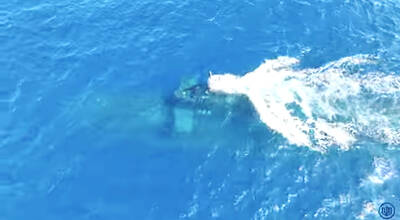
CSBC Corp, Taiwan (台灣國際造船) yesterday released the first video documenting the submerged sea trials of Taiwan’s indigenous defense submarine prototype, the Hai Kun (海鯤), or Narwhal, showing underwater navigation and the launch of countermeasures. The footage shows the vessel’s first dive, steering and control system tests, and the raising and lowering of the periscope and antenna masts. It offered a rare look at the progress in the submarine’s sea acceptance tests. The Hai Kun carried out its first shallow-water diving trial late last month and has since completed four submerged tests, CSBC said. The newly released video compiles images recorded from Jan. 29 to
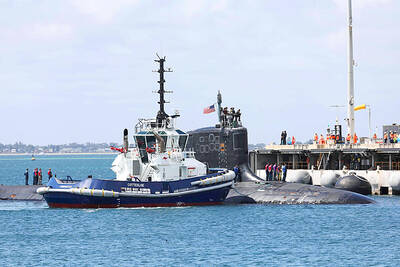
DETERRENCE EFFORTS: Washington and partners hope demonstrations of force would convince Beijing that military action against Taiwan would carry high costs The US is considering using HMAS Stirling in Western Australia as a forward base to strengthen its naval posture in a potential conflict with China, particularly over Taiwan, the Wall Street Journal reported on Saturday. As part of its Indo-Pacific strategy, Washington plans to deploy up to four nuclear-powered submarines at Stirling starting in 2027, providing a base near potential hot spots such as Taiwan and the South China Sea. The move also aims to enhance military integration with Pacific allies under the Australia-UK-US trilateral security partnership, the report said. Currently, US submarines operate from Guam, but the island could
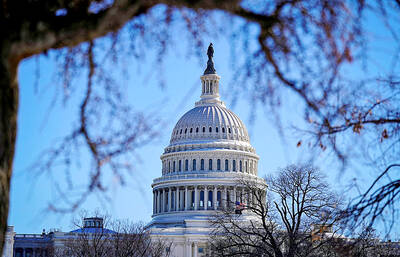
RESTRAINTS: Should China’s actions pose any threat to Taiwan’s security, economic or social systems, China would be excluded from major financial institutions, the bill says The US House of Representatives on Monday passed the PROTECT Taiwan Act, which states that Washington would exclude China from participating in major global financial organizations if its actions directly threaten Taiwan’s security. The bill, proposed by Republican Representative Frank Lucas, passed with 395 votes in favor and two against. It stipulates that if China’s actions pose any threat to Taiwan’s security, economic or social systems, the US would, “to the maximum extent practicable,” exclude Beijing from international financial institutions, including the G20, the Bank for International Settlements and the Financial Stability Board. The bill makes it clear that China must be prepared

Taiwanese trade negotiators told Washington that Taipei would not relocate 40 percent of its semiconductor production to the US, and that its most advanced technologies would remain in the nation, Vice Premier Cheng Li-chiun (鄭麗君) said on Sunday. “I told the US side very clearly — that’s impossible,” Cheng, who led the negotiation team, said in an interview that aired on Sunday night on Chinese Television System. Cheng was referring to remarks last month by US Secretary of Commerce Howard Lutnick, in which he said his goal was to bring 40 percent of Taiwan’s chip supply chain to the US Taiwan’s almost


 RSS
RSS