


While President Ma Ying-jeou’s (馬英九) announcement late on Tuesday of the government’s plan of a more gradual series of electricity price increases won praise yesterday for heeding the public’s complaints, opposition politicians said the rate increase would be unnecessary if state-run Taiwan Power Co (Taipower, 台電) underwent complete reform.
Legislative Speaker Wang Jin-pyng (王金平) commended Ma and Premier Sean Chen (陳冲) for sympathizing with people who would feel the added economic burden and for being willing to revise the planned rate increase.
“It’s not easy to overrule the original proposal after it has been promulgated,” Wang said.
Chinese National Federation of Industries chairman Rock Hsu (許勝雄) also praised the change in the planned increase in electricity tariffs.
“It’s better to raise the price in three stages rather than all at once,” Hsu said, adding that the Ma administration had “manifested compassion” and “used wisdom” in handling the issue.
However, Chinese Nationalist Party (KMT) lawmakers were divided on the issue.
KMT caucus whip Hsu Yao-chang (徐耀昌) and KMT Legislator Chi Kuo-tung (紀國棟) called a press conference in support of the revised plan and applauded the Ma administration for being willing to take advice from people with an open mind.
Under the new plan, the electricity rate hikes will be executed in three stages, with the first one being implemented on June 10 and the second one on Dec. 10. A date has not been set for the third stage.
Hsu said the Ma administration had no choice but to raise tariffs after being “irrationally frozen” for years, resulting in Taipower accumulating billions in losses.
According to Taipower, cumulative losses from 2008 through the end of February this year were NT$132.2 billion (US$4.48 billion).
However, some KMT lawmakers remain opposed to the new scheme, with KMT legislators Lee Ching-hua (李慶華), Yang Chiung-ying (楊瓊瓔) and Huang Chao-shun (黃昭順) calling on the government to put off the effective date for the first-stage price hike on June 10 until the summer electricity rates end on Sept. 30.
The Democratic Progressive Party (DPP), meanwhile, reiterated that electricity rates should not be raised at this moment.
“A one-off price increase or a three-stage increase ... that’s not the point,” DPP spokesperson Lin Yu-chang (林右昌) said.
Ma has ignored the DPP’s repeated warnings that a wrong policy could trigger retail price increases and stagflation, Lin said, adding that the president’s hastily called press conference at 10pm on Tuesday showed that Ma once again was trying to evade public scrutiny of his major policies.
The DPP legislative caucus also demanded that Ma apologize for his about-face and Minister of Economic Affairs Shih Yen-hsiang (施顏祥) step down for the flip-flop that has caused public unrest.
DPP Legislator Pan Men-an (潘孟安) described Ma’s adjustment plan as “firing three shots to kill a person when you could’ve killed him with one shot.”
Pan cited documents he obtained and accused Taipower of signing overseas coal purchasing deals with prices ranging from US$80 to US$116 per tonne after Ma took office in May 2008.
Taipower did not get cheaper prices from Indonesian and Australian companies for its long-term massive purchases, Pan said, adding that Taipower had signed multiple deals on the same day with differences as large as US$20 per tonne.
The deals that Taipower had signed showed the company was out of control, but Ma kept ignoring the necessity of total reform, he said.
The state utility would have to be reviewed based on past fuel purchases, investments on power plant construction, electricity purchases from independent power producers, reserve capacity and highly paid executive officers, DPP Legislator Tsai Chi-chang (蔡其昌) added.
Taiwan Solidarity Union caucus whip Hsu Chung-hsin (許忠信) said Ma’s policy change could be “only a temporary measure to reduce public anger.”

Right-wing political scientist Laura Fernandez on Sunday won Costa Rica’s presidential election by a landslide, after promising to crack down on rising violence linked to the cocaine trade. Fernandez’s nearest rival, economist Alvaro Ramos, conceded defeat as results showed the ruling party far exceeding the threshold of 40 percent needed to avoid a runoff. With 94 percent of polling stations counted, the political heir of outgoing Costa Rican President Rodrigo Chaves had captured 48.3 percent of the vote compared with Ramos’ 33.4 percent, the Supreme Electoral Tribunal said. As soon as the first results were announced, members of Fernandez’s Sovereign People’s Party
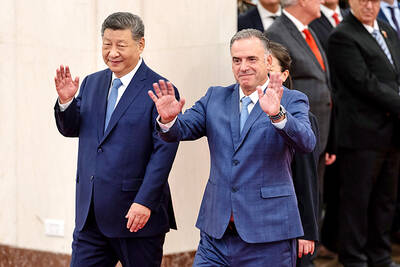
EMERGING FIELDS: The Chinese president said that the two countries would explore cooperation in green technology, the digital economy and artificial intelligence Chinese President Xi Jinping (習近平) yesterday called for an “equal and orderly multipolar world” in the face of “unilateral bullying,” in an apparent jab at the US. Xi was speaking during talks in Beijing with Uruguayan President Yamandu Orsi, the first South American leader to visit China since US special forces captured then-Venezuelan president Nicolas Maduro last month — an operation that Beijing condemned as a violation of sovereignty. Orsi follows a slew of leaders to have visited China seeking to boost ties with the world’s second-largest economy to hedge against US President Donald Trump’s increasingly unpredictable administration. “The international situation is fraught
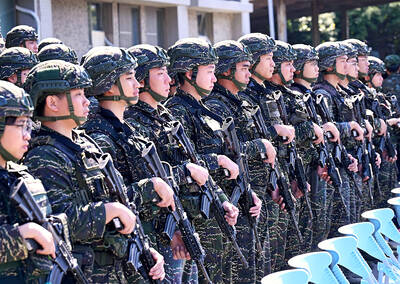
MORE RESPONSIBILITY: Draftees would be expected to fight alongside professional soldiers, likely requiring the transformation of some training brigades into combat units The armed forces are to start incorporating new conscripts into combined arms brigades this year to enhance combat readiness, the Executive Yuan’s latest policy report said. The new policy would affect Taiwanese men entering the military for their compulsory service, which was extended to one year under reforms by then-president Tsai Ing-wen (蔡英文) in 2022. The conscripts would be trained to operate machine guns, uncrewed aerial vehicles, anti-tank guided missile launchers and Stinger air defense systems, the report said, adding that the basic training would be lengthened to eight weeks. After basic training, conscripts would be sorted into infantry battalions that would take
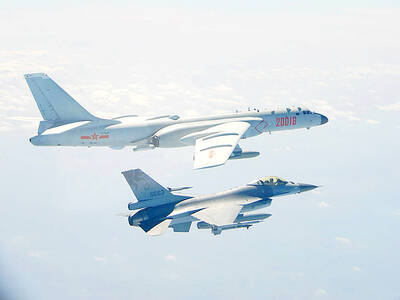
GROWING AMBITIONS: The scale and tempo of the operations show that the Strait has become the core theater for China to expand its security interests, the report said Chinese military aircraft incursions around Taiwan have surged nearly 15-fold over the past five years, according to a report released yesterday by the Democratic Progressive Party’s (DPP) Department of China Affairs. Sorties in the Taiwan Strait were previously irregular, totaling 380 in 2020, but have since evolved into routine operations, the report showed. “This demonstrates that the Taiwan Strait has become both the starting point and testing ground for Beijing’s expansionist ambitions,” it said. Driven by military expansionism, China is systematically pursuing actions aimed at altering the regional “status quo,” the department said, adding that Taiwan represents the most critical link in China’s


 RSS
RSS